Revenue numbers from every side project I worked on in 2020
Here are the total revenue numbers from every side project I worked on in 2020.
- $0 - svgflipbook.com (SaaS)
- $27 - SVG Animation Assistant (Windows app)
- $24 - selfhostedgit.com (SaaS)
- $0 - hostedgitea.com (SaaS)
- $110 - Roguelike Browser Boilerplate (info product)
- $285 - asterogue.space ($156 Windows app + $129 Android app)
- $47 - Beat Generator (Android app)
- $200 - PO LoopSync (Android app)
Total: a humble $693 USD.
(I also made a bunch of other stuff including some open source projects, but these above are the things people could actually pay for.)
Looking back at this year it feels like I got a toe-hold in the cliff-face of indie hacking. Whilst it is not very much money, $693 feels like a lot more summed than it did when trickling in over the course of 2020.
The thing I really learned this year was how to build in public, share what I am doing, and generate a bit of interest when launching things. I did this largely organically by posting to my email list and Twitter and in application-specific chat rooms and forums. Some of the projects I launched this year saw quite reasonable traffic for a single-person project.
Insights
The game Asterogue is the thing that made the most money this year. I had convinced myself that "you can't make money from games" and I still think this is largely true, but I can't ignore the fact that it was my most financially successful project in 2020.
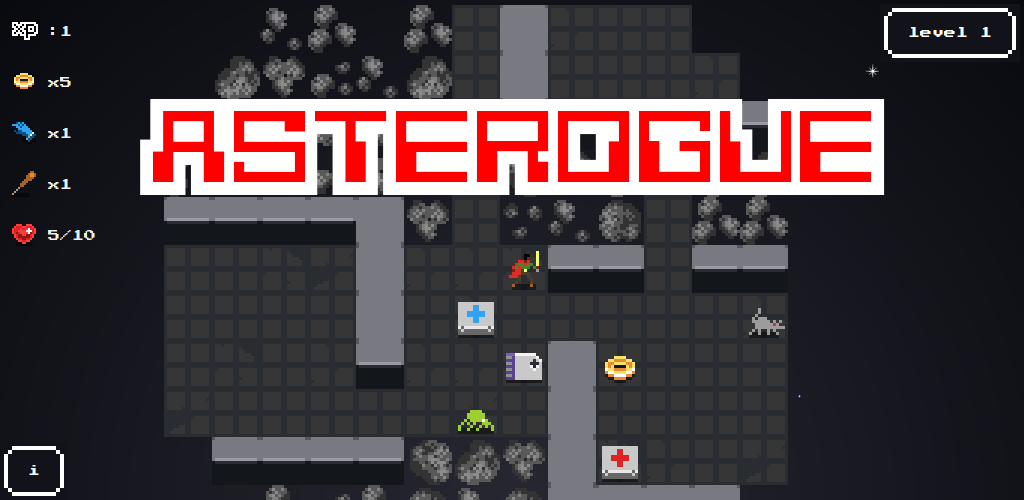
The game took me 1.5 months of side project time to build and I was posting continuous updates during development. Most games take several months or years to build and so I have this idea to build a company around the idea of putting games out very fast. I'd turn out a new game every couple of months and use the games themselves as a content-marketing foundation to find an audience. If I could keep it up for several games in a row I might be able to make it work.
I found an example of a team who are running this strategy successfully called sokpop collective. They are four indie developers putting out a game every two weeks. By my analysis they only became profitable after the 8th game went big on Steam, so it requires patience and persistence, like every endeavor I guess.
The truth is shiny object syndrome is going to keep me from doing this. There is too much other stuff I want to tinker with, and doing a game every two months would probably lead to burn-out. I'll probably just make a couple of games per year for fun and see where that takes me on the games front.
The music app PO LoopSync comes in at close second. I think it will overtake Asterogue soon. I tried not to make it all about the big launch for this product. Instead I followed the advice of Amy Hoy, found an audience first, and then tried to build a thing they want. It basically worked and I made a bunch of sales without having to grind at marketing so much, which was nice.
2021 Let's Go
In 2020 all my graphs look like this:

A spike of sales at launch followed by a flat trickle as traffic dries up.
What I need to work out in 2021 is how to create sustainable channels for customers to find the things I've made, instead of one-off launches followed by flat-lining sales.
SEO seems like the most obvious thing to try. It is frequently cited as a source of more reliable traffic and I personally know people (hello Tobias!) who have been hugely successful with this. However, I experience a lot of internal resistance to it because it's not "write more code". Internal resistance can be overcome, but there's the meta-question of "do I want to spend my time writing articles?"
Another thing I want to try is automated content generation. I have built a few procedural music generators and I have a vague plan to put a loop generating robot on Twitter. The idea is to find customers by giving away royalty free music loops that people can use in their own music, and sell my music apps as a side product.
My overall strategy for 2021 is to give away more high value free stuff so that people can discover the paid products more easily.
If you have any advice on this I would love to hear it!
Hope
Like @csallen says, this trend is yuuuge. Most people love the idea of being in control of their working life and income, having no boss, free time to spend with their kids, etc. etc. It's only going to get bigger.
Looking back at other movements I've been a passenger of, like Linux/GNU, what always happens is streamlining and efficiency as more people come on board. When Linux first came out you had to compile your own kernel. Decades later you can download a fully fledged Desktop OS that competes with proprietary OSes and a slick phone OS that runs on the majority of smartphones. Running Linux got way easier.
The same thing is going to happen with solo founders and small teams bootstrapping internet businesses. I know people have been bootstrapping for a long time, but we're still at the "compile your own kernel" phase of the indie hacker movement. You gotta work everything out yourself from scratch.
Innovations in marketing, distribution, culture, tools, and tech, etc. mean that in 10 years it will be much much easier to do what we are trying to do today. There will be software packages and best-practice manuals and a lot more evidence based materials for bootstrapping. The kind of wisdom we hear over and over from founders on the IH podcast will become common knowledge. It will become less of an art and more of a craft.
Can't wait.
Join me @mccrmx and mccormick.cx.

This is an amazing journey Chris. Thanks for sharing.
This comment was deleted 3 years ago
Thank Andrew! Don't worry, I am set up so that I can keep doing this "small bets" thing for a long time and don't plan to stop building stuff.
This comment was deleted 5 years ago