Risk is building wrong tool - real risk is overpaying
When I first started bootstrapping my SaaS idea, I fell into an all-too-common trap:
I spent weeks, even months, agonizing over building exactly “the right product” before launch. I feared wasting time crafting something nobody wanted, and treated that as the biggest risk of all.
This perception sounded logical at the time. After all, what's worse than putting all that effort into building the wrong thing?
But here’s what I discovered—the real risk for indie hackers and bootstrappers isn't necessarily building the wrong tool; it's overpaying in time, effort, and resources while building it.
Let me explain.
Why the Fear of Building the Wrong Tool is Overrated 📍
When you’re just starting out, you're bound to learn along the way. Yes, the product you initially build probably won’t perfectly solve the problem—at least not the first iteration. But that's fundamentally okay (actually, it's normal). The first product isn't the endpoint; it's just the starting line.
You can always pivot, adjust, listen to your users, and improve. By staying flexible and iterative, you can easily solve the “wrong product” problem over time.
I realized quickly that building the “wrong” thing temporarily isn’t catastrophic—but draining money, time, or valuable resources getting it built can be.
The Hidden Danger: Overpaying 💸
Early on, I had the misconception that to build anything meaningful, it had to be robust, custom-coded, and designed to scale massively from day one. I contracted expensive developers, subscribed to expensive tool stacks, and burned countless hours setting up complex infrastructures I didn't even fully understand.
This approach not only strained my finances, but led me down a long, winding development road with limited returns. The more I spent on overly ambitious technology or premium tools early on, the harder pivoting became. I created the exact rigidity an indie founder wants to avoid.
Essentially, I was not only paying costly bills, but also accumulating technical and strategic debt at a stage where I should have prioritized flexibility.
The Affordable, Lean & Effective Alternative 🚀
Once I realized that financial risk and heavy up-front investments are actually far more dangerous to bootstrappers, my approach shifted dramatically:
- I moved to free or affordable no-code and low-code platforms to rapidly prototype and test ideas without blowing my budget.
- Instead of expensive dev contracts, I utilized flexible solutions that allowed quick, affordable iteration.
- I simplified complexities wherever possible, removing unnecessary expenses and ensuring my "failures" never spiraled out of control.
For instance, tools like Notion, Airtable, Zapier—and even platforms like Fuzen.io (a super powerful no-code builder for SaaS and internal apps)—allowed me to rapidly validate concepts without overspending.
Launching became faster. Adjusting became easier. Risk went down dramatically, allowing more comfortable pivots and improvements.
An Example to Drive This Home 📊
Recently, I met a founder who had funneled close to $40K into his elaborate MVP built from scratch. Then came the realization his audience needed something simpler. Reworking the custom codebase proved prohibitively expensive, forcing him to halt completely.
Compare this to another indie hacker friend, who built a similar MVP with no-code. Total spent: ~$500 and 2 weeks. Feedback helped refine the MVP quickly, and their product eventually took off, revenue-positive within just two months.
The difference wasn’t building the wrong product itself. The key difference was how much each founder spent — time, money, and resources—before learning what actually worked.
Key Takeaways & Advice to Fellow Indie Hackers 📌
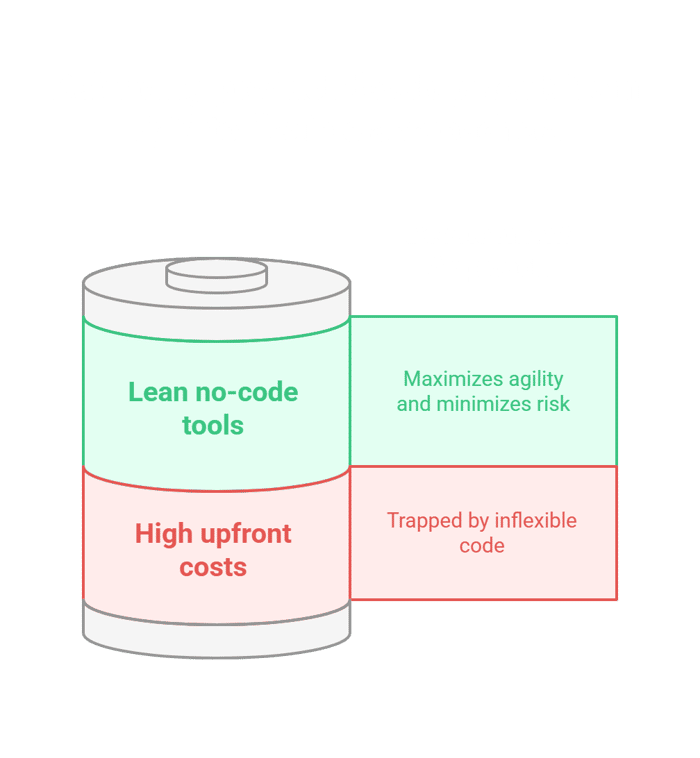
- Wrong products can quickly become right with smart iteration, but high upfront costs or rigid codebases trap you.
- Invest in flexibility instead of premium technology or custom dev early on.
- Lean, no-code, and affordable tools (like Fuzen.io, Airtable, Bubble, etc.) can significantly minimize your financial risk and maximize your agility.
- The greatest risk to your project is losing your runway. Protect it fiercely by managing expenses wisely.
The insight that real risk isn't building the wrong product, but overpaying was a game-changing lesson for me—saving money, enabling pivots, and ultimately increasing my chance for success.
Has anyone else experienced something similar? I'd love to hear from you... What lessons did costly mistakes teach you along your indie hacker journey?
