Roast my landing page
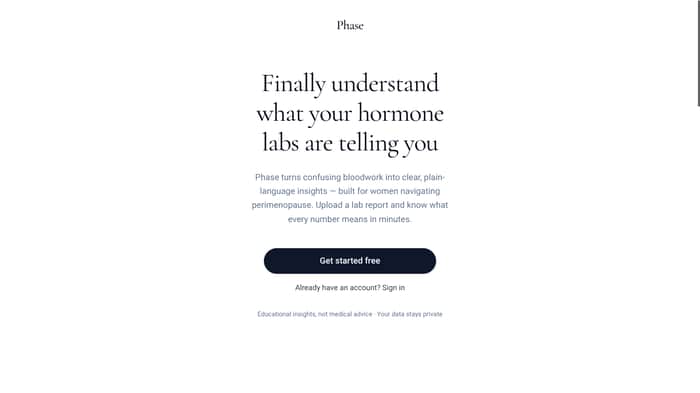
Specifically: does the headline make it clear what this does in under three seconds? Would you trust it with a health document? What makes you bounce?
Specifically: does the headline make it clear what this does in under three seconds? Would you trust it with a health document? What makes you bounce?

Answering your three questions directly, and this is a strong page, so the roast is about sharpening, not fixing broken stuff.
Headline in 3 seconds: yes. "Finally understand what your hormone labs are telling you" is genuinely good. "Finally" does quiet work, it signals you know this has been frustrating them, which builds instant recognition. The subhead naming perimenopause tells the exact person "this is for you." You pass the clarity test.
Would I trust it with a health doc: this is where it could do more. "Educational insights, not medical advice, your data stays private" is the right instinct but it's tiny and buried under the CTA, exactly where trust anxiety peaks. For health data, trust isn't a footnote, it's the conversion lever. Someone about to upload a hormone panel is thinking "who sees this, where does it go." Move a stronger privacy promise up near the CTA and be specific: "zero-knowledge encrypted, we can't read it, deleted anytime" beats "your data stays private." Specific privacy claims convert nervous health users, vague ones don't.
What makes me bounce: the page says what it does but not what happens after. I upload a report, then what? One line or a small visual of the actual output (a scary lab number turned into a plain sentence) makes the value concrete instead of promised. Show the transformation, don't just claim it.
One more, given the messenger thing we discussed: nowhere does the page say who's behind it or why it's trustworthy on women's health. A small "reviewed by [credential]" or founder's-note link closes the trust gap your product structurally has. Highest-leverage add.
Since positioning-and-trust framing is what Hivemind pressure-tests, worth running the page through it: https://hivemind.myosin.xyz. But it's already 80% there. Tighten privacy proximity and show the output, and it's sharp.
This is the useful kind of roast — sharpening, not just praise. Three things I'm taking:
Move the privacy promise up next to the CTA and make it specific instead of a tiny footnote, since that's exactly where someone about to upload a hormone panel gets nervous.
Show the actual output, a scary lab number turned into a plain sentence instead of just promising the transformation.
Say who's behind it and why it's trustworthy on women's health, which is the trust gap this product structurally has.
That third one is the one I keep avoiding because it's the hardest to answer honestly. Working on it. Thank you.
That third one being the hardest is exactly why it's the highest leverage. It's also more solvable than it feels, because you don't need a credential you don't have. You need to be honest about the one you do.
Three versions that work, in ascending order of strength:
The founder's note. A short, plain page: why you built this, what you're not (a doctor), and what the tool actually does (translates lab language, doesn't diagnose). Owning the limitation directly builds more trust than tiptoeing around it. People forgive "I'm a builder who saw a gap" far more readily than they forgive a vague, faceless health app. Sincerity beats credentials at this stage.
The reviewer credential. This is where the partner conversation you're already having pays double. "Reviewed by [name], NP, women's health" on the page isn't just a trust badge, it's the structural fix. One practitioner willing to attach their name solves the messenger problem permanently, and it makes the product better because they'll catch what's wrong in your explanations.
The sourcing. Show where the explanations come from. If your plain-English translations map to established clinical reference ranges and published guidance, say so and link it. "Here's what this number means, per [source]" is verifiable in a way "our AI explains it" isn't.
The reason to do the founder's note now, even before the practitioner lands: it takes an hour, and an honest human face beats an anonymous health app immediately. The reviewer credential is the durable fix, but don't wait on it to stop being faceless.
For what it's worth, the fact that you find that question uncomfortable is a good sign. Founders who aren't uneasy about credibility in women's health are usually the ones who should be.