Run a Model-Swap Drill Before Choosing an AI Gateway
The fastest way to overbuy AI infrastructure is to compare catalogs before you compare change costs. A founder sees dozens of models, imagines painless optionality, and signs up. Three weeks later, the application still depends on one request shape, one brittle parser, and a set of prompts that only behave under the first model. The catalog was broad. The product was not portable.
For a small team, the useful question is whether a gateway lets one working feature survive a model change without turning the sprint into integration work. APINEED is an interesting candidate because its text-model pages use an OpenAI-compatible chat-completions route, while the homepage currently groups 40 live models behind one account and one key. That is enough to design a fair drill. It is not enough to skip the drill.
Define The Swap Before Touching Production Code
A good test starts with a narrow promise: the same product action should run against two suitable models, and the code around it should barely move. Do not start by rebuilding your abstraction layer. Use the client that already powers one real feature, then isolate the few values a gateway expects you to change.
Freeze Three Prompts And One Baseline Client
Pick three prompts that expose different failure modes. One should be a short extraction job with a strict output shape. One should contain messy user language. The third should resemble the longest request you expect in ordinary use. Save the current responses, token use, and parsing behavior before changing anything. These are comparison fixtures, not a benchmark theater production.
The point is to protect the product question. If the baseline prompt, schema, and client all change during the test, a successful response proves very little. You will not know whether the gateway simplified the integration or whether a hidden rewrite made the new model look easy.
Record Failure Signals Before Comparing Any Outputs
Write the rejection rules before the first request. A response fails if required fields disappear, the parser needs a model-specific branch, streaming breaks the interface, or the answer becomes too inconsistent for the user-facing action. Quality still matters, but so does the repair bill. A prettier answer that forces a day of glue code may be the worse choice for an early product.
Change Only The Endpoint Key And Model
APINEED shows a deliberately small migration surface for text calls. Its examples keep the OpenAI SDK, set the base URL to the platform's \/v1\ route, supply an APINEED key, and choose a model value. The request then goes through \POST /v1/chat/completions\, with either streaming or a normal completed response. That gives the drill a clean boundary.
Keep The OpenAI Request Shape Intact
Start with a copy of the working client. Change the base URL, key source, and model value. Leave messages, timeouts, parsing, and product logic alone for the first pass. If the call succeeds, replay the three fixtures. If it fails, record the exact layer that needs attention: authentication, request validation, response shape, streaming, or the model's behavior.
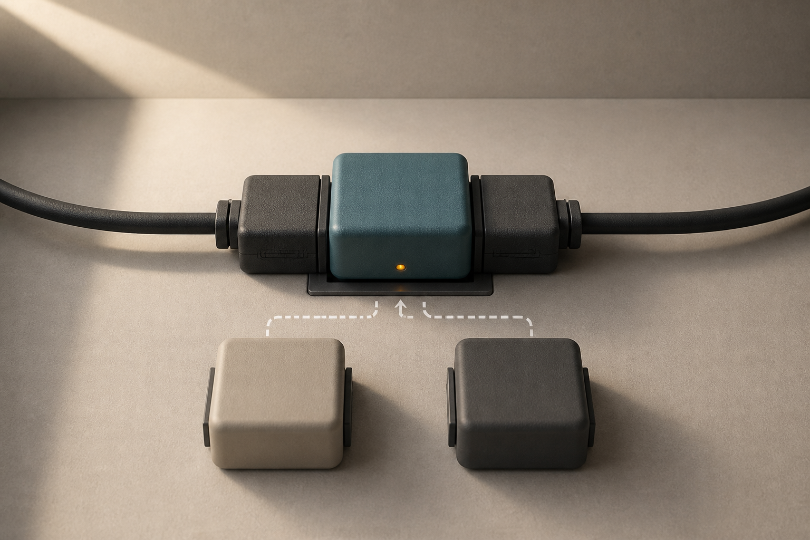
This sequence matters because compatibility is not the same as identical output. The transport can remain familiar while models still differ in tool use, structured responses, context handling, or tone. A unified endpoint reduces one category of work. It does not erase the need to test the model against your own product contract.
Separate Gateway Work From Product Work
Keep a tiny change log with two columns in your notes. Gateway work includes the base URL, credentials, supported parameters, and any response-envelope difference. Product work includes prompt repair, output validation, and changes to user experience. The split prevents a common founder mistake: crediting the gateway for model quality or blaming the model for a client configuration error.
APINEED also describes provider-health routing and fallback handling behind the same endpoint. Treat that as a feature to verify under your own conditions, not as permission to remove retries, timeouts, logs, or a visible failure state from the product. A gateway can manage upstream choices while your application still owns what the user sees.
Measure Integration Cost Instead Of Model Count
Catalog size becomes useful only after the first clean swap. If switching one text model requires a new SDK, a new authentication flow, and a fresh parser, the rest of the list represents future work. If it requires a model value and a bounded prompt adjustment, the list starts to behave like real optionality.
A second pass through APINEED should therefore test an adjacent model, not a random one. Choose a model that could plausibly handle the same feature at a different price or quality point. Replay the fixtures, compare the rejection rules, and count changed lines outside configuration. That number is often more useful than a broad leaderboard.
Count Rework That Appears After The Demo
The dangerous costs arrive after a happy-path response. Does the new model return the same structured fields when the input is vague? Does streaming preserve the events your front end expects? Can the team identify which model handled a request in its own logs? Does a failed call create a clear product state, or does it leave a spinner running?
None of those questions require a large evaluation platform. A folder of frozen inputs, expected fields, and short failure notes is enough for an early-stage team. The discipline is what matters. Without it, a gateway demo can feel flexible while the production feature remains tied to one narrow behavior.
Reject model-specific branches without a payoff. Some model differences justify custom handling. A feature may need a parameter that only one model exposes, or a response may be valuable enough to deserve its own parser. Make that a conscious exception. If every swap creates a branch, the team is rebuilding the provider problem inside its own repository.
Budget Usage Without Buying Another Subscription
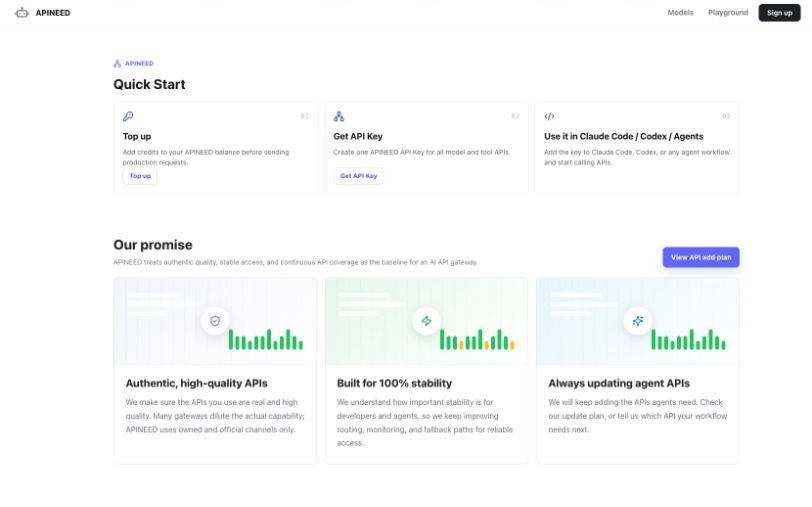
The homepage positions APINEED as pay as you go with no subscription, and it advertises selected APIs at discounts of up to 50 percent. That structure fits a drill because you can fund a bounded set of replays instead of adding another monthly commitment. The percentage is a ceiling across selected routes, not a promise for every model, so the actual model page should drive the estimate.
Run Cheap Replays Before Expensive Edge Cases
Start with the three fixed prompts and a small repetition count. Record actual usage, then decide whether longer contexts, richer media, or more runs will answer a real risk. The aim is not to produce a statistically impressive chart. It is to discover whether the integration stays simple and whether a model is good enough for this feature at a cost the product can absorb.
Put a hard stop on the experiment. Once one model passes the product contract and one alternative can replace it with limited code change, the gateway has answered the portability question. Further browsing may be interesting, but it is no longer the highest-value engineering work.
Choose The Gateway That Leaves An Exit
A solo founder or small team should consider APINEED when an existing OpenAI-style client needs access to several model choices without several fresh integrations. The strongest evidence is a boring diff: configuration changed, fixtures still passed, and the user-facing path remained intact.
It is a weaker fit if the product depends on one provider-specific capability that the shared request shape does not expose. Run the swap drill before committing, keep the fixtures in the repository, and repeat it when the feature changes. Portability is not the number of logos on a models page. It is the ability to leave one model without rebuilding the product.

This is a smart way to test it. Better to find out how painful switching models is during a drill than when something actually breaks.
We’ve learned the same with ScaleBlogger, flexibility with AI providers matters.