Running our company, year 1 update + Data Market premiere: we are good Data Scientists 🧪, but terrible Product Makers 😞
Hi everyone!
Presentation
David and Pedro from Spain 🇪🇸 here, we're back to IH to share an update about our business adventures, and the premiere of our brand new product (a DaaS: Data Market!). We need your feedback.
Update
First things first. For those of you who don't know us, we were coworkers in a Data consultancy company, and, in October 2019 we started our company together and have been quite successful with the consultancy business line of our company so far (specially taking into account the COVID-19 pandemic).
But consultancy has a big problem: it does not scale well (unless you start hiring a lot of people) and selling cycles are slow and hard (selling a 100k€ project to develop a ML model to a company is not the same as selling a Spotify subscription). High quality boutique-style consultancy is even harder to scale. That's why we are obsessed about being successful with our products.
We have been basically investing high amounts of our consultancy income in buying the time we need to develop products. For us, developing a new product means rejecting projects worth thousands of € and compromising our market position (if you don't do the job, some competitor is going to be there to fill the gap) 💸.
Our last idea: A DATA MARKET 🛍️
We are not going to bore you with the full story of our failed products 📉 (you can check our profile here if you are interested).
We are now focusing on the Spanish local market (we are supposed to understand it better) and, as always, products related to Data & AI (to be able to reuse the knowledge and technology from our consultancy projects).
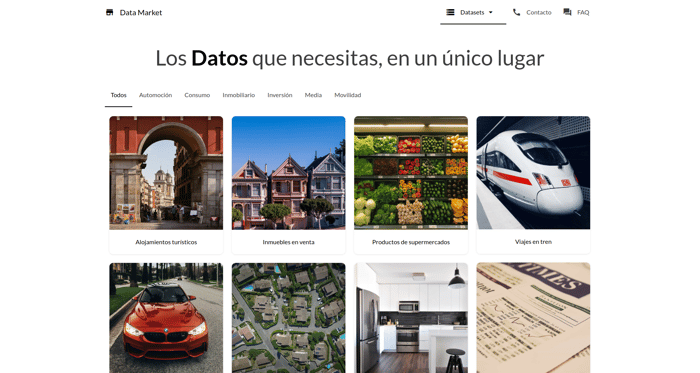
Our new product (not yet officially released) is a platform where you can buy and (in the future) sell data. We are good extracting data from the internet and have a rich collection of datasets very well maintained thanks to robust scraping processes running for years now 💪. Most of these Datasets are very hard to scrape (some professional web scraping companies refused to give us a price during our research for competitors). The data has been collected to enrich analysis for our clients or develop ML models 🤖.
This MVP is just a channel for selling the core part of the business, which is the Data stored in our servers (the real product), so the website is intended to be clear and easy to use. So far, to deliver the data, we collect the email and reach the potential buyer back.
Our clients are companies (B2B) and technical profiles (DS, DE, Analysts, etc.). They must know how to manage the (sometimes big) Data themselves. Our job in Data Market is keeping the Data flowing free of mistakes and with the best frequency possible.
We don't want to extend a lot in the description because we prefer to let you browse the market and get your feedback. The product is in Spanish, but it is easy to relate to the corresponding English equivalent word/expression.
We are specially interested in your suggestions about:
- 💡 The idea itself: Do you find it interesting?
- 🖌️ The UX/UI of the MVP: Do you find it easy to use and clear?
- 📱 The design: Is it beautiful?
How would you market the app? (We are terrible marketing our products). Do you have recommendation for training in marketing skills for technical founders?
Thanks in advance for your help!

I had this idea but ultimately decided against pursuing it (around 1.5 years ago) as I didn't believe in the fundamentals.
The Google datasearch https://datasetsearch.research.google.com/ was just coming out.
In any case, all the best. It could be very big (but with huge risk)
Hey!
Reading your post my head went into a sort of internal brainstorm. Might as well write down and post this response in case you find anything useful in It right? =D
I find the idea of marketplaces appealing, as you certainly do as well. But from the short experience I have with marketing (content and direct response) It's usually troublesome to find customers for marketplaces and avoid churn when you do get those clients.
The core issue imo? How does your product (data marketplace) can solve my burning problem?
Unpacking:
A burning problem must be well defined. A burning problem for me might not be for you, thus audience matters a lot. The way in which your product solves my burning problem has to be on point, so that I choose to pay for your solution.
"well defined"
Let's assume you are going to market your product using direct to response marketing. What would be your target audience? What's the angle of your marketing that would lead someone to buy? B2B and technical profiles is a bit too broad agree? For example, you would need to spend a lot on ads to get any meaningful data on who your ideal customer might be. Expensive but possible, with great ads Masterclass did It.
If broad and general seems tough how about niching down?
Let me try to map possible interests -> products.
Financial funds in Spain focused on agriculture stocks -> *Bundled data pack about weather and historical prices of the main agriculture stocks.
Burning problem: gain market edge over competitors with contextual data on price movement.
Solution: reliable data related to their problem.
Hotel recommendation websites trying to provide safe travel alternatives to Spain in uncertain times -> *Bundled data pack crossing hotel, mobility and local health organization's ratings.
Burning problem: generate relevant content for their newsletter subscribers/website visitors in a time where people are not looking to travel as much.
Solution: data backed recommendations of safe touristic hotels.
From those two examples the idea can be generalized. You may lead buying customers to your website but not convert if you don't offer something related to their problem.
Takeaway: Lead possible customers to a relevant product page rather than hope they get there by themselves :)
I reckon my response is already too long, but I still wanted to touch on the subject of content marketing. Given enough time, creating data-related content around trending subjects might be a good way to grow as well. Slower burn than direct response but compounds really well long term. This would also allow you to focus on consulting while you grow a following.
I hope you take my response in a positive way, as I'm just dropping ideas as I'm having them :D
Footnote (*): Bundles could be an interesting idea if you try direct to response as It conveys extra value compared to a single item. Plus you could increase average order value with a bundle.
I also wanted to suggest content marketing but the peculiarity of their product could make such an effort a waste of time.
It’s important to start from the customer experience and work backwards.
Do potential customers search for these types of data sets on the general web or using specialized (private) databases?
How do practitioners seek out new data sources? Do they ask for pointers in chats/on forums of data science communities?
Without this context, blindly following suggestions will only deliver a negative ROI, while not moving the needle very much in terms of acquiring paying customers—which is their main objective here.
We created some dashboards with our datasets and posted in our LinkedIn profiles posts with analytics like:
The problem is that creating dashboards to extract that kind of analytics is time consuming. The good thing is that with one dashboard that gets updated automatically everyday, you can post a lot of insights :-D.
One new thing we are doing in our MVP website is tracking the datasets the visitors clicks, downloads the sample, etc., so we can analyze which data catch the interest of the potential users.
Have you tried listing on the AWS marketplace? If you haven't, you need to be listed where your customers already rent cloud resources to process large datasets.
You'll get a few inbound leads that way. A small bonus is that your presence on each cloud's marketplace will eventually lead to you hosting your datasets there, if they turn out to be viable. Your customers will save on egress fees since they wont have to download GBs from a different cloud.
Perhaps a good example is Foursquare. They used to be a hot social networking app with a focus on location-based activities. Now, they enrich and sell access to their massive location data, contributed by consumers.
Here's the profile for Foursquare on the AWS marketplace.
Thanks for your comment! We are now setting an account in the AWS marketplace. Great idea!
Glad to be of service ☺️.
Listing on AWS is only one acquisition channel. For instance, even on AWS, depending on your budget, you could explore three different tactics to get noticed by Spanish customers of AWS:
IOW, you need to map out a strategy to reach your target customers from each of the channels you wish to explore.
I’m trying to understand the context surrounding how your data product gets bought, so it is clear which strategy (sales-first or marketing-first) will aid your efforts.
If you could be kind enough to share 2-3 use cases of how:
Of course!
For example, two real cases of customers:
A classified ads company specialized in motor vehicles. They need data from other classified websites to improve an algorithm they have which is able to estimate the fair price of a car (more samples, better algorithm) and keeping it updated (they have to train the algorithm periodically to avoid drift).
A company providing location intelligence services (they have very exclusive data thanks to deals with telco companies). They are interested in a dataset with all existing real estate properties in Spain (with the location and other metadata like if they have swimming pool, doorman, parking, etc.) to combine with their existing data and perform more advanced analytics.
Other example (this time hypothetical) related to the data we have about supermarket products with its price (https://datamarket.es/#productos-de-supermercados-dataset):
A company that sells its products in supermarkets (for example, Coca-Cola) wants to know at which prices the stores are selling its products and also its competitors (e.g. PepsiCo).
A supermarket company (for example, Mercadona in Spain) wants to know the prices of its competitors (e.g. Carrefour) to trigger special deals automatically, or perform causal analytics on their sales data, for example: what happens to my daily sales of Coca-Cola if my competitor lowers the price a 10%.
Consumer organizations who want to have an eye on average consumer prices to compute CPI (Consumer Price Index) in almost real time. Right now, they send people with notes and pencil to the groceries.
We did some cold mailing / LinkedIn message to the CTO, CDO, Digital Transformation Managers of some supermarkets with no answer :-(
So far, the few customers we have, know about our Data Market because of our consultancy business, so I can say our main channel now is cross-selling.
Our main value is that the data we collect is not easy to get and that companies need some kind of guarantee that the process is well maintained before they integrate external data in their models, dashboards, etc.
Some companies are paying to consultants to develop custom scraping processes (with high development and maintenance costs). To be profitable, we have to sell the same dataset to at least 5-10 customers, so we both benefit from the economy of scale. Some companies even asked for exclusive rights on the data for a period of time, but it goes against our business model of becoming a market: collecting once, selling many times.
Another idea we have for the future is performing analytics with our own data and selling the insights instead of the data.
Thanks for your help!
A. Update your Message
You need to clearly articulate what it is you are selling in a sentence or two, so it is immediately obvious to your ideal customer what kind of benefit they can derive from your product.
You mention that:
A1. You need to position your product as a cheaper and more robust alternative to custom scraping. In your sales message, you need to emphasize how you will help a potential customer save lots of money and time by buying your data set which is available in a ready-to-use format (csv).
A2. You need to approach your current customers and ask for endorsements. With their consent, you want to be able to use their endorsements in your sales/marketing collateral. Social proof helps signal to potential customers that customers similar to them have paid for your product, that you are not some fly-by-night operation.
A3. Since prospects that want to learn more will likely visit your website, you should consider rewriting your landing page to show your updated message. Marketing Examples is an excellent resource and in this landing page guide, they show how to write good copy by contrasting bad with good examples.
B. LinkedIn
B1. You can avoid cold mailing by making your leads warm before trying to make a sale. There's an excellent playbook on organic customer acquisition using LinkedIn by the fine folks at Demand Curve.
It's a fairly long document as it goes in detail about dos and donts on how to succeed on LinkedIn, but I'll highlight a few tips that should be immediately actionable for you.
B2.
If you can muster the time, you could share some of these insights in your LinkedIn posts to foster lively discussions in your feed, thereby increasing the visibility of your posts to a larger audience than just your network.
B3. When you tried cold outreach, you mentioned that were targeting decision-makers (CTOs, CDOs etc). Perhaps you could try a different tactic by reaching the practitioners directly? Since practitioners will understand the value of your product immediately, you could ask them to facilitate warm intros. to the decision-makers.
HTH.
There’s so much to unpack here but it is clear you’ll need a sales-first approach. There’s no sugar coating it but you’ll have to pound the pavement and get better at sales 🙂.
I’ll try to respond with a more substantive reply when I find time.
Sound good. Can you share your research documents of drifting file?
I'm thinking t start the same program for my car drifting website, you can see here https://bestdrifting.com/