SaaS Growth Strategy:The Complete SaaS Founder Playbook for 2026
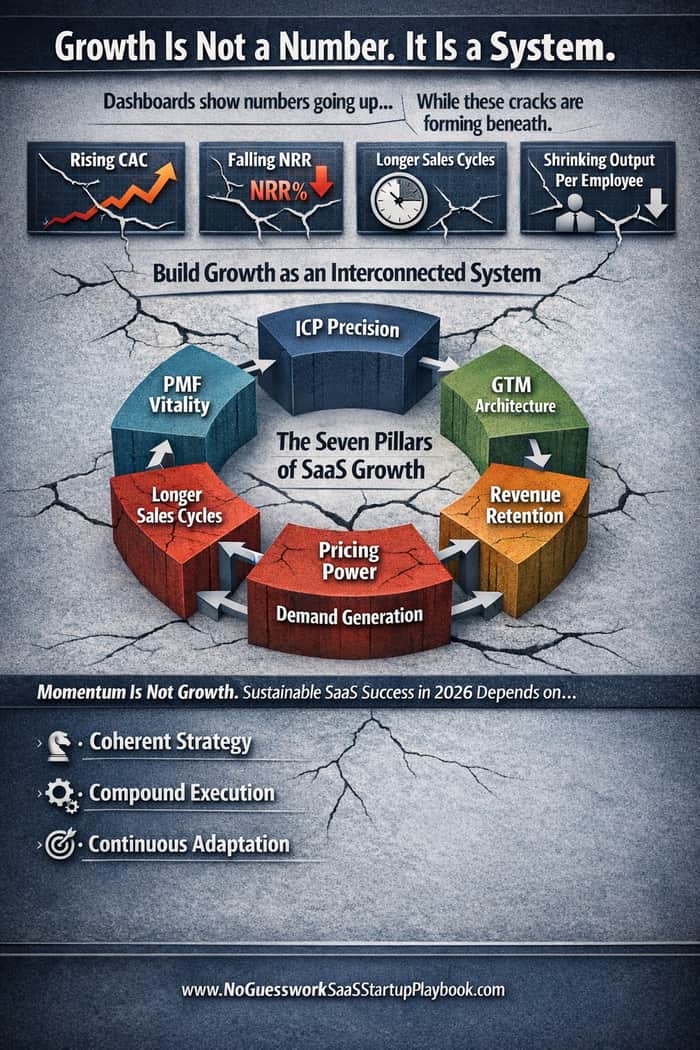
Growth Is Not a Number. It Is a System.
Every SaaS founder wants growth. Most are pursuing it in the wrong direction optimizing for the metrics that look like growth on a dashboard while the foundations that make growth sustainable are quietly cracking underneath them. Revenue goes up.
CAC goes up faster. NRR drifts downward.
Sales cycles lengthen. The team grows but the output per person shrinks. This is not a growth story.
This is a growth facade, and it ends the same way every time.
The SaaS companies that build durable, compounding growth in 2026 are not the ones with the most aggressive acquisition targets or the most ambitious product roadmaps.
They are the ones that have built growth as a system a deliberate, interconnected architecture where every function reinforces every other function, and where the gains from one quarter become the foundation for the gains of the next.
This playbook is built on a framework I use with every SaaS company I advise:
the Seven Pillars of SaaS Growth. Each pillar represents a fundamental dimension of a sustainable growth system.
A company that executes strongly across all seven builds the kind of compounding growth engine that becomes increasingly difficult for competitors to disrupt.
A company that executes on three or four while neglecting the others builds a growth story that stalls, plateaus, and eventually reverses at the exact moment it looks most impressive from the outside.
This is the complete playbook. It is not a collection of tactics. It is an architecture. Read it as a diagnostic of your current business against each pillar. The pillars where you are weakest are the ones that are most likely to cap your growth ceiling regardless of how well you execute on the others.
The Seven Pillars of SaaS Growth: ICP Precision · PMF Vitality · GTM Architecture · Revenue Retention · Pricing Power · Demand Generation · Operational Leverage
SaaS growth that is not built on a system is not growth. It is momentum borrowed from a future you will eventually have to repay with compounding interest.
Growth Diagnostic: If you mapped your current growth trajectory forward 18 months without changing anything you are doing today, would the result be the business you are trying to build
or would the structural gaps you are ignoring today become crises you cannot ignore tomorrow?
THE SEVEN PILLARS OF SAAS GROWTH
Pillar 1: ICP Precision The Foundation Everything Else Stands On
There is no growth pillar more important, more frequently neglected, and more reliably correlated with sustainable SaaS growth than the precision of your Ideal Customer Profile.
This is not a marketing exercise. It is the architectural decision that determines the quality of your pipeline, the efficiency of your sales motion, the depth of your product-market fit, and the shape of your retention curve
simultaneously.
An imprecise ICP is the single most common root cause of the growth plateau I see in SaaS companies between $1M and $15M ARR. The company grew by selling to anyone willing to buy.
The customer base is now a heterogeneous collection of accounts with different problems, different workflows, different support requirements, and different definitions of what success looks like.
The product roadmap is fragmented trying to serve all of them. The sales team cannot articulate a consistent value proposition. NRR is mediocre because the retention characteristics of the customer base vary wildly.
ICP precision means you can describe your ideal customer with enough specificity that a new account executive on her first week could disqualify a misfit prospect in under ten minutes. Firmographic profile, technology stack, organizational structure, buyer persona, problem intensity, and the specific trigger events that create buying urgency all of it defined, documented, and enforced at every stage of the GTM motion.
Every quarter you spend selling to the wrong customers is a quarter you are not learning how to serve the right ones. ICP precision is not a constraint on growth. It is the condition for it.
A broad ICP is not an opportunity. It is a tax paid in longer sales cycles, higher churn, a fragmented roadmap, and a sales team that cannot scale because it has never found the repeatable motion.
Growth Diagnostic: If you tightened your ICP to the top 20% of your current customers by retention, expansion, and advocacy what percentage of your current pipeline would qualify, and what would you do differently tomorrow if you enforced that standard today?
Pillar 2: PMF Vitality Growth Cannot Compound on Decaying Fit
Product-market fit is not a milestone. It is a vital sign. And like all vital signs, it needs to be monitored continuously not checked once, declared healthy, and assumed stable indefinitely. The SaaS graveyard is full of companies that achieved genuine PMF, declared victory, and then lost that fit to a market that kept moving while they stood still.
PMF vitality is the ongoing health of the relationship between your product and your market. It is measured not in a single metric but in a constellation of leading indicators: the direction of your ICP conversion rate, the trajectory of your net revenue retention, the trend in your competitive win rate, the velocity of your time-to-close, and the momentum of your expansion revenue.
These five metrics, tracked quarterly as a composite score, form what I call the PMF Decay Index.
A growth strategy built on declining PMF vitality is a growth strategy with an expiration date already stamped on it. The revenue may look strong today because PMF decay takes 12 to 18 months to fully express itself in the commercial numbers. But the leading indicators are already moving.
And the companies that catch those movements early, while the commercial momentum still provides strategic options, are the ones that navigate category shifts and competitive disruptions without existential crisis.
Build PMF vitality monitoring into your operating cadence. Review the PMF Decay Index every quarter at the leadership level. Run structured ICP discovery conversations monthly. Treat any two-quarter declining trend in any component as a strategic alarm not a target adjustment.
Growth built on PMF vitality compounds. Growth built on PMF assumption expires. The difference between them shows up in your metrics about 18 months before it shows up in your conversations.
Growth Diagnostic: When did you last run a structured PMF vitality audit across all five components of the PMF Decay Index and do you know, with evidence rather than assumption, whether your product-market fit is strengthening or weakening right now?
Pillar 3: GTM Architecture — The Motion Must Match the Market
Go-to-market architecture is the structural decision about how your product reaches, converts, and expands its market.
It is not a campaign. It is not a channel strategy. It is the fundamental design of how value flows from your product to your buyer and how efficiently and repeatably that flow can be engineered at scale.
The GTM architecture decisions that most directly determine growth outcomes are: the primary motion (product-led, sales-led, or hybrid), the primary acquisition channel (outbound, inbound, partner, or community-driven), the primary conversion mechanism (trial, demo, or freemium), and the primary expansion lever (seat-based, usage-based, outcome-based, or tier-based).
These four decisions must be internally consistent, must match the profile of your ICP, and must be supported by your product's design and your company's operational capacity.
The most common GTM architecture failure I see in SaaS growth is motion mismatch a product-led acquisition motion deployed against a buyer who requires a sales-led relationship, or a sales-led motion applied to a product and buyer that would convert far more efficiently through product-led growth.
Motion mismatch wastes capital, demoralizes teams, and produces growth metrics that look like execution problems but are actually structural design problems.
Audit your GTM architecture annually. Not the tactics within the motion the motion itself.
Ask whether the fundamental design of your go-to-market still matches the reality of how your ICP wants to buy. Markets mature.
Buyer preferences evolve. The architecture that was optimal at Series A may be structurally inefficient by Series B.
A GTM motion that does not match how your buyer wants to buy is not a sales problem, a marketing problem, or a product problem. It is a structural mismatch that will resist every tactical intervention until the architecture is corrected.
Growth Diagnostic: Does your current GTM architecture reflect how your ICP actually wants to discover, evaluate, and buy your product in 2026 or does it reflect how you wanted them to buy it when you designed the motion two years ago?
Pillar 4: Revenue Retention — The Multiplier That Makes Everything Else Matter More
Net revenue retention is the most important single metric in SaaS growth. Not new ARR. Not MRR growth rate. Not pipeline coverage.
NRR. Because NRR determines whether your growth compounds or simply accumulates.
A company with 115% NRR doubles its ARR from its existing base in under five years without a single new customer.
A company with 85% NRR burns through its customer base faster than it can replace it, no matter how aggressive its acquisition motion.
Revenue retention is not built by the customer success team. It is built by every function in the company, starting with the precision of the ICP definition and ending with the depth of the product's integration into the customer's workflow. Customer success executes retention.
It does not create the conditions for it. Those conditions are created upstream in the quality of the deal qualification, the accuracy of the onboarding expectations, the clarity of the value proposition, and the relentlessness of the product's pursuit of genuine outcome delivery.
The growth lever most SaaS companies underinvest in relative to its return is the systematic improvement of NRR.
Every percentage point of NRR improvement is worth more to your growth trajectory than an equivalent percentage point improvement in new logo acquisition because it compounds forward, accumulates without additional CAC, and signals to the market, to investors, and to your own team that the product is delivering what it promised.
Review your NRR by cohort, by ICP segment, by acquisition channel, and by onboarding path.
The cell in that matrix where NRR is strongest tells you exactly where your product-market fit is most genuine.
The cell where it is weakest tells you where to focus your most urgent strategic attention.
New ARR grows your revenue. High NRR grows your company. The founders who understand the difference build category leaders. The ones who don't build acquisition treadmills.
Growth Diagnostic: What is your NRR broken down by ICP segment, by cohort year, and by acquisition channel and does that breakdown tell you where your growth engine is most structurally healthy and where it is most at risk?
Pillar 5: Pricing Power The Most Underutilized Growth Lever in SaaS
Pricing is the highest-leverage, lowest-cost growth lever available to a SaaS company at any stage and the one most consistently underutilized by the founders I advise.
The reasons are psychological rather than strategic: pricing feels permanent, feels confrontational, and feels like the variable most likely to kill a deal.
None of these fears are well-founded, and all of them are expensive to maintain.
Pricing power in SaaS is the ability to price your product in proportion to the value it delivers and to increase that price over time as the value increases, the category matures, and the switching cost of your product grows.
Companies with genuine pricing power can increase revenue from their existing customer base without increasing headcount, without expanding their feature set, and without acquiring a single new customer. That is the definition of a leveraged growth mechanism.
The most significant pricing failure in SaaS is not charging too much. It is charging too little and then being unable to raise prices because the initial price anchored the customer's perception of the product's value at a level that makes future price increases feel unreasonable.
The time to establish the right pricing architecture is at the beginning of a customer relationship, when the product's value is being actively demonstrated and the investment feels proportionate to the outcome being purchased.
Run a pricing audit every six months. Interview your ten best customers about the specific, quantifiable value your product has delivered in the last 12 months. Calculate the ROI they have received.
Then compare that ROI to what they are paying. The gap between the value they are receiving and the price they are paying is the unrealized pricing power sitting in your existing customer base right now.
Underpricing is not humility. It is a growth strategy that leaves your best revenue on the table and anchors your market's perception of your product's value at a floor you will spend years trying to raise.
Growth Diagnostic: What is the average ROI your best customers receive from your product in year one, how does that ROI compare to your current pricing, and have you had an honest conversation about that gap with your leadership team?
Pillar 6: Demand Generation Creating Buyers, Not Just Collecting Contacts
Demand generation is the function that creates the conviction in your ICP's mind that the problem you solve is urgent, that the cost of the status quo is real, and that your product is the most credible solution available.
It is distinct from lead generation which collects the names of people who might buy and it is distinct from brand awareness which makes people recognize your name without necessarily creating any urgency to act.
Genuine demand generation in 2026 operates across four dimensions simultaneously. Content that names the problem with more specificity and insight than your ICP has encountered elsewhere.
Community presence that positions you as the most knowledgeable voice in the conversations your ICP is already having.
Event programming that creates the peer validation and expert credibility that accelerates buying conviction. And a personal brand ecosystem founders, advisors, and senior leaders —whose consistent, specific, opinionated voice builds the kind of trust that converts to pipeline before a sales conversation is ever initiated.
The test for whether your demand generation is working is not traffic, not MQL volume, and not social media engagement.
The test is this: when a fully qualified ICP buyer decides to evaluate a solution to the problem you solve, do they already know your name, have an opinion about your credibility, and arrive at the first sales conversation with pre-built trust? If yes, your demand generation is working.
If no, it is producing noise rather than buyers.
Build demand generation as a 12-month compounding investment, not a quarterly campaign. The companies that dominate their categories in 2026 are the ones that started building genuine demand two years ago and never stopped. The companies starting today will own their categories in 2028 if they start now and sustain the discipline.
The difference between a pipeline that closes and a pipeline that stalls is almost always the quality of the demand that existed before the first sales conversation. Build demand relentlessly and your sales team will close deals that feel inevitable rather than hard-won.
Growth Diagnostic: When a fully qualified ICP buyer first speaks to your sales team, what percentage of them already have a positive, credible impression of your company and how many of those impressions were created by your demand generation activity versus by your sales team's outreach?
Pillar 7: Operational Leverage Growing Output Faster Than You Grow Headcount
Operational leverage is the ratio between the growth of your revenue and the growth of your cost base. A SaaS company with strong operational leverage grows ARR at a rate that significantly exceeds the rate at which it grows headcount, infrastructure cost, and operational complexity. A company without operational leverage is on a treadmill hiring to maintain growth rather than investing to accelerate it.
The growth constraint that most SaaS founders encounter between $5M and $20M ARR is not market size, not product capability, and not competitive pressure. It is operational complexity that has accumulated faster than the systems and processes designed to manage it.
The company has grown through heroics through the extraordinary effort of a small team that has not yet built the processes, the tooling, or the institutional knowledge to scale those heroics into repeatable, leverage-creating operations.
Operational leverage in 2026 is built through three disciplines. First, process design the deliberate documentation and optimization of every repeatable function in the company, from sales qualification to customer onboarding to product deployment.
Second, tooling intelligence the strategic deployment of AI and automation to replace manual effort in every function where human judgment is not the irreplaceable value-add.
Third, measurement discipline the construction of dashboards and leading indicators that allow leadership to identify leverage bottlenecks before they become growth ceilings.
The founders who build the most operationally leveraged SaaS companies are the ones who think about systems before they hire. They ask: how do we build the process that makes the next hire ten times more productive than the previous hire? The answer to that question is the difference between a company that grows efficiently and one that grows expensively.
Every hire made before the process exists to leverage that hire is a hire made at half the return. Build the leverage first. Then hire into it.
Growth Diagnostic: For every major function in your company sales, onboarding, customer success, product development can you identify the specific process, tool, or system that would make the next person you hire in that function twice as productive as the current team without doubling the effort required?
The Growth Playbook That Actually Compounds
The Seven Pillars framework is not a checklist. It is a diagnostic. The companies that use it most effectively do not try to improve all seven pillars simultaneously.
They assess honestly, identify the one or two pillars that are most structurally weak, and invest the focused attention of the leadership team on those constraints because in any growth system, the weakest pillar determines the ceiling of the entire structure.
In 2026, the SaaS market rewards specificity, discipline, and the long view. The era of growth through abundance where capital was cheap, buyers were plentiful, and the market rewarded every company that could fog a mirror and articulate a vaguely compelling value proposition is over.
The market in 2026 is more competitive, more informed, and more demanding than at any prior point in the industry's history.
The founders and GTM leaders who build great SaaS companies in this environment are the ones who understand that growth is not something that happens to a good product.
It is something that is engineered, maintained, and defended through a system of interconnected disciplines that reinforce one another over time. They are the ones who treat the PMF Decay Index as a vital sign, not a curiosity. Who price for value, not for comfort.
Who build demand before they need pipeline. Who invest in operational leverage before the team feels the weight of complexity.
Advisor Insight: The most common growth mistake I see at every stage of SaaS is mistaking momentum for system.
Momentum is what the market gives you when the timing is right. System is what you build so that the growth continues when the timing shifts. In 2026, timing has shifted for most categories.
What remains is the question of which companies built the system before they needed it.
The complete growth playbook for 2026 is not about doing more. It is about building better more precisely targeted, more deeply retained, more honestly priced, more systemically leveraged, and more continuously validated against the only standard that actually matters: whether the market still agrees that what you built is exactly what they need.
SaaS growth in 2026 is not won by the company that moves fastest. It is won by the company that built the most coherent system while everyone else was chasing the next quarter's number.
Growth Diagnostic: Across the Seven Pillars of SaaS Growth, which single pillar if you invested your most focused strategic attention on it for the next 90 days
would create the greatest acceleration in your growth trajectory, and what is the honest reason you have not already made it your top priority?
About Robert Moment
Most SaaS companies do not lose Product-Market Fit overnight.
They drift.
Sales conversations require more explanation.
Win rates soften.
Pricing resistance appears.
Competitors sound increasingly similar.
Growth continues but with more effort.
Robert Moment is a No-Guesswork Product Market Fit Consultant and SaaS Advisor brought in at that exact moment when founders sense something has changed but cannot yet prove it.
He works with B2B SaaS companies scaling between $1M–$20M ARR to diagnose silent Product-Market Fit erosion, clarify positioning, tighten ICP precision, and restore demand momentum before revenue reflects the problem.
Robert’s PMF Expiration Audit™ translates ambiguous signals into strategic clarity across messaging, pricing, sales velocity, retention risk, and competitive pressure. The goal is not experimentation. It is confidence.
Founders engage Robert when decisions feel heavier, growth feels less efficient, and guessing becomes expensive.
He is the author of multiple SaaS strategy books including:
• Product Market Fit is Expiring
• How to Find Product Market Fit for SaaS Startups
• How to Scale Your SaaS Startup to $1M ARR
• SaaS Sales Demo
• SaaS Growth Playbook
👉 Visit www.noguessworksaasstartupplaybook.com to download the FREE PMF Is Expiring Consulting Guide for SaaS Founders and learn how elite teams detect drift before ARR slows.
2026 Edition

This is an incredible breakdown, Robert. The 'growth facade' is real—so many teams scale ad spend or headcount to push lagging metrics, completely ignoring underlying operational gaps.
As someone deeply focused on modern SEO architectures, Pillar 3 (GTM Architecture) and Pillar 6 (Demand Generation) really hit home. In 2026, building a scalable demand engine means moving away from linear growth models (like simply adding more writers or strategists) and moving toward programmatic, automated loops.
The biggest operational shift we are seeing right now is the transition to hybrid human + AI agent workflows. By delegating programmatic research, data mapping, and heavy optimization tasks to specialized AI SEO agents, human growth strategists are freed up to focus purely on high-leverage architectural decisions - like sharp ICP positioning and intent alignment. It fundamentally changes the math on CAC and operational leverage.
How early do you see successful SaaS companies transitioning from purely manual, human-driven execution to building these automated, agentic systems?
Hey Robert Moment — I build custom lead reports from HN "Who is Hiring?" threads. If you want a curated list of 20+ startups matching your skills with direct contacts, I can deliver one in 24h for $5. First buyer gets a free 5-company sample to verify quality before paying. DM or reply here if interested — https://lukassbrad.gumroad.com/l/rjtaos
Solid framework — the demand generation pillar is where most founders stall in practice. The missing piece is usually the execution layer between "targeted content and community presence" and actual pipeline.
What I've seen break it: demand gen creates interest, but the outbound follow-through doesn't adapt to that intent. Someone reads your content, hits your pricing page twice, and still gets a generic cold sequence — because the tools don't talk to each other. You end up manually coordinating what should be automatic.
Building PitchGale around exactly this gap — behavior-based follow-up that reacts to what each prospect actually does, not just a timer. Still early but the signal is there.
The NRR section is the most underrated part of this. Most founders I've worked with track acquisition metrics obsessively and barely glance at retention until it's a crisis. The framing of "revenue retention is built by every function, not just CS" is exactly right. At the companies where I ran CX, the highest-leverage retention improvement never came from the support team. It came from fixing the gap between what sales promised and what onboarding delivered. When those two things aligned, churn dropped without any product changes at all.
One thing I’ve been noticing when founders talk about growth systems is how much depends on users actually reaching the “aha moment”.
If someone gets that first real win, retention almost takes care of itself.
But if they stall before that point, they usually disappear.
Makes me think a lot of product growth is really about designing the path to that first outcome.
The "growth as a system" framing makes sense but feels aspirational for solo founders. I'm building tubespark.ai on my own, and my "growth system" right now is commenting on IH and PH every morning for 20 minutes. No paid ads, no content team, no SEO strategy beyond basic meta tags. Curious how other solopreneurs are applying these pillars without a team. Which one moved the needle first for you
This is a comprehensive framework. Pillar 7 (Operational Leverage) is the one I see founders misunderstand most often.
The instinct is to add: add processes, add tooling, add dashboards. But leverage doesn’t come from addition, but from subtraction.
The highest‑leverage operational improvements I’ve seen are always about removing a coordination point. Killing a weekly sync that three teams attend, but only one needs. Merging two approval workflows that evolved separately. Deleting a dashboard nobody looks at.
Every interface between people or systems creates a sort of "tax". That tax compounds silently, 15 minutes here, a Slack thread there, until you’re hiring just to manage the overhead you created.
The test I use: If you removed this process/tool/meeting, would the work still get done? If the answer is “yes, but with less coordination,” you’ve found leverage.
Most growth frameworks focus on what to build. The real differentiator is knowing what to stop building.