SaaS Isn’t Always Safer — Why I Switched to a Self-Hosted CRM
Myth - SaaS is safer - self-hosted CRMs offer more control.
Myth Busted: SaaS Isn’t Always Safer — Why I Switched to a Self-Hosted CRM
I’ll admit it—to me, SaaS products always felt secure and hassle-free. Pay monthly, log in, forget about maintenance. Easy life, right?
But recently, I uncovered some deeper truths that seriously challenged this assumption. The journey pushed me into rethinking everything, especially when it came to something as critical as my CRM.
Here's what I've learned about the supposed “security” of SaaS versus self-hosted solutions — and why I moved to a self-hosted CRM platform.
Why I Trusted SaaS in the First Place?
For years, I believed SaaS solutions were implicitly safer. They promise top-notch security infrastructure and support. Plus:
- Convenience: No more worrying about backups or uptime.
- Quick Start: Takes minutes to get going.
- Scalability: It grows with your business effortlessly.
And honestly, all these benefits are real. SaaS does offer convenience and peace of mind—theoretically.
But then a few things quietly changed my mind.
Cracks Begin to Show — The Real Downsides of SaaS CRMs
About 6 months ago, I faced two unsettling incidents:
-
Unexpected Downtime:
That promising SaaS CRM suffered multiple hours long outages across two critical months. My sales team was frozen. Helplessly refreshing pages, missing leads, opportunities vanishing. The dreaded "We'll be back shortly" screen haunted us while sales calls went unanswered. -
Data Ownership & Control:
More disturbingly, I realized we had little real control over company data. A minor payment mishap—our accounts got temporarily locked. Our data? Inaccessible. It felt vulnerable and uncomfortable.
These issues could happen even to established SaaS platforms. Clearly, “automatic security” was kind of a myth.
Diving Deep: Re-Assessing Risk & Control
I stepped back and asked myself—what am I really gaining and losing here?
- Data Ownership? SaaS companies control your CRM data, not you.
- Security? Outages and hacks are real possibilities—even for SaaS giants.
- Customization? SaaS solutions often impose rigid constraints.
- Cost? Long-term licensing costs stack up pretty quickly.
This eye-opening realization forced me to reassess. The narrative that SaaS platforms always guarantee better safety was clearly questionable. Maybe it was time I took back control.
Enter Self-Hosted CRMs — An Unexpected Solution?
Shifting to a self-hosted solution terrified me initially—I assumed it called for heavy technical expertise and ongoing headaches. But my fears were quickly dispelled:
- Enhanced Control: I became the ultimate data gatekeeper. Data access policies, backup routines—I controlled it all.
- Customization Freedom: No more half-hearted integrations or workarounds. I shaped the tool to perfectly fit our workflows.
- Cost-Effective Long-Term: No surprise price hikes or uncertain pricing structures. Hosting costs remained transparent and stable.
To be honest, implementing this took some initial elbow grease. But using low-cost, no-code platforms (personally I used Fuzen.io) meant I didn't need extensive developer resources to set up and maintain my CRM infrastructure.
A Quick Reality Check — Data & Stats
Let me quickly share some statistics:
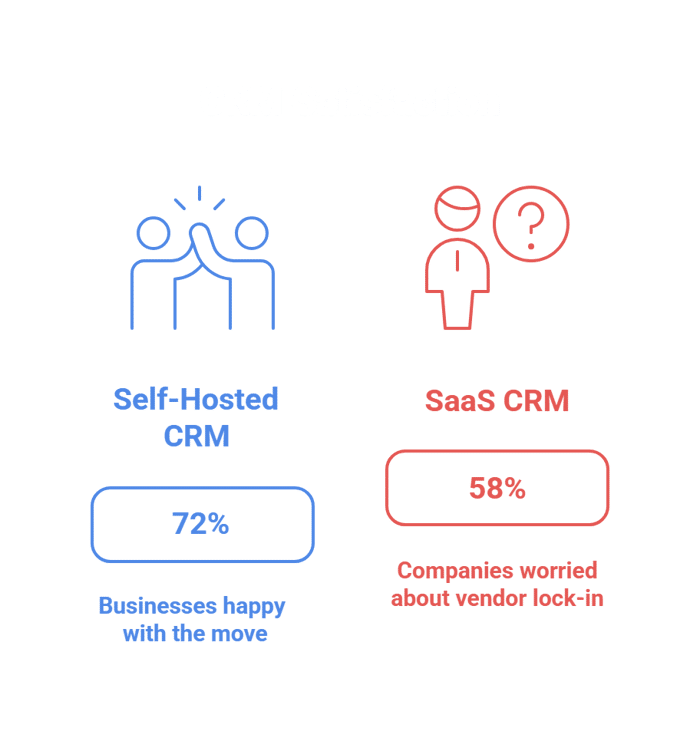
- 72% of businesses say they’d move to self-hosted if they could do it easily, according to a report by Hosting Tribunal.
- 58% of companies express worries about SaaS vendor lock-ins and data control (Gartner report 2022).
These numbers indeed resonated deeply with me—and drove my decision.
So, Is SaaS CRM Always Bad?
Absolutely not! SaaS still makes sense for many founders—especially smaller teams or startups rapidly iterating their product-market fit. Convenience is hard to beat when you urgently need simplicity.
But as you grow, your stake in controlling and securing your data increases. That’s when exploring self-hosted solutions becomes increasingly important and viable.
Conclusion & Key Takeaways
My goal isn't to discourage everyone from using SaaS CRMs. Rather, I'm hoping to shed light on this common myth and inspire a genuine reassessment.
So what's my final stance?
- SaaS may not always be safer. Control matters—a lot.
- Self-hosting isn't as terrifying or technical as you'd expect. Simple tools, especially low/no-code platforms like Fuzen.io, make transitioning easier.
- Data and control deserve deeper analysis. Don't base your CRM decisions exclusively on promises of cloud security—understand your priorities and risk tolerance.
If you've ever felt uneasy about trusting your CRM entirely to external SaaS providers, perhaps now is the perfect moment to explore what a self-hosted solution could do for you.
As indie founders and SaaS enthusiasts, we owe it to our businesses—and to ourselves—to separate myths from reality.
So tell me, have you considered shifting (or already shifted) to a self-hosted CRM? I’d love to hear your experiences!
