Sage Hosting vs Xero vs QuickBooks Hosting: Which Cloud Accounting Solution Fits Your Business?
Accounting software plays a much bigger role than recording transactions. It helps businesses manage invoices, payroll, inventory, taxes, reporting, and daily financial operations. As companies grow and teams become more distributed, running accounting software on a single office computer often creates unnecessary limitations. Employees cannot always access files remotely, hardware failures interrupt work, and maintaining servers adds extra costs.
Cloud hosting like QuickBooks hosting solves many of these challenges by giving businesses secure access to accounting software from almost anywhere. Teams can work together in real time, backups happen automatically, and IT maintenance becomes much easier to manage.
Three accounting platforms continue to dominate the market: Sage, Xero, and QuickBooks. Each offers different strengths, and each serves a different type of business. Understanding how these platforms compare helps organizations choose a solution that supports their current needs while leaving room for future growth.
Why Cloud Hosting Matters for Accounting Software
Traditional desktop accounting software worked well when employees spent every day in the office. That model has changed. Many businesses now operate across multiple locations or support hybrid and remote work.
Hosting accounting software in the cloud offers several practical advantages:
Secure remote access from any location
Multi-user collaboration without file conflicts
Automatic data backups
Reduced hardware maintenance
Better disaster recovery planning
Centralized data management
These benefits allow finance teams to stay productive without depending on office-based infrastructure.
Sage Hosting: Built for Complex Business Operations
Sage hosting places Sage accounting software on a secure cloud server instead of a local computer. Employees access the same accounting environment through the internet while business data remains centralized and protected.
Many manufacturers, construction companies, wholesalers, and accounting firms prefer Sage because it supports more advanced financial processes than many entry-level accounting platforms.
Key strengths of Sage Hosting
Sage Hosting works particularly well for organizations that require:
Advanced inventory management
Job costing
Industry-specific accounting features
Detailed financial reporting
Multi-user collaboration
Because the software runs in the cloud, businesses also avoid many of the maintenance tasks associated with on-premises servers.
Xero: A Cloud-Native Accounting Platform
Unlike Sage and QuickBooks Desktop, Xero was built as a cloud application from the beginning. Users simply log in through a web browser without installing traditional desktop software. Some organizations still choose to run Xero inside a hosted virtual desktop. This allows employees to work with Xero alongside Microsoft Office, document management software, and other business applications from one secure workspace.
Why businesses choose Xero
Xero appeals to many startups and smaller organizations because it offers:
Simple cloud access
Easy collaboration
Automatic software updates
Unlimited users on most plans
Minimal IT administration
Businesses with straightforward accounting requirements often appreciate its clean interface and ease of use.
QuickBooks Hosting: Familiar Software with Cloud Flexibility
Many businesses already rely on QuickBooks Desktop for accounting. Hosting QuickBooks in the cloud allows those businesses to continue using familiar software without remaining tied to a single office computer.
Cloud hosting gives accountants, bookkeepers, and business owners secure access to the same company file from different locations.
Benefits of QuickBooks Hosting
Businesses commonly choose QuickBooks Hosting because it provides:
Anywhere access
Multi-user functionality
Automatic backups
Strong security controls
Reliable uptime
Lower infrastructure costs
Instead of replacing existing accounting processes, hosting simply makes QuickBooks more accessible and easier to manage.
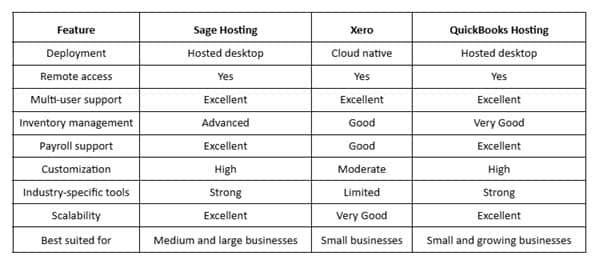
Sage Hosting vs Xero vs QuickBooks Hosting
The right platform depends on the way your business operates rather than the number of available features:
Security Should Never Be an Afterthought
Financial data deserves strong protection regardless of the accounting platform you choose.
A reliable cloud hosting provider should offer:
Multi-factor authentication
Daily automated backups
Role-based user permissions
SSAE 18 or SOC 2 certified data centers
Service Level Agreements with uptime guarantees
These features help businesses reduce operational risks while supporting compliance requirements.
Understanding the Costs
Pricing varies based on users, server resources, software licensing, and additional services.
1. Sage Hosting
Most hosted Sage environments cost between $30 and $100 per user each month. Organizations using existing software licenses may reduce monthly hosting expenses.
2. Xero
Xero charges subscription fees instead of hosting fees, ranging from $25 to $90 per month. Pricing varies significantly by country, but the standard United States base subscription fees are structured on a monthly basis. Businesses that add hosted virtual desktops should budget additional monthly costs for that environment.
3. QuickBooks Hosting
QuickBooks Hosting generally starts around $35 per user per month, although pricing varies depending on hosting providers, server resources, and the number of users.
Looking beyond monthly pricing is equally important. Businesses should evaluate reliability, technical support, security, and long-term scalability before making a decision.
Choosing the Right Solution
Each platform serves a different business profile.
Choose Sage Hosting when:
Your company manages complex inventory.
You need detailed financial reporting.
Industry-specific accounting features matter.
Multiple departments rely on accounting data.
Choose Xero when:
Your business prefers a cloud-native platform.
Accounting requirements remain relatively simple.
Your team values ease of use.
You want minimal IT management.
Choose QuickBooks Hosting when:
Your business already uses QuickBooks Desktop.
Remote access has become a priority.
Multiple users need simultaneous access.
You want cloud benefits without changing accounting software.
Matching the software to your business processes usually produces better long-term results than simply selecting the platform with the largest feature list.
Planning for Future Growth
Accounting software should support your business for years, not just the next few months.
As organizations grow, they often need additional users, stronger reporting capabilities, better integrations, and greater flexibility. Cloud hosting makes these transitions much easier because computing resources can expand without replacing local hardware.
Businesses that invest in scalable cloud infrastructure also reduce downtime, simplify IT management, and improve collaboration across departments.
Planning saves time, reduces future migration efforts, and allows accounting systems to grow alongside the business.
Conclusion
Choosing between Sage Hosting, Xero, and QuickBooks Hosting depends on your company's size, operational complexity, and long-term goals. Sage works well for organizations with advanced accounting requirements. Xero offers a straightforward cloud solution for smaller businesses, while QuickBooks Hosting gives existing users the flexibility of secure remote access without changing familiar workflows.
Working with an experienced cloud hosting provider also makes a meaningful difference. Apps4Rent delivers secure hosting for Sage, QuickBooks, and many other business applications through reliable infrastructure, automatic backups, high availability, migration assistance, and round-the-clock technical support.
Businesses planning to move their accounting environment to the cloud can rely on Apps4Rent to make the transition smooth, secure, and ready for future growth.

