Scaling AI Products with Claude Sonnet 4.6 AP1, Gemini 3.1 Pro API, and Qwen 3.5 Plus API
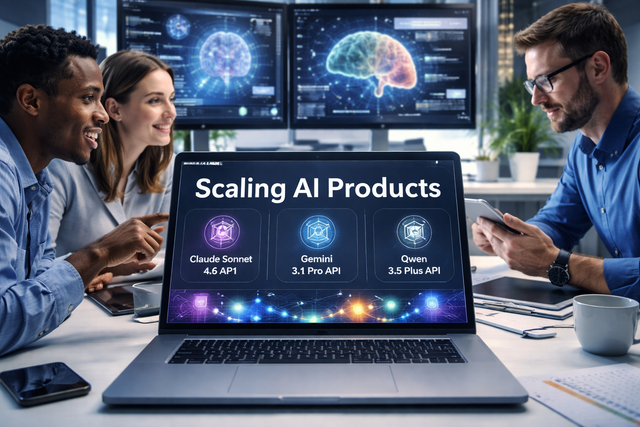
Artificial intelligence is no longer a side experiment for digital businesses. It is a core growth engine. From intelligent chat systems to automated research tools and enterprise copilots, AI products are redefining how companies operate and deliver value. However, building an AI-powered solution is only the beginning. The real challenge lies in scaling it efficiently, reliably, and profitably.
As someone who has worked closely with high-growth digital platforms, I have seen that selecting the right AI models and APIs can make or break long-term scalability. Today, three powerful solutions stand out for businesses aiming to scale responsibly and competitively: Claude Sonnet 4.6 AP1, Gemini 3.1 pro API, and qwen 3.5 Plus API. When combined with a cost-effective infrastructure provider like CometAPI, these models unlock serious growth potential.
Let’s explore how to scale AI products strategically using these advanced APIs.
Why Scaling AI Products Is Different from Launching Them
Launching an AI application often focuses on proof of concept. The goal is to demonstrate that the model can generate useful outputs. Scaling, on the other hand, demands:
Consistent performance under heavy traffic
Reliable uptime and low latency
Predictable cost management
Flexibility across use cases
Data security and compliance
Many startups underestimate how quickly inference costs rise when user demand increases. Others struggle with model limitations when moving from niche use cases to enterprise-level deployments.
That is why choosing scalable APIs like Claude Sonnet 4.6 AP1, Gemini 3.1 pro API, and qwen 3.5 Plus API from the beginning is a strategic move rather than a technical afterthought.
Understanding Claude Sonnet 4.6 AP1 for Enterprise-Grade Performance
Claude Sonnet 4.6 AP1 is designed for sophisticated reasoning, contextual understanding, and safe output generation. It performs exceptionally well in complex workflows that require:
Long context handling
Structured content generation
Code assistance
Business analysis
Document summarization
For AI products targeting enterprises, clarity and reliability matter more than flashy responses. Claude Sonnet 4.6 AP1 excels in maintaining coherent outputs across longer prompts and multi-step instructions. This makes it ideal for knowledge assistants, compliance automation tools, and research platforms.
From a scaling perspective, the model’s consistency reduces the need for heavy post-processing layers. Fewer corrections mean faster responses and lower operational overhead. That translates directly into better margins at scale.
Leveraging Gemini 3.1 Pro API for Multimodal Intelligence
Modern AI products are no longer limited to text. Businesses are integrating images, code, structured data, and conversational interfaces into unified systems. Gemini 3.1 pro API is particularly strong in this multimodal environment.
It supports advanced reasoning across different input types and is well-suited for:
AI-driven analytics dashboards
Interactive learning platforms
Image-enhanced search systems
Cross-format document understanding
Conversational coding assistants
When scaling a product that relies on varied data inputs, flexibility becomes critical. Gemini 3.1 pro API provides adaptability across industries, including fintech, education, healthcare, and e-commerce.
From a growth strategy standpoint, having a model capable of handling both structured and unstructured data reduces the need to integrate multiple specialized systems. This simplifies architecture and speeds up product expansion into new markets.
Expanding Global Reach with qwen 3.5 Plus API
For companies targeting international audiences, language diversity and cultural nuance are crucial. qwen 3.5 Plus API is particularly valuable in multilingual environments and high-volume deployments.
Its strengths include:
Strong multilingual support
Efficient inference performance
Competitive cost structure
Versatility across customer support and content tasks
If you are scaling a global SaaS platform or an AI-powered customer service solution, qwen 3.5 Plus API can handle large user bases without significantly increasing cost per request.
In scaling scenarios, cost control is as important as technical capability. Even small differences in per-token pricing can have a substantial impact when serving millions of users. That is where thoughtful API selection becomes a financial decision, not just a technical one.
Building a Scalable Architecture with Multiple AI APIs
One common mistake is relying on a single model for every function. While that may work during early development, it often becomes inefficient at scale.
A smarter approach is model orchestration. For example:
Use Claude Sonnet 4.6 AP1 for high-level reasoning and complex report generation
Use Gemini 3.1 pro API for multimodal tasks and structured analysis
Use qwen 3.5 Plus API for high-volume, multilingual interactions
This layered strategy allows you to allocate tasks to the most suitable model. It optimizes cost, improves performance, and reduces bottlenecks.
When your AI product grows from hundreds to hundreds of thousands of users, intelligent routing between models can significantly enhance stability and profitability.
Cost Control and Infrastructure Strategy
Scaling AI products without a clear cost strategy can quickly erode profits. Many founders are surprised by how quickly usage fees accumulate when user engagement increases.
To scale sustainably, focus on:
Token optimization through better prompt engineering
Caching frequent responses
Rate limiting and usage tiers
Monitoring usage patterns in real time
Selecting cost-efficient API providers
This is where CometAPI becomes particularly valuable. CometAPI offers access to Claude Sonnet 4.6 AP1, Gemini 3.1 pro API, and qwen 3.5 Plus API in a single ecosystem. Instead of juggling multiple vendor relationships, businesses can manage their AI integrations through one streamlined platform.
What makes CometAPI especially attractive is its affordable pricing structure. It provides access to advanced AI APIs at highly competitive rates, making it a cost-effective solution for startups and enterprises alike. Lower infrastructure costs mean you can reinvest more into product development, marketing, and user acquisition.
Performance Optimization for High-Traffic Applications
Once your AI product gains traction, performance optimization becomes non-negotiable. Even a one-second delay can reduce user satisfaction and retention.
To ensure smooth scaling:
Use asynchronous processing for non-critical tasks
Implement load balancing across servers
Optimize prompts to reduce unnecessary tokens
Continuously benchmark model outputs
Monitor latency and error rates
Claude Sonnet 4.6 AP1 is well-suited for deep reasoning tasks that require precision. Gemini 3.1 pro API handles diverse workloads efficiently. qwen 3.5 Plus API supports large user bases with cost efficiency.
When deployed strategically through CometAPI, these models can form the backbone of a resilient AI infrastructure capable of supporting rapid growth.
Security, Compliance, and Responsible Scaling
As AI systems grow, so do regulatory and security concerns. Enterprises, in particular, require:
Data encryption
Secure API connections
Usage transparency
Clear data handling policies
Choosing reputable API providers and unified platforms reduces operational risk. By centralizing model access through CometAPI, companies can maintain clearer oversight of usage patterns and costs while simplifying governance.
Scaling responsibly is not just about traffic numbers. It is about building trust with users and partners.
Real-World Use Cases of Scaled AI Products
Let’s look at how businesses can combine these APIs in practical scenarios.
A SaaS research platform could use Claude Sonnet 4.6 AP1 to generate analytical summaries of large datasets. It might rely on Gemini 3.1 pro API to interpret visual charts and structured inputs. Meanwhile, qwen 3.5 Plus API could power multilingual customer chat support.
An e-commerce company could integrate Gemini 3.1 pro API for image-based product search, use Claude Sonnet 4.6 AP1 for intelligent product descriptions, and deploy qwen 3.5 Plus API for global customer interactions.
This hybrid approach ensures both innovation and cost discipline.
Positioning Your AI Product for Long-Term Growth
Scaling AI products is not only about technical capability. It is also about strategic positioning. Businesses that succeed long term typically:
Choose flexible and future-ready models
Build modular AI architectures
Monitor performance continuously
Prioritize user experience
Keep operational costs under control
Claude Sonnet 4.6 AP1 provides high-level reasoning and structured output. Gemini 3.1 pro API delivers multimodal versatility. qwen 3.5 Plus API ensures scalable multilingual support. Combined through CometAPI’s affordable infrastructure, these tools create a strong foundation for expansion.
The companies that win in the AI era are those that balance innovation with discipline. They experiment, but they also measure. They scale, but they optimize.
The Path Forward for AI-Driven Businesses
The next wave of digital growth will be powered by intelligent systems that are reliable, scalable, and economically sustainable. Selecting the right APIs from the beginning is one of the most important decisions you will make.
By leveraging Claude Sonnet 4.6 AP1 for advanced reasoning, Gemini 3.1 pro API for multimodal intelligence, and qwen 3.5 Plus API for global scalability, businesses can design AI products that grow confidently with user demand. With CometAPI offering these advanced APIs at highly affordable pricing, scaling becomes not only technically feasible but financially smart.
If you are building or expanding an AI-powered platform, think beyond launch. Think about infrastructure, cost control, performance, and adaptability. That forward-looking mindset will determine whether your AI product remains a feature or becomes a market leader.
