Scaling AiLancerX: Why I stopped focusing on "AI Writing" and started focusing on "Connect Conservation"
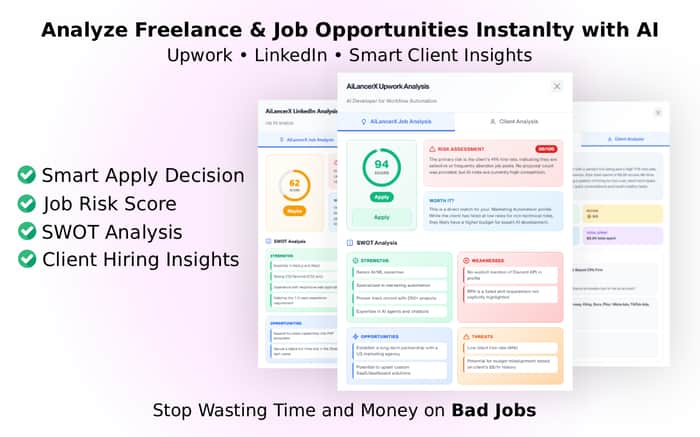
It’s been a few weeks since I shifted the core focus of AiLancerX from just a 'Proposal Writer' to a 'Job Analyzer.'
The feedback has been interesting. Most freelancers I talk to are less worried about writing (they can do that) and more terrified of wasting their expensive Upwork Connects.
What I'm doing now:
I’m currently pushing out features that help users identify 'Red Flags' in job posts before they hit apply. Things like:
- Flagging low-hire-rate clients.
- Identifying mismatched budgets.
- Analyzing job complexity vs. freelancer profile.
The Marketing Experiment:
I’m now testing different platforms (Quora, LinkedIn, Reddit) to see where the real 'pain' is most vocal. My hypothesis is that freelancers aren't looking for another ChatGPT wrapper; they are looking for a risk-management tool.
I’m curious for the IH community:
For those building browser extensions or niche AI tools—how did you find your first 100 active users? Did you focus on the 'AI' aspect or the 'Problem' aspect more in your copy?"

You accidentally moved closer to the real product the moment you stopped selling “AI writing.”
Freelancers do not wake up thinking:
“I need better proposal generation.”
They wake up thinking:
“I can’t afford to burn 16 Connects on fake or impossible jobs.”
That’s a risk problem, not a writing problem.
The strongest part of the shift is the phrase “job analyzer.”
That reframes the product from output generation into decision support.
Honestly, the more you lean into risk filtering, scam detection, budget mismatch, client quality, and probability-of-reply scoring, the less this competes with generic AI tools.
Right now AiLancerX still sounds slightly broad for that sharper positioning though.
If the product keeps moving toward freelancer risk intelligence / opportunity scoring, something tighter like Xevoa.com or Exirra.com would carry that direction much better long term than an “AI freelancer” frame.
You explained the shift better than I could honestly.
The biggest thing I’ve realized is that most freelancers do not really struggle with writing anymore. AI already solved a big part of that.
What they actually stress about is wasting Connects on jobs they probably never had a chance of winning in the first place.
The more conversations I have, the more I keep hearing the same pain points:
That’s what slowly pushed me toward the “job analyzer” direction.
And I think you’re right that the more it focuses on opportunity scoring and risk filtering, the less it competes with generic AI tools.
Still figuring things out, but this direction feels much more real and much closer to an actual pain point people already have. Appreciate the thoughtful comment.
Meer, remembered this thread because your product had one of the clearer positioning shifts I’ve seen: from AI proposal writing to freelancer job-risk intelligence.
If you’re still moving toward job analysis, Connect-waste prevention, fake-client filtering, budget mismatch, and probability-of-reply scoring, then the next issue is probably not features. It is whether AiLancerX still frames the product correctly.
That name made sense when the product sounded like AI for freelancers. But if the real value is “should I spend Connects on this job or avoid it,” the brand and landing page need to make that decision-support layer obvious fast.
I’m doing focused naming/positioning audits for early products now: current name risk, category framing, domain/name ceiling, buyer perception, and the strongest direction before more landing copy or users build around the current frame.
For AiLancerX, I’d focus specifically on whether the product should stay in the AI freelancer bucket or move toward freelancer risk/opportunity intelligence.
It is a sharp written breakdown, not a long consulting thing. I’m doing a few at $99 while refining the format.
If useful, connect here and I can give you a clear outside read:
https://www.linkedin.com/in/aryan-y-0163b0278/
This comment was deleted 3 months ago