Seeking builders: how do you handle handoff freeze between teammates?
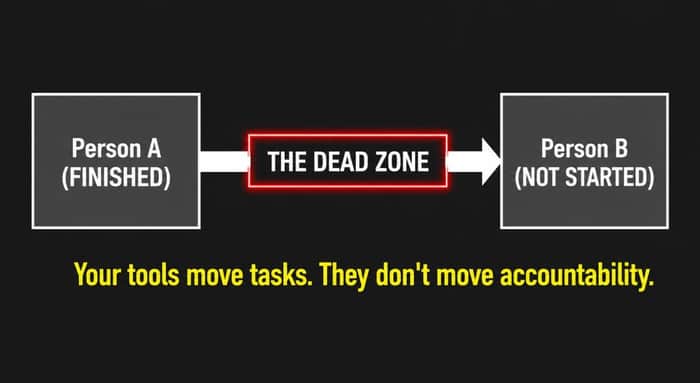
The agreement exists. What's missing is a named owner and a trigger condition for the next action.
So "soon" becomes the universal pass, and the task sits in a dead zone nobody's watching.
Small teams running fragmented handoffs can leak more revenue than a slow enterprise team, just less visibly.
What handoff rule do you actually enforce to protect priority? I'm not talking about the tool you use, but the actual rule.

Have you tried making the outgoing owner responsible until the incoming owner explicitly confirms receipt? We found that "handoff complete" requires a verbal/written "got it"—not just assignment in a tool. The danger is creating bottcks, but the alternative is the dead zone you mentioned. Curious if you've seen trade-offs between speed and clarity here?
Spot on. The "got it" rule works, but like you said, it turns into a real bottleneck when teams need to move fast.
Most tools only show who's assigned, not who actually took ownership. Relying on people to manually reply back just kills velocity.
Instead of waiting on manual confirmation, we use automated state validation—basically, the system doesn't clear the handoff until the output schema matches, so nobody has to chase anyone down for a "got it."
If you're trying to fix handoff freezes or multi-agent sync drag, check out how we structured the async routing logic here: https://github.com/koniJang/max-token-saver-light
The rule I find most effective is simple: every handoff needs one owner, one specific next action, and a deadline. If any of those is missing, the handoff isn’t complete. Shared ownership usually turns into no ownership.
Spot on. A clear owner plus a hard deadline kills that endless back-and-forth instantly. Drop me a line at koni910901@gmail.com if you want to look at how to systemize that across the board.
The smallest enforceable rule I know is: every handoff needs a named receiver, a trigger that tells them exactly when ownership starts, and an expiry time. If the receiver does not acknowledge by expiry, ownership returns to the sender instead of falling into “soon.” The interesting test is not whether the note was written, but whether the receiver can state the next action and the condition that starts it. Which failure costs you more today: no acknowledgement or acknowledgement without action?
Acknowledgement without action costs more—it's false safety. A receiver who says "got it" makes the sender believe ownership has already transferred, while nothing has actually moved. Silence, at least, keeps the risk visible.
Your expiry mechanism fixes the ownership ambiguity. What it doesn't fix is the "soon" problem inside the acknowledgement itself—someone can ack the handoff and still not state the next action, because the system doesn't force that field to be filled.
That's the piece I've been hard-coding: the trigger condition isn't just time-based expiry, it's a required next-action string at the moment of ack. No next-action, no valid ack — ownership doesn't transfer.
That makes acknowledgement a real state transition rather than a courtesy. The next failure mode I’d test is semantic compliance: “review it soon” technically fills the field but preserves the freeze. I’d require an observable action plus a deadline or trigger, then measure time-to-first-action rather than acknowledgement rate. Will you validate the quality of the next-action structurally, or let the sender reject a weak acknowledgement?
Structural validation wins — sender rejection just reintroduces the human friction you're trying to remove. If closing a handoff depends on someone judging 'is this vague?', you've replaced one soft field with another.
The rule I enforce is simple: the acknowledgement field rejects generic inputs ('soon', 'later', 'got it') at the schema level. A valid acknowledgement must include one of three things: a linked artifact, a named trigger condition, or a measurable checkpoint. Anything else fails validation.
The sender never has to argue about quality; the system just won't accept vague.
The thing that's helped us most isn't a tool, it's a habit: whoever's handing off writes a 3-line "why" note — not what the code does, but why it's built that way, what we tried and rejected. Handoff freezes usually happen because the receiving person is scared of breaking something they don't understand the reasoning for, not because they don't understand the code itself.
Full disclosure — I'm building Rootr, which tries to make that "why" context something you don't have to write manually every time (it links docs/decisions automatically), but even a lightweight decision log helps a ton before you reach for a tool.
The 'why' note works because it forces a decision to be stated, not just logged.
But the handoff trigger is still missing. Writing the note doesn't guarantee someone reads it at the moment it matters. It just moves the failure point from 'no documentation' to 'documentation nobody checks on time.'
What's actually separating adopters from lip-service teams—is it the friction of writing it, or is it that nothing forces the next person to open it before they act?
A handoff works better as a small state contract than as a long document: current owner, active goal, last verified command, known blocker, and the next human decision. If those fields update with the work, teammates can resume without reconstructing the whole history from chat.
"Next human decision" is the field that matters most here. Most handoff frameworks stop at "current status" — which tells you where the work sits, not who's supposed to move it next. That gap is exactly where the Dead Zone opens.
The static-vs-dynamic split is the real fault line. A document is a snapshot the moment it's written — accurate at t=0, stale by t=1. A state contract only works if it's structurally forced to update with the work, not appended to after the fact as a status report someone remembers to write.
Curious how you're enforcing this in practice — is the state contract living inside your task tool as required fields, or is it something CI/automation writes to on every commit/action? The failure mode I keep seeing is teams designing the right five fields, then leaving the update step manual — which just relocates the freeze one layer up.
The practical version is required fields at the transition boundary, plus one escape hatch. A task can't enter 'handed off' until owner, trigger, next action, and expected outcome exist; automation can attach evidence, but it shouldn't invent missing intent. CI is useful for proving the handoff happened, not deciding what the next human decision is.
That is the exact technical threshold where the system leaks revenue. CI handles the hard data of the handoff, but it can't fix a misaligned execution intent between Person A and Person B.
Even with strict boundary constraints, if the next human isn't operationally cleared to make that decision, the file freezes anyway—just under a 'cleaner' tracking status.
We mapped out a custom async blueprint specifically to bridge this exact engineering-to-product gap without adding more status fields to the PM tool. Drop me a line at koni910901@gmail.com if you want to see how we bypass the execution drag.
The cleaner status still freezes if decision rights are missing. I'd make the handoff name the next decider, a decision deadline, and a reversible default if they don't respond; the last field keeps clearance from turning into indefinite waiting. No extra status needed.
Exactly. The "reversible default" is the ultimate vaccine against indefinite waiting. If the next decider doesn't act by T-minus 0, the pre-approved branch executes. It forces momentum.
But in practical application, we noticed this rule leaks when the "default path" itself requires a critical external dependency or financial clearance. We actually had to design a 3-tier escalation rule to make reversible defaults safe without causing silent wrecks.
Since you already understand the mechanics at this level, I'd love to share how we structured this fail-safe mapping in our async blueprint. Drop me an email (koni910901@gmail.com) and I’ll send over the diagram.
The dependency case is exactly where a reversible default needs a precondition, not just a timer. I’d make each branch declare its required approval or external dependency at handoff; if that precondition is missing at T-minus zero, the default becomes “pause this branch and notify the named decider,” never “execute anyway.” That keeps momentum without turning silence into financial authorization.
This is brilliant engineering. Transitioning the default behavior from "execute anyway" to "pause and notify" based on dependency checking is the only way to protect the balance sheet.
But here is where the last mile of async operations gets muddy: Once the system triggers "pause and notify," the ball is back in the human decider's court. If they remain silent, the project stalls under a different name.
To solve this, we had to pair the "pause branch" with a strict "escalation path with non-overlapping clearance."
Since you are thinking about edge cases at this scale, you'll want to see how we mapped this exact dependency check-and-escalation flow in our Figma blueprint. Drop me an email (koni910901@gmail.com) and I’ll send you the diagram.
The human-silence case needs an escalation budget, not an endless ladder. I'd cap it at one named backup decider plus a hard timeout; after that, freeze only the blocked branch and let unrelated work continue. Otherwise "three-tier escalation" can become a more elaborate way to keep everyone waiting.
Hey Agentisland,
Just circling back on this thread. You mentioned dropping a line at koni910901@gmail.com to check the Figma async blueprint and cold node mapping for handling handoff freezes.
Whenever you have a spare moment, drop a quick ping there and I'll send over the architectural specs. No rush, just keeping the sync alive.
Best,
Koni
Exactly. You just nailed the exact paradox of scaling operations: over-engineered safety nets often become luxury waiting rooms.
"Escalation budget" is the perfect term for this. If you have more than one level of redundancy, people subconsciously default to "someone else will catch it."
That’s why in our blueprint, we mapped this as a strict 1-1 backup assignment rather than a hierarchical ladder. When the hard timeout hits, the blocked branch is isolated as a "cold node"—freezing that specific task to protect the execution pipeline of the rest of the project.
We actually built a visual logic map in Figma illustrating how we configure these "cold nodes" and non-overlapping clearances without bloating the PM tool.
Since you've got the exact operator’s eye for this, I'd love to share that visual map with you.
Drop me a quick line at koni910901@gmail.com with "Cold Node Map" and I'll send the Figma view over.
Would love to get your thoughts on how we handle the isolation rules.
As a solo builder this hit differently.
I don't have a Person B. I AM Person A and Person B. So the dead zone is just… me, staring at my own finished task, somehow still not starting the next one.
Turns out accountability doesn't fix itself just because you eliminated the handoff. You still need the trigger condition — you just have to set it for yourself.
For me it's been writing the next action as a single sentence before I close my laptop. "Tomorrow I will ___." Specific beats vague every time :)
The one-sentence rule gets stronger if the sentence names a stopping condition: 'ship X until Y is visible,' not 'work on X.' I'd also cap tomorrow at one carried action; the moment it becomes five, the handoff has turned back into prioritization. What gets bumped should be explicit, not silently rolled over.
"I AM Person A and Person B" — that's the solo builder dead zone nobody talks about, and you nailed it.
When you eliminate the handoff, the friction doesn't disappear. It just moves inward. The stall becomes cognitive instead of organizational — you're not waiting on someone else, you're waiting on yourself to re-engage with something your brain already mentally closed.
The laptop rule is genuinely solid as an operational threshold. Writing the next action as a single sentence before you close forces the transition to happen while context is still live, not after the brain has fully disengaged and has to reconstruct everything from scratch the next morning. Specific beats vague precisely because vague requires a decision and specific just requires execution.
One thing I'm curious about: when execution gets heavy and the backlog starts stacking, how do you stop "tomorrow I will ___" from quietly reopening into a list of five things, or from getting pushed a day at a time until it loses its teeth?
I think the biggest issue is that many teams treat a handoff as the end of one person's work rather than the beginning of someone else's.
A rule I've found valuable is that a handoff isn't complete until four things are explicit: the owner, the next action, the trigger for that action, and the expected outcome. If any one of those is missing, you've created a waiting point rather than a workflow.
In my experience, those "waiting points" are where priorities quietly stall and accountability starts to blur.
"The end of one person's work rather than the beginning of someone else's" — that framing is exactly right, and most teams never make that shift explicitly.
Your four elements are solid. In practice, the trigger and next action are the two that get skipped most often. Owner gets named, outcome gets assumed, but nobody defines what actually fires the handoff or what the first move looks like on the receiving end. That's where the waiting point forms.
The only way to reliably kill it is to make the trigger and next action visible at the system level — not something a person has to remember to communicate, but something the workflow surfaces automatically. Once that's baked in, the handoff stops being a social transaction and starts being a mechanical one.
Curious what your enforcement looks like in practice — do you have a specific protocol that keeps all four elements from getting dropped when things move fast?
Good question. I try to avoid relying on people to remember the protocol because that's usually where consistency breaks down.
The approach I'm developing is to make every handoff answer the same four questions before it's considered complete:
If any of those are unclear, I don't treat it as a completed handoff, I treat it as an unresolved dependency.
The goal isn't to add another checklist. It's to make incomplete handoffs visible early, because they tend to become the bottlenecks that only show up later as "communication problems."
Calling it an unresolved dependency is useful because it gives the workflow a state that can age. The missing piece I'd add is an expiry: if owner, trigger, or outcome isn't resolved by a set time, it returns to the sender instead of sitting blocked forever. A soft lock without escalation is just a better-labeled dead zone.
Solid framework, ndakousman — those four elements are exactly right.
Calling it an "unresolved dependency" instead of a communication failure is the correct system-level move. Most teams still frame this as a soft skills problem ("we should communicate better"), which is why it never actually gets fixed. You framed it as a structural gap, which is the only framing that survives contact with a real team under deadline pressure.
Here's where we took it one layer further. In our architecture, those four questions — Owner, Next Action, Trigger, Expected Outcome — aren't a checklist someone runs through manually. They're required fields in the handoff data block itself. If any one of them is missing when a task moves from one stage to the next, the pipeline soft-locks the task automatically and flags it as a Dead Zone.
The difference: it's not a person's job to notice the gap and ask. The workflow refuses to advance until the missing dependency is resolved. You're not relying on someone remembering to check — you're relying on the workflow physically refusing to proceed.
Curious how you're enforcing those four fields today. Is it still a manual review, or is it enforced directly in your workflow or database layer?
This is one of the biggest bottlenecks in software development.
What I've found works best is moving away from verbal or informal handoffs and adopting a spec-driven approach.
Before any handoff happens, we create a single feature specification that defines three things:
If the checklist isn't complete, the handoff doesn't happen.
I recently used this methodology while building a healthcare EMR with more than 100 database models, and it virtually eliminated the "freeze" that often happens during transitions. Whether it's another developer or an AI coding agent picking up the work, they know exactly what needs to be built, what constraints to respect, and how success will be measured.
The binary verification checklist is the strong part, especially with 100 models. The risk is freezing the spec while implementation discovers a new constraint; I'd require every changed assumption to update the spec before the checklist can pass. Otherwise the handoff is precise, but precisely stale.
Most teams pass tasks verbally and pray the next person guesses the context right. No frozen spec, no binary checklist, just vibes and hope.
The handoff literally shouldn't happen until both exist. That's not bureaucracy, that's the only thing that stops the next person from spending two days reconstructing what the first person already figured out.
Mixing human devs with AI agents makes this worse, not better. Without a hard exit criteria, you're not running a workflow; you're running a guessing game at scale.
The rule that worked for us: if a task sits untouched for more than 24 hours after handoff, it auto-escalates to whoever passed it. That shifts the incentive from 'I will get to it' to 'I either do it now or explicitly push back.' The key insight was that handoff freeze is rarely a tool problem. Its a missing accountability trigger. Most teams track start and finish but ignore the gap between. Do you see the freeze more on creative decisions or execution steps?
Per-handoff windows make more sense than a single threshold. A production block and a creative review have completely different escalation cadences and applying the same clock to both creates noise on one side and gaps on the other. The question is whether the person doing the handoff is reliable enough to set the right window, or if you end up with everyone defaulting to the longest window to buy themselves time.
The auto-escalation is right, but 24 hours feels too blunt for mixed work. I'd attach an expected response window to the handoff itself: 30 minutes for a production block, two days for a creative review. The useful invariant is 'escalate when the promised window expires,' not one clock for every task.