Selling his agency and hitting $10k MRR within 60 days of launching his SaaS

Ivan Nedelkovski sold his agency and carefully validated his next idea. The idea passed his rubric, so he built Lancer— an AI agent for scaling on Upwork that scratched his own itch. Within two months, he hit a $10k MRR. And now, it's at $20k.
Here's Uvan on how he did it. 👇
Dropping out twice
I was a teaching assistant before dropping out of university twice (Mechanical Engineering & Computer Science). I started a few businesses tackling local problems in Skopje, Macedonia. Then, I started a Software Development consulting business in 2020.
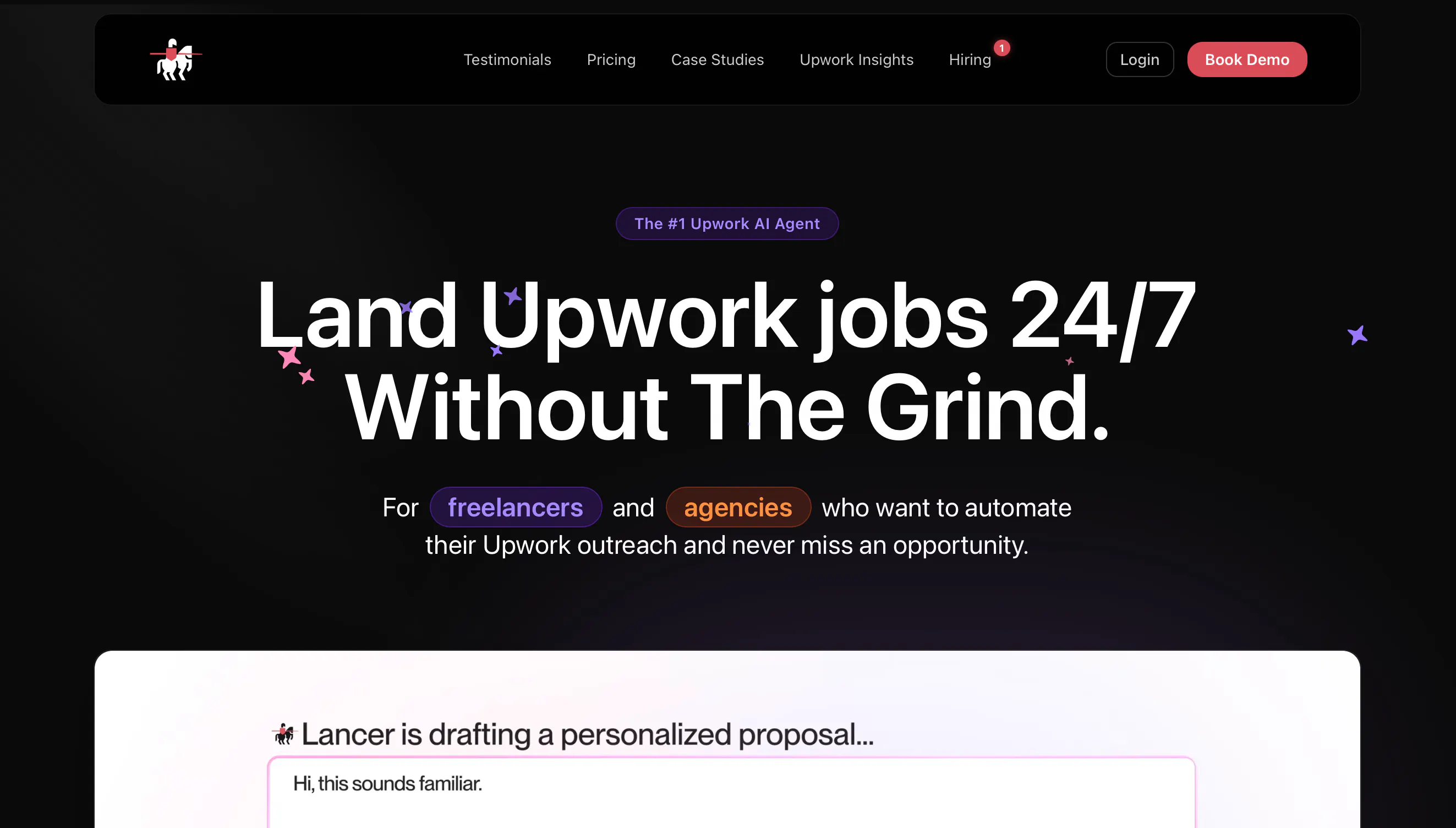
I scaled that to 15 FTEs and 7 figures in revenue before exiting it in 2025 to start a product studio. The first product was Lancer, an AI Agent helping freelancers and agencies get leads and scale on Upwork — fully automated.
We currently have $20K MRR with a two-person team.
Scratching his own itch
It was the classic "scratch your own itch" situation — I was running MVP Masters, the dev agency I mentioned, and we still didn't have a consistent channel for acquiring clients.
A fellow agency owner and friend recommended I try Upwork — this was back in 2024. After a few months of experimenting and learning the platform, I started getting leads and, eventually, clients. First, a $1k consultation; then a $14k iOS app build; then a $10k MVP build that turned into a long-term project with a $15k/mo retainer that is still with us and has generated close to $500,000 in revenue for the agency.
Upwork was the real deal, but there was a ton of noise, and the process of opening up the platform every day, reading job listings, filtering them out, and creating personalized proposals was so repetitive. I hated doing it.
An AI Agent could perfectly automate this job, so I decided to build an MVP version over a weekend. I dogfooded it, and it worked great for me. Then, I shared it with a couple of friends who were already on Upwork, and they closed clients with it in the first week — we were onto something.
I connected with one of the highest-rated Upwork coaches on the platform who, luckily for me, was also from Macedonia, and he was blown away by it. He said he'd bring us a ton of users, and this was exactly what he'd been looking for.
It turns out he was already an affiliate with a competitor (an established player), but he hated their product, and he said our MVP version of the product was 10x better than theirs. That was pretty good validation.
Two months after launch, we had 30 paying users at around $300 ARPU, reaching $10K MRR — most of which came from that Upwork coach.
Building it in a weekend
As I said, I built Version 0.1 over a weekend. Version 1.0 — the first commercial version — took longer to build. Building a scrappy automation for yourself differs from building an automation product that offers >95% job marketplace coverage (scraping) and ensures 100% account safety for your users. We proudly provide this, unlike more established players who have gotten some of their users banned.
That required some trial and error. We launched our first commercial version after two people built it full-time for six months.
Our tech stack is:
GCP
Firestore
Hetzner
Typescript
Node
Next
Elastic
Various proxy vendors
Openrouter
Making it work or shutting it down
Safely scaling scraping and automation has been our biggest challenge — by far.
If I could start over, I’d skip running automation from our own third-party accounts and run it the way we do now (through the users’ own provided accounts).
Anyone with in-depth Upwork experience knows you can set up an agency account and invite other freelancer accounts with a specific role called “Agency Manager". An Agency Manager can apply to job listings in the name of any other agency member. I believe this was originally meant to allow you to hire and invite a VA to your agency who could send applications in your name.
The established competitor I mentioned — the one our first affiliate didn’t like — used this account hierarchy to run product automation. They sourced Upwork accounts. When a user signed up with them, they instructed them to create an Upwork Agency Account and invited one of their sourced accounts as an "Agency Manager."
This approach had many drawbacks. You don’t have access to the user’s account, so you lose insights and data — especially for inbound leads, and inbound leads (such as DMs or direct job invitations) are about 50% of the total opportunities that established freelancers get on Upwork. You also don’t have access to the inbox, preventing inbox automation, which seemed like an obvious next step even when we were starting.
Another big reason here is account safety — even though that competitor justifies their method as "safer" than directly connecting to accounts, that is false, and here is why. Since sourcing "verified" Upwork accounts is hard, there are only so many that you can source. As a result, they end up sharing those accounts across multiple users. Meaning one of their sourced Upwork accounts has the role of an "Upwork Agency Manager" in dozens of agencies, actively sending proposals for all of them. You can see how that might trigger a red flag in Upwork's bot detection system, causing a chain ban for all of the agencies that the account is connected to.
There are other reasons to not run automations that way, but I won't go into all of them. The point is that we adopted the same approach anyway. It's how the competitor was doing it, and they'd been on the market for three years already. Plus, it seemed less risky than connecting to the user's accounts directly.
This turned out to be a huge mistake. Four months and thousands of dollars in crypto-sourced accounts later, we decided to either make direct account connection work or shut everything down.
We successfully made it work — our current approach is better, safer for our users, and much more scalable.
Subscriptions and "reverse referrals"
Lancer is a SaaS and uses the standard subscription-based model in the industry. We have two plans. And we're able to set better pricing because we are a small, lean team that spends nothing on marketing.
Pay-per-Lead: $149/mo (or $99/mo if you purchase the quarterly plan)
You receive 5 leads; for each additional lead Lancer provides, you pay $19
Connect a single Upwork account
Every feature unlocked
Unlimited proposals sent
Unlimited: $499/mo (or $333/mo if you purchase the quarterly plan)
You receive unlimited leads
Connect up to three Upwork accounts (you can purchase more seats)
Every feature unlocked
DFY Setup & White-glove onboarding
We included the DFY setup in the Unlimited tier as a specific feature because many users struggled with setup; even with strong Upwork profiles, their Lancer campaigns performed poorly. However, once we set them up, their campaigns crushed. We began offering it to all new users, regardless of their plan, but when that became overwhelming, we moved it to a dedicated service/feature within the higher-cost tier, which increased our ARPU.
We also monetize through "reverse-referrals." We refer clients who we believe will benefit from working with our affiliate Upwork coaches. This is "reverse" because they typically refer users to us. Approximately 10% of our monthly revenue comes from this.
Affiliates, cold outreach, and content
As I mentioned, my first customers were friends who used Upwork. And from there, one Upwork coach became an affiliate and quickly moved us to $10k MRR. That was within about 60 days of launch. Since then, we've done the following:
We added more affiliates who are Upwork Coaches and content creators in the space.
We created a free, viral platform that generated significant free traffic — UpworkMRR.
We conducted very precise cold outreach based on data we pulled for every active freelancer on the Upwork public marketplace — this data came from UpworkMRR.
We appeared as a guest here and on Starter Story.
We created LinkedIn Content — interesting experiences, learnings, case studies, testimonials, and insights from building the tool and talking to users. A few pieces have gone viral.
Ask these questions before building
If your goal is to reach $10k/mo and eventually scale to a $1M ARR business, here's my advice.
Pre-launch, consider these points:
How big is the market?
Is there an existing solution to the problem I want to solve, and how successful is it?
How do I market/sell it?
Most indie hackers are more builders than entrepreneurs; They can whip something up over a weekend, especially in 2026 with agentic development. However, builders rarely monetize and market it effectively.
Let's use Lancer as an example. It was initially an AI Agent for Upwork, so the platform it automated always limited Lancer's maximum potential size — a hard limit. But how big is that? Is it a $1K MRR project, a $10K MRR micro-SaaS, or a $100K MRR startup? I asked these questions to get my answer:
How many freelancers are registered on Upwork? 18,000,000+ based on Upwork data
How many freelancers are active? ±30,000
How do you define an active freelancer? At least two projects won and $6,000 earned on the platform within the last six months.
How much are they earning, i.e. what's their spending power? 30,000 earn at least $1,000 a month, 16,000 earn at least $2,000 a month, 9,000 earn at least $3,000 a month, and 5,000 earn at least $5,000 a month.
Do existing competitors offer a solution for this problem, and what are their user numbers and ARR? Yes; the biggest competitor reported $2M ARR.
Can my solution add value and improve existing solutions? I subscribed (paid $500/month after a sales call — no self-checkout) to that competitor. Their product was genuinely lackluster, especially at the $500 price tag. I genuinely would not have built Lancer if they had a better product.
Only after I knew all this did I get started with marketing and building.
What's next?
For Lancer, I want to build the best product in the Upwork niche, a tool thousands of freelancers use to automate Upwork. We currently have only 100 users, so there's quite a bit of room to grow.
The key to getting there involves going deep into agentic-enabling features and employing a fair, usage-based pricing model.
You can follow along on LinkedIn, YouTube, and Instagram. Or check out UpworkMRR and Lancer!

Leave a Comment