Sentiment Analysis AI: How It Reads News, Data, and Market Reaction
Market behaviour is not driven solely by numbers. News, reactions, opinions, and overall mood all play major roles in how a stock moves. Traders who understand this mood often make steadier decisions than those who rely only on charts.
Sentiment analysis AI studies how the market feels and presents a simple view of whether the mood around a stock is positive, neutral, or negative.
This blog explains how sentiment analysis AI works and which platforms offer strong sentiment tools.
Top Sentiment Analysis AI Tools for Stock Market Traders
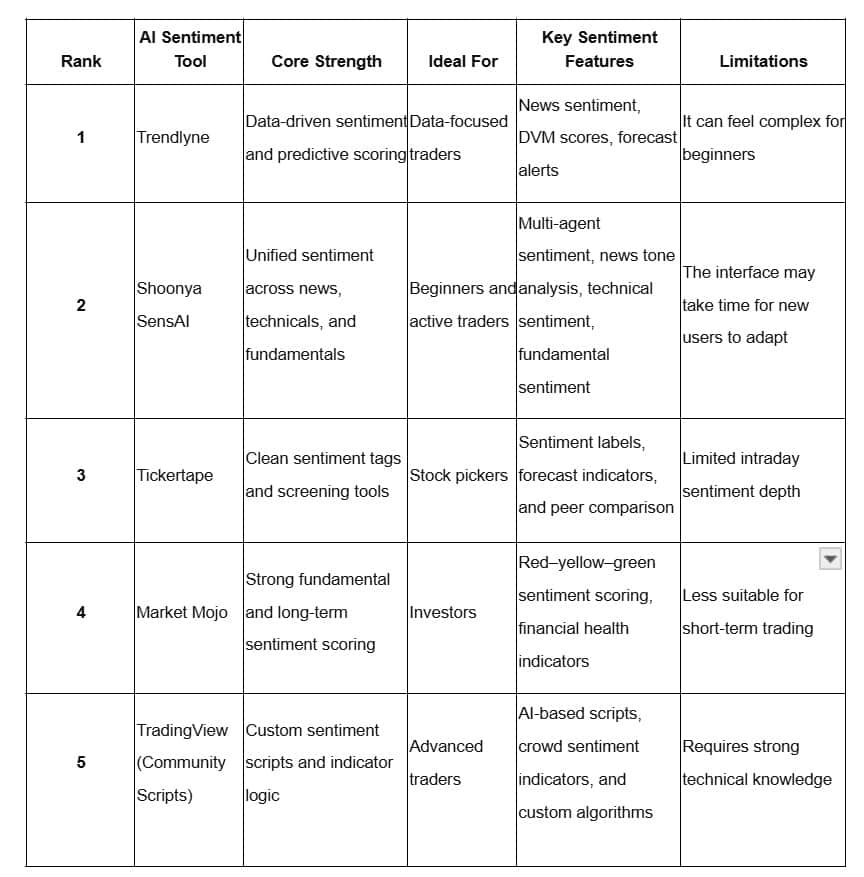
Detailed Features of the Best Sentiment Analysis AI Tools
Below is a clear and balanced explanation of how each platform interprets market sentiment.
1. Trendlyne
Trendlyne uses a data-driven approach to sentiment. It focuses on predicting stock behaviour through structured scoring and alerts.
Key Features
Trendlyne reads news and assigns sentiment tags that help traders identify whether recent information is positive, neutral, or negative.
It offers DVM scores that analyse long-term financial strength and reflect changing sentiment over time.
Traders receive alerts when forecast models detect unusual price movement or sentiment shifts.
Trendlyne’s screeners include sentiment-based filters that help users shortlist strong stocks quickly.
2. Shoonya SensAI
Shoonya SensAI provides a unified sentiment view that blends news, technical behaviour, and fundamentals. It uses multi-agent intelligence to present market mood in a simple, readable format.
Key Features
SensAI creates a single consolidated sentiment score by combining technical, fundamental, and news inputs, helping traders understand the overall market mood instantly.
It reads financial news using natural language processing to classify sentiment as positive, neutral, or negative.
SensAI tracks SMA, EMA, RSI, and volume patterns to interpret technical sentiment and highlight shifts in trend strength.
It shows technical indicators with sentiment tags, making it easier for traders to understand market behaviour without deep technical study.
Fundamental sentiment is built by reading multi-year revenue, margins, earnings, and key financial ratios.
3. Tickertape
Tickertape offers sentiment tags that help traders interpret stock behaviour quickly.
Key Features
It displays simple sentiment labels based on recent performance and underlying data.
Tickertape provides forecast indicators that show how sentiment may shift in the short term.
It allows peer comparison, helping users understand whether sentiment is stronger or weaker than similar companies.
4. Market Mojo
Market Mojo offers long-term sentiment evaluation using a colour-coded scoring system.
Key Features
It assigns a simple red, yellow, or green score for each stock, reflecting financial strength and overall sentiment.
The platform reads earnings patterns, valuation changes, and long-term performance to create sentiment grades.
It helps users understand whether a stock is fundamentally strong and aligned with positive sentiment.
Market Mojo focuses more on stability than short-term movement.
5. TradingView (Community Scripts)
TradingView allows traders to apply sentiment through custom scripts.
Key Features
Community developers create AI-based indicators that track crowd sentiment, behaviour, and volatility.
Traders can use Pine Script to design their own sentiment-based logic.
Custom indicators help identify market emotional extremes.
Backtesting tools allow users to check how sentiment signals performed in the past.
How Sentiment Analysis Improves Trading Decisions
Market behaviour is often influenced by how people feel, not only by numbers. Sentiment analysis AI helps traders understand this emotional movement in a structured and practical way.
AI reads news, price behaviour, and volume to show whether the current mood is positive, neutral, or negative. This helps traders avoid acting blindly during sudden movement.
When the market feels noisy, sentiment analysis highlights the parts that matter most, allowing traders to stay focused.
By understanding the market's tone, traders can confirm their views with clear signals before placing trades.
Short-term traders use sentiment to track reactions, while long-term investors use it to measure stability.
When mood becomes clear, decisions lean more on insight and less on impulse.
Get a better market grip with the basics of the stock market course.
End Note
Sentiment analysis AI helps traders understand market mood with more clarity and less confusion. It turns scattered information into simple signals that support steady and confident decisions.
If you are planning to take the first step into the market, opening a demat account can help you get started smoothly.
FAQ’s
1. What is sentiment analysis in trading?
Sentiment analysis in trading is the process of understanding the overall mood of the market by studying news, price behaviour, volume, and reactions. It helps traders see whether the sentiment around a stock is positive, neutral, or negative.
2. How does sentiment analysis AI work?
Sentiment analysis AI reads news, trends, technical signals, and behaviour patterns. It organises this information and shows a simple sentiment view that helps traders understand how the market is reacting.
3. Why is sentiment important in the stock market?
Market movement is often driven by emotion. When traders understand market mood, they can avoid unclear conditions, spot early shifts, and make steadier decisions.
4. Which are the best sentiment analysis tools for traders?
Popular tools include Shoonya SensAI, Trendlyne, Tickertape, Market Mojo, and TradingView community scripts. Each tool uses AI differently to help traders read the market mood.
5. Is sentiment analysis AI useful for beginners?
Yes. It simplifies complex information and presents it in an easy-to-read format. Beginners can understand market reactions better and make decisions with more clarity.


Sentiment analysis always sounds straightforward until you realize how messy real-world data is.
Context, tone, sarcasm… it’s not as clean as it looks on paper.
Curious how accurate it actually feels in practice vs controlled environments.