SEO Audit + Fix: an SEO tool that judges before it rewrites
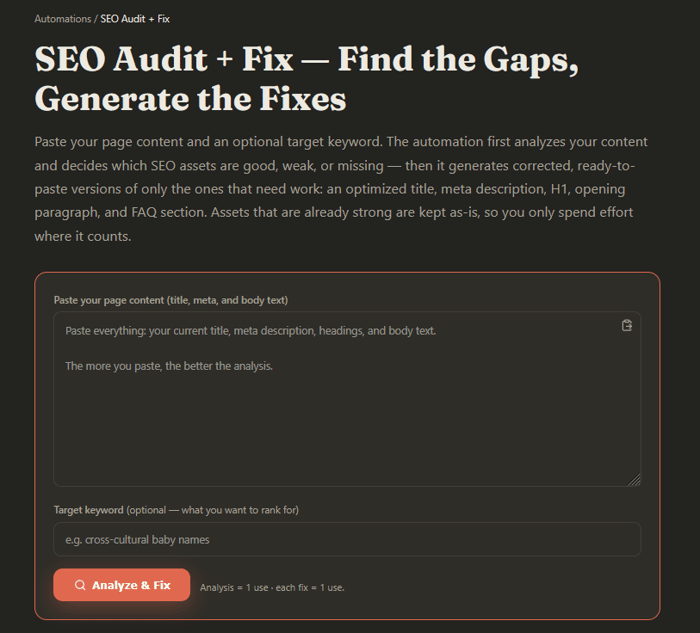
Shipped something this week I've wanted to build for a while: an SEO tool that doesn't just tell you everything's broken.
Most SEO tools either flag every field on your page as a problem (so you buy the upgrade), or rewrite the whole thing blindly. I built SEO Audit + Fix to do neither — paste your page content in, it judges five core assets (title, meta description, H1, opening paragraph, FAQ) as good, weak, or missing, then only generates fixes for what's actually weak or missing. Anything already strong gets left alone.
Part of letsflw, the AI writing platform I've been building — 100+ tools, all in one place, free tier included.
Try it here: https://letsflw.com/automations/seo-audit-fix?utm_source=indiehackers&utm_medium=social&utm_campaign=seo_audit_fix_ih
Would love feedback from anyone here who's tried it, especially if the "kept vs. fixed" judgment calls feel right or off on your own pages.

Love the “judge before rewrite” approach. SEO fixes work much better when you identify the actual issue before changing content. I’m building SERPSpur with the same mindset—an SEO toolkit for auditing technical issues, performance, backlinks, and other ranking factors before making changes.
"Judges before it rewrites" is a genuinely sharp wedge, sharper than you're letting it be. The restraint is the product: every other AI SEO tool rewrites everything because generating tokens is what they do, so they flag your already-good title as "needs work." A tool that says "this is fine, leave it" is trustworthy in a way the rewrite-everything crowd can't be. Trust is the differentiator, not the fixes.
Which is why "part of letsflw, 100+ tools" undercuts you. The bundle says "we do everything," your wedge says "we do one thing with judgment." Opposite directions, restraint sold inside abundance muddies the signal.
What's your false-positive rate, how often does it flag something actually fine? That number is the whole product.
Fair point on the framing, noted.
On false-positive rate that's genuinely better answered by running it than debating it. If you try it on a few of your own pages, real strong ones and real weak ones, I'd actually want to know what you find. That tells us both more than anything I could estimate from here.
Fair, running it beats estimating, and "try it on real strong and real weak pages" is exactly the right test. The strong-page cases are the ones that matter most, because that's where trust is won or lost: correctly saying "leave this alone" is your whole differentiator, and it's also the harder call than catching an obviously weak one.
The one thing that holds regardless of the false-positive number: if it does nail the "this is already good, don't touch it" calls, that restraint deserves to be the headline, not buried under "100+ tools." A tool that knows when to do nothing is rare enough to lead with. That's the point worth keeping whatever the test shows.