From broke and idealess to building a $100k/mo AI services company

Aryan Mahajan stayed in a tiny apartment, living off canned tuna while he grew a following and figured out what he wanted to build. Now, he has a $100k/mo portfolio that includes Zoro.
Here's Aryan with his story. 👇
Surviving on canned tuna
It was September 2024. I was in Dallas and out of ideas. I paid $4k to fly to Dubai for a mastermind event. That was most of the money I had.
I went for one night. I did not even attend the event I paid for. I met the people in that room and watched how they moved. How they talked about money like it was a solvable problem. Something in me refused to go back. I called my parents that week and told them I was staying in Dubai permanently. They thought I was being scammed by people who had found an easy mark. Honestly, from where they were sitting, that was a reasonable conclusion.
The next four months included the highest and the lowest points of my life, often inside the same 24 hours. I lived in a 400-square-foot room. I ate one or two cans of tuna a day and lost 22 pounds. Every credit card I owned was maxed out, and I was still paying rent on a Dallas lease I could not break.
And in that same stretch, I was on a private yacht with people worth more than everyone I grew up around combined. Marina penthouses. The Burj at 3 a.m. One day, I'm eating tuna alone in a room the size of a parking space; the next, I'm in a place where nobody thinks about money at all. Then, back to the room. That contrast did something permanent to me. I learned that it's your presence and usefulness that open doors — not your bank account. And if you can survive the tuna, you genuinely cannot be scared of much.
But I still had no business. I was around money without making any, which is its own specific kind of humiliation. Then, at about 2am. one night, I found a video about AI chatbots. Nothing profound, just a guy explaining that businesses would pay for one. I built the first working version before the sun came up, badly, and I did not stop for the next two years.
Building a $100k/mo portfolio
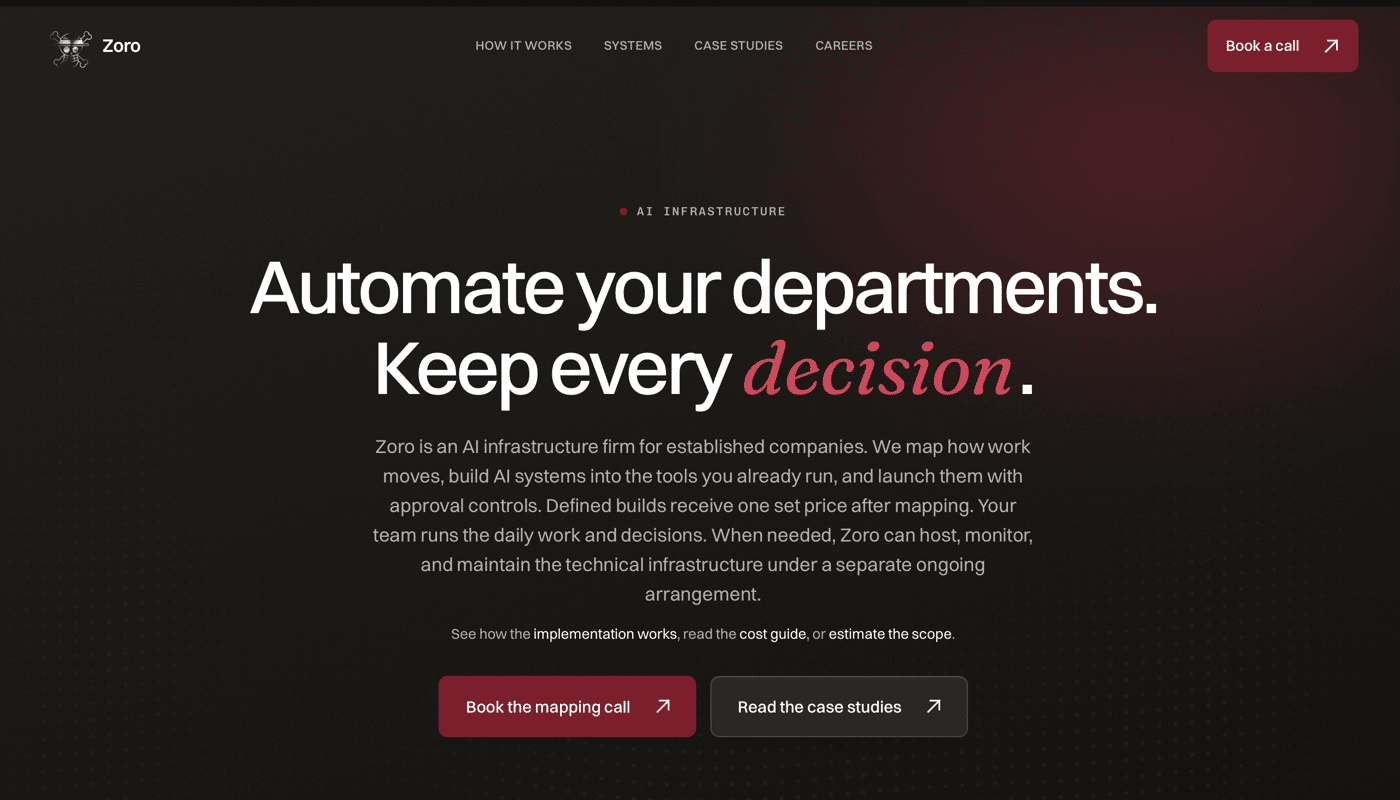
Now, I'm the founder and CEO of Zoro, an AI infrastructure company in Los Angeles. At the time of this interview, I'm 23.
Zoro builds the AI systems that companies run on. Not a chatbot bolted onto a website, and not a workflow that breaks the first time someone does something unusual. Customer, money, and work records live in one place; AI agents handle repetitive execution; exact software provides precise answers; and humans approve anything that matters. Founders come to me because they are the bottleneck in their own companies. I take one expensive part of that and make it run without them.
Alongside that, I built an audience of 50,000+ on LinkedIn and over 25 million organic views by publishing my builds, which is how most of my clients find me. Across the businesses I own and operate, revenue is seven figures with over $100k recurring every month. And I run my own companies on the same infrastructure I sell.
z
Starting on Upwork
Zoro was the first chatbot. It kept growing.
The morning after I built it, I went to Upwork, where businesses were, and I sent 47 proposals. Everyone else sent the same paragraph of text. I recorded a short, custom Loom for every single one, showing the buyer the product already working in their business, their use case, and their name on the screen. That was the whole edge. They did not have to imagine whether I could do it.
My first client paid me $180 for a real estate chatbot. The number is embarrassing, and it changed my life because it proved a skill I learned at 2am could turn into money the same week.
From there, it was repetition and raising the ceiling. Chatbots became automations. Automations became full workflows. Workflows became systems that ran a real part of a business, and at some point, clients stopped asking me for a tool and started handing me responsibility for an outcome, when the money changed completely. Same work, different frame. Nobody with a real budget wants a chatbot. They want one expensive problem to stop costing them.
I think my biggest mistake was scope discipline. I said yes to adjacent work because it paid, and adjacent work quietly makes you the owner of things that never compound. If I started again, I would go straight to businesses instead of marketplaces, charge properly from the first client, and build distribution from day one instead of month four. Every month I sold effort instead of an outcome was a month priced wrong.
An AI service stack
I build with AI all day on real work. Claude Code is its core: I point it at a company's actual files, records, and rules, direct it to build the thing, and then judge what it built.
Around that sit the tools most operators already know: n8n for connecting systems, Gamma for presentations, Apollo and enrichment tools for pipeline work, and the platforms a business already lives in—Gmail, Slack, Teams, WhatsApp, Stripe, and their CRM.
Underneath, real engineering, a proper application, and one database act as the single source of truth, because a business cannot run on a chain of automations that forget everything the moment one step fails.
Productized services
The core business is straightforward. A company pays me to build the system that runs an expensive part of their operation, and then pays a subscription for me to run, watch, and improve it.
Expansion occurs because the first build also serves as the diagnosis. Sitting inside the real workflow reveals everything nobody mentioned in the sales call, and the client funds the next phase based on what they now see for themselves, rather than on a proposal. A single lead-response system for a sports academy became the layer that now runs their registration, payments, family records, roster placement, staff follow-up, and the owner's view of the entire business. This is the pattern every time: Earn the next piece.
Expansion also occurs because of who ends up in the room. I built a working system for one team at a Fortune 500 billion-dollar consulting firm in six days, and internal referrals spread it to other teams and practice areas. Nobody there bought a roadmap. They saw a machine working and asked for another.
Serious companies can say "yes: because of the approval boundary. A company can adopt an agent that cannot touch money, a contract, or a customer without human approval, because the downside is bounded and every action remains on record. That is the difference between an experiment and infrastructure.
Building funnels
Everything came from content and precision outbound. I have never paid for a lead in this business.
I started posting on LinkedIn while I was still broke in Dubai, showing the systems I was building on video rather than posting opinions about AI. Then, I found lead magnets. I would build something genuinely useful, post it, and ask people to comment a word to get it.
My biggest post received roughly 10,000 comments. That single post spread far outside my network and pulled in the enterprise conversation that became my first serious client in March 2025, a Fortune 500 billion-dollar consulting firm. That was the moment I understood that content was not marketing; it was distribution, and that one post could reach further than a year of cold outreach.
From there, I ran the same playbook on every surface. I grew LinkedIn to 50,000+ followers and 25 million+ views. Then X. Then Instagram, where I built past 20,000. Different formats, same mechanic: show real work, make the resource genuinely worth having, capture the demand it creates.
YouTube sits at the bottom of the funnel and is the most underrated piece. Short-form content wins attention, but nobody buys a system from a 30-second clip. So YouTube is where I go deep on funnels, marketing, and how a business makes money, because a serious buyer needs twenty minutes with the mechanism before they believe it. By the time someone books a call after watching that, the selling is already done.
For offers where only a few dozen credible buyers exist on earth, content is the wrong tool, so I go direct. On one specialized data offer, we mapped about 30 real decision-makers and fixed the language first, because "market insights" is what an outsider says, and "backtestable alpha signal" is what the buying room says. Multiple people inside the same major global fund independently continued the conversation. Thirty relevant conversations taught us more than ten thousand generic emails ever would.
Unfair advantages (and disadvantages)
The most useful thing I have done repeatedly is put myself in the right room on purpose, even when I could not afford it. Flying to Dubai with almost nothing. Joining a community as the guy doing the unglamorous work and leaving two years later as an equal partner in a venture. Moving to Los Angeles with two suitcases because the people I wanted to build with were here. Proximity to people who have already done it compresses years into months, and when you have no money, it is the only leverage available.
Here are some habits that compounded:
Working by talking. I dictate almost everything because typing bottlenecks thinking.
Getting the full context out of my head and into a system makes AI useful rather than generic.
Publishing work instead of perfecting it privately.
Running my own companies on everything I sell, so the proof is always live.
My biggest disadvantage was being 22 and asking established companies to let me operate part of their business. No degree they cared about, no logo wall, no track record. Nothing I said would have fixed that. Showing a working machine fixed it, which is why the six-day build mattered so much more than any deck I could have made. When someone can inspect the thing running, your age stops being the deciding factor.
Five pieces of advice
Here's my advice:
Go get one client before you build anything big. One person paying you a small amount teaches you more than a year of building alone, because their objections are information you cannot invent at your desk. My first client came from 47 proposals in one day, each with a short video showing the thing already working on their business. Show the machine, do not describe it.
Steal the buyer's language before you pitch. Sitting in the market and learning the exact words they use is worth more than any amount of copywriting talent.
Sell the outcome, not the object. Nobody with real money wants software. They want a specific expensive problem to stop happening. The same technical work, framed as responsibility for that outcome, is worth many times more.
Start publishing before you feel ready. The audience I built while eating tuna in a 400-square-foot room is the same audience that brings me enterprise inbound now. It took four months to produce anything and two years to look obvious.
Understand that your real edge is usually the business understanding, not the technology. Anyone can point a model at a problem now. Knowing where a company loses money, and having the judgment to leave the dangerous parts under human control, is the part that is hard to copy.
What's next?
In the near term, I want to take the infrastructure business to a million a month. The path is deliberately boring: fewer and bigger builds, a larger share of every new system assembled from pieces already proven, and the recurring side growing underneath. My constraint is my own attention, not demand, so productizing the repeatable parts is the growth lever.
Then, the interesting move. If installing this infrastructure reliably makes a company more valuable, the logical next step is to stop only selling it and start owning the companies. Buy something unglamorous but real, install the system, run it lean, then grow it or sell it. I want to end up operating a portfolio of businesses that run on infrastructure I built.
And I will keep publishing all of it as it happens, including what breaks, because everything I know came from people who showed their work instead of just talking about it.
You can follow along on X, LinkedIn, Instagram, and YouTube. And check out Zoro.

Leave a Comment
The core insight here is that showing working proof is a completely different measurement than claiming capability. "I built a chatbot" vs "here's your business running on this chatbot" are measuring two different things - one measures technical skill, the other measures outcome.
That's exactly why the first $180 client mattered so much. It's the first proof that the capability translates to an outcome someone will pay for. Everything after that is just scaling the same signal.
The approval boundary works for the same reason - it's measurable proof that the system respects the boundary between what it can do and what still needs human judgment. That boundary being visible and enforced is what transforms it from an experiment into something a Fortune 500 company will actually run.