Shattering the 7-figure ceiling after a 4-year
plateau
Jesse Schoberg started DropInBlog as a side project in 2015. The first four years were a grind. The next three got him near seven figures. The four after that, he was stuck.
Here's Jesse on how he finally shattered the ceiling. 👇
Both ends of the barbell
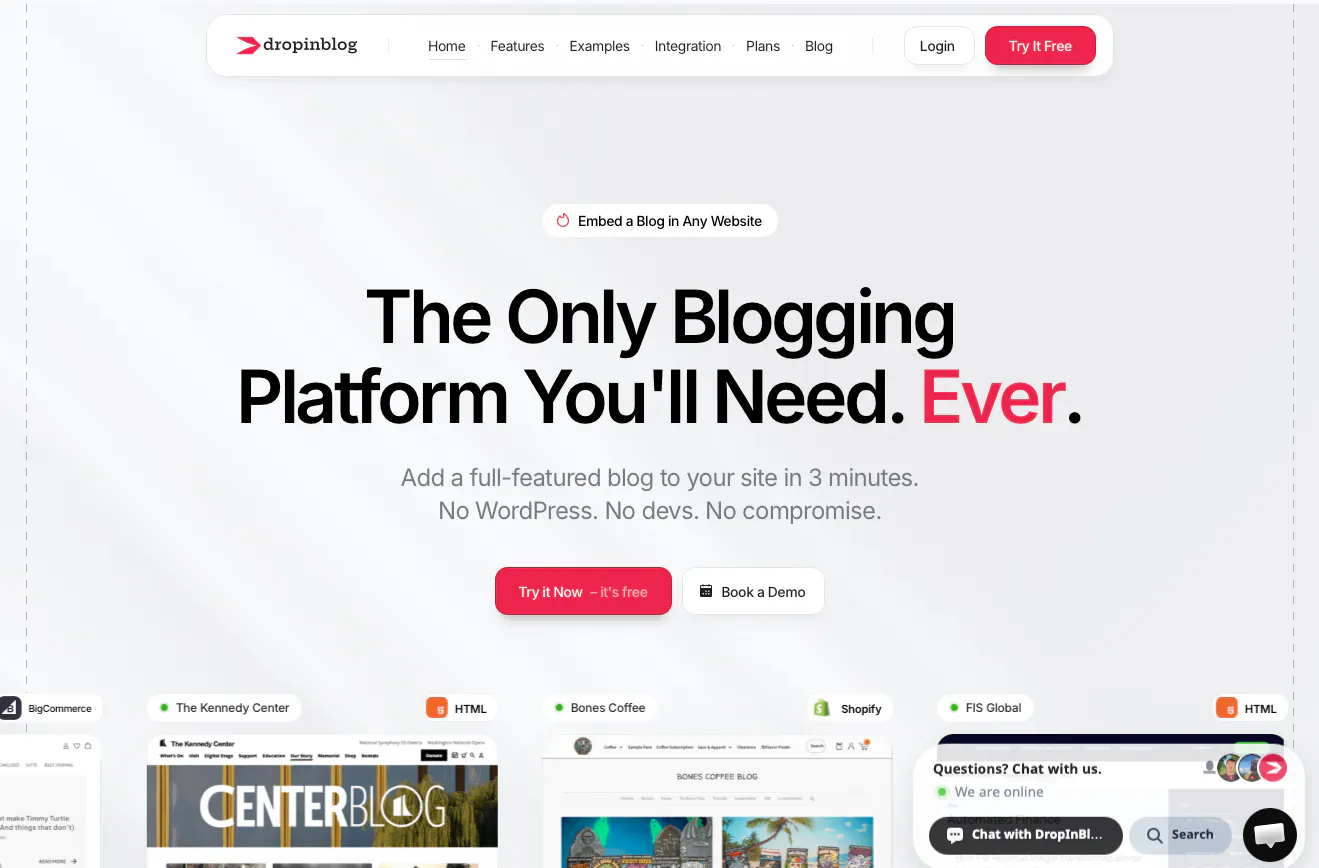
I'm Jesse, co-founder and CEO of DropInBlog. It's a headless blog CMS that drops into any existing website.
Most companies have a marketing site they love and a blog they hate, usually because the blog lives on a subdomain or in a platform that doesn't match the rest of the brand. We fix that. We now have SDKs for React, Next.js, Laravel, and Express, plus a Rendered API and an MCP server for AI workflows. Your blog looks beautiful with a super-powerful infrastructure behind it.
We launched in 2015, but didn't gain traction until 2019. Four years of grinding before it clicked. We experienced strong growth from 2019 to 2021, then reached a near-plateau of slow growth around 7 figures. That lasted about four years. In the last stretch, we finally broke through that ceiling and are growing again, with bigger plans and a much stronger brand and product. It's a really exciting chapter.
We've been bootstrapped from day one and now power 2,000+ blogs across 50+ platforms. Our customers include venture-backed startups, publicly traded companies, established B2B SaaS brands, and ecommerce names you'd recognize. I run the company with my two cofounders and a small team.
These days, I'm focused on the other end of our barbell. We've had self-serve pretty dialed in for a few years, but we hadn't focused as much on the upmarket side, where we have a lot of demand. So we are currently working on pre-enterprise and bigger customers, plus a recent UI/UX refresh to match. It's been a lot of fun.
Outside of work, my wife Janine and I live nomadically, based mostly in Bangkok, and traveling the rest of the year. She plans retreats for remote teams all over. We've been doing the location-independent thing for about ten years now.
Starting as a side project
Before getting started with DropInBlog, we ran an agency for years. But running a SaaS was the promised land.
We shipped a few products, but could never get any of them over $2k MRR. DropInBlog started as a side project to solve a problem we kept having with our agency clients: they wanted to embed a blog on their existing sites without needing WordPress or Ghost on a mismatched subdomain.
In 2015, the stack reflected that era. V1 was Symfony 1.4 and Bootstrap.
Then, the no-code revolution hit in 2019, and suddenly, a lot more people had the same problem. We got traction and went all in. We completely rewrote it in Laravel, and we couldn't be happier with that decision.
I'm a CSS and front-end guy at heart, so I manually handled much of the UX/UI and really dialed it in. Jason (my CTO and cofounder) handled the heavy backend work. Meanwhile, Laura (my COO and cofounder) ran the business while we played with the code. That's still the case today.
More recently, we redid the dashboard's presentation layer using Flux, which has been a huge upgrade.
Early technical challenges
The main challenge early on was embedding a blog cleanly into someone else's site design, ensuring it worked across dozens of uncontrolled platforms, and remained SEO-friendly.
Initially, we only had a rough API. Then we developed some JS magic that could render a blog anywhere and ensure proper crawling and indexing. From there, we continued to build upon it.
Today, we offer SDKs for major frameworks, a Rendered API, an MCP server... allll the things!
The stack
So, here's the stack:
Backend: Laravel
Frontend/dashboard: Livewire + Flux UI, Tailwind
Customer-facing Blog SDKs: React, Next.js, Laravel, Express
APIs: Rendered API, Raw API, plus an MCP server for AI workflows
Infrastructure: Laravel Cloud, Cloudflare, PlanetScale
The whole game is making something complex feel simple. The dashboard is where customers write, schedule, and manage content. That's all Laravel on the backend with a Livewire and Flux UI on the front. Content lives in PlanetScale.
When someone visits a customer's blog, the request hits us via their chosen integration. Enterprise customers typically call the Rendered API server-side, some use one of our SDKs, and others use our platform apps for Shopify, BigCommerce, and others. Cloudflare sits in front of all of it for caching and edge delivery.
The infrastructure runs on Laravel Cloud; PlanetScale manages the database. We use a few smaller APIs where it makes sense, but we try to avoid external dependencies as much as possible. The architecture ensures the customer never thinks about any of this. Their site stays their site. We're just the blog underneath.
SEO, GEO, and word of mouth
The early years were a slow grind. We primarily used SEO and agency word of mouth. And we became the obvious solution when people searched for it.
As far as SEO, we do what most serious SEO teams do. This involves constant data analysis of keywords, search volume, and rank difficulty. We've been doing it so long, it's just become muscle memory.
That's the foundation we are now building upon.
The shift upmarket has also opened up channels that didn't make sense before, like podcast sponsorships and direct sales. Honestly, this whole new push feels like running a new business again. I'm learning things I haven't had to learn in years and failing at new ideas as fast as I can. That, plus how much Claude Code has changed how we build. It's the most fun I've had with the company in years.
Recently, we researched with our customers how their content appeared in LLMs, which provided real data on what works. I recently turned that into a talk at MicroConf. We built Mention Boost™ directly from that work.
The broader trend is that blogging's next chapter involves feeding AI. Search isn't going away, but becoming the source LLMs cite is becoming equally, if not more, important. We built for that shift, and it's been pretty wild watching our smallest customers beat out big names in AI mentions as a result.
Overcoming the 7-figure plateau
The biggest challenge was the plateau that I mentioned. We spent almost four years stuck at 7 figures. I had finally "made it" and joined the big indie hackers, but it was a very frustrating period. The old saying, "If you're not growing, you're dying," is a feeling that's hard to shake.
What happened lines up with what Jason Cohen calls Max MRR. Every SaaS has a ceiling determined by how much new MRR you bring in versus what churns out. Our main channel has always been SEO, and at a certain point, the math was the math. I didn't know it was coming, or even that this concept existed.
We addressed it in two ways: fixing pricing and finding new channels. Until this point, the whole team consisted of hourly contractors, but we finally leveled up, hiring three full-time employees in marketing and success to solve it.
During that period of finding a new growth lever, we also rebuilt the foundation. Using de-anonymization tools, we noticed that customers from large companies visited our site but did not sign up. Since we couldn't find a magic wand for our current customer base, we took a big bet. We built bigger plans with features larger businesses need, redesigned the site, rebranded, and rewrote the copy to reflect a more serious business, aligning with our product's growth.
This was a lot of work and a big bet, but I got it right. Those customers now sign up.
We also started offering demos, which are almost required for larger customers. An unexpected benefit is that the demos have also shaped the product better for our self-serve tiers.
It's still in progress, but we can finally see the light. Higher pricing tiers opened up a new customer profile we couldn't serve before, and now we can test more new channels.
Rob Walling has a great talk on this called Break Through the 7 SaaS Plateaus. TL;DR: most SaaS companies never break through. Most founders get bored and sell, or just coast forever. If you want to keep growing, you have to work on new markets, new pricing, or new channels. That's it.
If I were starting over, I'd solve this earlier. SEO had been compounding for us for years, and we kept assuming it would keep going. Channels tap out. By the time growth slows, you are already late, and the plateau is imminent.
Community, tools, and time
A few things that have been particularly helpful:
Being around other founders working on similar things has been the most helpful. I've been a member of Dynamite Circle for about 10 years, and it's a special community full of the most amazing and diverse people I have ever met.
In the business, we've had good results using Microsoft Clarity to understand user behavior and fix onboarding flows.
This point is more counterintuitive: DropInBlog took a long time to get traction, and that's been oddly helpful (or so I tell myself). I truly respect how hard it is to grow a 7-figure business. I see many newer founders gain traction, sell right away, and assume they can quickly spin up the next business. Usually, they can't. Having $200k in the bank and burning $5k a month is scarier than $5k a month landing in your account. Cash flow and cash piles are not the same.
Lessons for new indie hackers
Here's what I'd tell anyone on this journey:
Details matter.
Surround yourself with other indie hackers IRL.
Talk to customers and pivot early.
Work on marketing as hard as you work on product.
Read The SaaS Playbook.
Do the Dreamline exercise.
Move somewhere cheaper.
Don't sell too early.
What's next?
I'm excited to play in the upmarket category. It's a lot of fun and a new challenge. For now, I'll see where that goes, and if we're still having fun, we'll pursue proper enterprise next.
Personally, my wife Janine and I have a good cadence, spending about half the year in Bangkok and significant time in Barcelona or Mexico City. It's been a nice contrast. This year, we discovered and fell in love with Hong Kong; it could be a nice addition to our rotation.
I'm trying to stay curious, be grateful for the magic internet money, and eat good food and share good company around the world.
You can banter with me on X, read my thoughts, or upgrade your blog with DropInBlog. Happy to chat with other founders about SEO, growth issues, or global living.

Leave a Comment
Stories like this are rare and useful. Keep up the good work.
Join us for Hiring a h.acker event at Mighty H. field recovery! Connect with like-minded powerful individuals, learn new skills, and explore the world of ha . cking in a supportive and fun environment. Visit MIGHTY H. ACKER RECOVERY for more information and to secure your free conversation ticket. Don't miss out on this unique opportunity to get back your missing money and network to other fellows!
After falling for a cry, pto scam and losing $349,000 in USDT, the user sought help despite doubts. Mighty H,acker Recovery service traced the transactions and, within three days, restored the full amount. The experience brought relief and reshaped the user.
#FaceBook #Twitter #TikTok #Youtube #Thread #Viral comment on I need a hacker to recover my stolen BTC
Really inspiring story. The biggest takeaway for me was how you didn’t just rely on SEO forever — you adapted when growth plateaued. A lot of founders would’ve stayed comfortable at 7 figures, but rebuilding the brand, pricing, and sales motion to unlock the next stage is a smart move. Proof that long-term SaaS growth is about evolving, not just surviving.
The 4-year plateau before breakthrough is the part that doesn't get talked about enough. Everyone shares the hockey stick; nobody shows the flat line that preceded it. Reading this at month 7 of building "daily AI tools" is genuinely useful framing
Great Job! Keep up the good work
Really interesting journey.
What do you think was the biggest factor behind breaking out of the multi-year growth plateau: product improvements, positioning, branding, or moving upmarket?
A lot of bootstrapped companies seem to hit that stage and struggle to get past it.
4 years of grinding before it clicked, then a
4-year plateau at 7 figures — and still pushing
through. This is the most honest growth timeline
I've seen on IH.
The "both ends of the barbell" strategy is
something every SaaS founder should read. Most
chase one customer type and ignore the other.
Jesse's decision to finally attack the enterprise
end after years of self-serve is a reminder that
plateaus are often a positioning problem, not a
product problem.
I just launched AgentFlow Pro — a Real Estate
CRM with legal docs, AI, and global maps at
$15/mo. Reading this at day 2 of zero customers
is both humbling and motivating. The 4-year
grind story tells me to just keep going.
The SEO + GEO + word of mouth section is my
next study. Thanks Jesse for sharing the full
11-year arc — this is exactly what IH is for. 🙌
What’s interesting in cases like this is that “plateau → breakout” rarely comes from a single growth lever it usually happens when operational bottlenecks finally get aligned with product positioning.
Most teams interpret a plateau as a marketing issue, when in reality it’s often a system maturity problem across acquisition, onboarding, and retention working out of sync.
Curious what changed first for you the product direction, or the way you were executing internally?
The math behind Max MRR is a brutal reality check when you rely so heavily on a single channel like SEO. You get complacent because traffic grows steadily for years until it hits the ceiling of the available market.
A question about your upmarket strategy: When you bundled more expensive plans for large companies to break through the plateau, how did you manage the impact on churn? Do those corporate accounts require complex custom integrations, or is the Rendered API alone enough to handle onboarding without overburdening the technical team?
Mention Boost is such a smart move to stay ahead of AI-generated mentions. Best of luck with this new chapter!
Great Job
Love the post! Easy to read and connect. What would you say is the biggest risk when youre traveling with your wife but also need to put the work in? Where there moments, when the traveling felt so good, that you neglected DropInBlog?
The Max MRR point is the sharpest part of this story.
A lot of founders think a plateau means the product stopped working, but sometimes it just means the original channel/customer/pricing system has reached its natural ceiling.
The de-anonymization insight is especially useful: if bigger companies are already visiting but not converting, the problem is not awareness. It is trust, packaging, pricing, and sales motion.
That feels like a very different kind of problem to solve.
A CRYPTO/DATA BASE RECOVERY EXPERT WITH A LICENSE: ALPHA KEY
After contacting Alpha Key Recovery, a licensed cryptocurrency recovery expert, about my case, I was able to get back on track after a month of being depressed over being conned out of $379,800 in cryptocurrency investments with the wrong broker. Alpha Key Recovery Hacker Expert is a recovery hacker that I will be proud to refer anyone to because of what I have seen out here with scammers.
WhatsApp : +15714122170
Signal : +15403249396
A CRYPTO/DATA BASE RECOVERY EXPERT WITH A LICENSE: ALPHA KEY
After contacting Alpha Key Recovery, a licensed cryptocurrency recovery expert, about my case, I was able to get back on track after a month of being depressed over being conned out of $379,800 in cryptocurrency investments with the wrong broker. Alpha Key Recovery Hacker Expert is a recovery hacker that I will be proud to refer anyone to because of what I have seen out here with scammers.
WhatsApp : +15714122170
Signal : +15403249396
4 years of plateau would mentally destroy most people.
Respect for pushing through long enough to see the compounding effect happen
“Really informative article and very easy to understand. The content was explained clearly and shared some useful insights. Thanks for sharing such valuable information, looking forward to reading more posts like this.”
By the time growth slows, you are already late" is probably the most important line in this whole piece. The instinct is to keep doubling down on what's working, but every channel has a ceiling and it doesn't announce itself. The de-anonymization step is underrated too — finding out enterprise buyers were already visiting but not converting is a completely different problem than not having traffic at all.
How do you see the blog world changing with AI coming onto the landscape?
“Four years of grinding before it clicked” honestly feels like the most real part of this whole story.
A lot of SaaS journeys online make growth look immediate, but the long plateaus and slow years are probably way more common than people admit.
Also really liked the point about solving an actual agency pain point first instead of trying to invent a market from scratch. Feels like many solid products come from repeatedly hitting the same annoying problem in real client work.
And as someone building frontend-heavy products too, I appreciated the “CSS/front-end guy at heart” part 😄
Structured dispute resolution for landlords and tenants — with guided negotiation, documented communication, and state-aware workflows designed to help both sides reach fair agreements faster.
The portfolio framing is underrated. Most people think about "building a YouTube channel" when the real play is building a system that can run multiple channels — and treating each one as an asset rather than a job.
The part that resonates most here is the compounding piece. Individual channels plateau, but a portfolio with shared infrastructure (same automation stack, same content process, different niches) compounds in a way a single channel never can.
Currently running 3 automated channels myself using GitHub Actions + AI script generation. The system is the asset, not any individual channel. Jacky's portfolio thinking is exactly the right mental model for anyone serious about this space.
This resonates deeply. I'm at day 1 of building
RecebeZap — a WhatsApp billing app for Brazilian
self-employed workers.
Reading about your 4-year plateau is both scary
and motivating. One question: looking back, what
was the ONE thing that finally broke the plateau?
Was it a product change, a distribution shift,
or something else entirely?
Trying to learn from founders who've been through
the long game before I hit my own walls.
The Max MRR point is the real one. SEO compounds until it doesn't, and the math just stops. Most founders treat their main channel like it's infinite. It's a finite resource you're slowly burning down.
Thanks for sharing the numbers. Transparency like this is what makes IH valuable. What's your biggest challenge going into the next growth phase?
"If you want to keep growing, you have to work on new markets, new pricing, or new channels."
Needed to hear this - my existing channel (HubSpot) might be tapped out. Will explore as I walk the Camino this month.
This is one of the most honest indie hacker stories I've read.
The plateau, the frustration, the big bet on rebranding and upmarket — most people only share the wins.
Thanks for the roadmap on breaking through.
This is very relatable. Launching something publicly always feels terrifying.BEST RECOVERY HACKER CRYPTOCURRENCY /BANK ACCT RECOVERY/ MARK WIZARD HACKERS RECOVERY
I became a victim of a romance scam that led me to invest $654,000 in Tether USDT on a fake site. After realising I had been scammed, I felt utterly hopeless and desperate for help. I began searching for a hacker online and came across Wizard Hackers Recovery. His professionalism and expertise gave me hope. Wizard Hackers Recovery worked to recover my lost funds, and I’m thrilled to say he succeeded! I am incredibly grateful for their assistance and highly recommend their services to anyone in a similar situation or any issues you can connect with them Thank you,
Email: :Markwizard 23 @ gmailcom
WHATSAPP +4915218465599
TELEGRAM : @ wizardhackersrecovery
A 4-year plateau would make most founders quit, which is why stories like this matter. People usually see the “7-figure” headline but ignore the years of iteration, patience, and consistency behind it.
A lot of startup growth is compounding disguised as stagnation. At Foundersbar, we’ve noticed that founders who survive long enough to keep learning and adapting often end up breaking through eventually - not because of one magic tactic, but because they stayed in the game long enough to improve.
This breaks down the 7-figure plateau so well. I'm building multiple products right now and trying to avoid betting everything on one channel from the start. When you realized SEO had hit its ceiling, how quickly were you able to pivot to new channels like podcasts and direct sales? Great reminder that founders need to work on marketing as hard as product. That's easy to forget early on.
"Channels tap out" is the most under-appreciated line in this whole post. Most founders miss the plateau because it's gradual. ROI on the channel doesn't crash, it just slowly declines for 2 or 3 quarters while you keep doing the same thing harder. The trap is treating your dominant channel as a constant when it's actually an S-curve.
Saw the same pattern running Henson Group. The Microsoft direct partner channel carried us for years, then quietly flattened. We didn't react fast enough. Managed services was the right next leg but we left a year on the table debating it. The lesson: pick your next channel before the current one feels stuck, not after.
The 4 years plateau part honestly felt too real. Oh my God, I can imagine how difficult that phase must’ve been mentally. Most people would’ve quit, sold, or just settled there.
Huge respect for staying consistent and pushing through it instead of giving up. Stories like this remind me that long-term success is usually just years of hard work that nobody sees.
Really enjoyed reading this article. The information was explained in a very simple and clear way, which makes it useful for all types of readers. We also work in a related field through ScrapMyCar, where we help people with legal and eco-friendly vehicle recycling and old car disposal services across India. Great content and keep sharing more informative posts.
ScrapMyCar
Four years of grinding. Three years to nearly $1M. Four years stuck. Then growth returned.
Jesse Schoberg’s story is a great reminder that every SaaS hits a ceiling and breaking through usually means new pricing, new channels, and a bigger market. Patience and persistence win.
What stood out to me is that the breakthrough didn’t come from “more traffic,” it came from changing how the business positioned itself psychologically.
A lot of SaaS founders underestimate how many larger companies silently disqualify them before sign up based purely on messaging, branding, onboarding flow, and perceived seriousness.
The interesting part is that your product likely became enterprise-ready before your communication did.
Especially pushing through four years before traction. Solving the disconnected blog problem is genuinely valuable, and your move toward pre-enterprise customers makes sense. Bootstrapped growth to 2,000+ blogs across 50+ platforms is a strong achievement.
4 years stuck is brutal. curious what the first thing was that actually moved the needle - the 'this is what's been holding me back' moment.
4 years stuck is brutal. curious what the first thing was that actually moved the needle - the 'this is what's been holding me back' moment.
Super inspirational story and you sharing of what happened and historical events pre revenue
The line that hit hardest: "By the time growth slows, you are already late."
Most SEO-first founders treat their channel like a bank account — they know the balance, they don't think about the ceiling. The Max MRR framing reframes it entirely: your channel isn't a strategy, it's a resource, and every resource has a depletion curve you don't see until you're already past the inflection point.
What I find underrated in this story is the de-anonymization step — using tooling to see that enterprise-sized companies were visiting but not converting. That's not a product failure, that's a positioning and trust signal failure. The rebrand, the demo motion, the copy rewrite — all of it was basically translating an existing signal into a language those customers could act on.
The demos-as-product-research angle is one more founders should take seriously. Most avoid sales calls because they feel like a betrayal of the "build it and they'll come" thesis. But you essentially got paid (in market intelligence) to run continuous discovery on a customer segment you hadn't fully understood yet.
One genuine question: when you rebuilt the copy and positioning to speak to larger customers, did you find it created any churn or confusion among your existing self-serve base — or did the product improvements that came with it end up lifting that tier too?
Hi I am Rishiraj. I just signed up. I am excited about this platform. I wanna say this is an interesting post and for definitely I learnt something I didn't know. Coming from an AI development background I wanted to know if AI played an important role in the success of the company. More precisely, what were the circumstances under which you thought of incorporating AI?
The de-anonymization tool insight is the most underrated part of this story. You essentially ran a data query on your own traffic and found that enterprise buyers were already arriving — they just weren't converting. That's a completely different problem than "we don't have leads." Most founders stuck at a plateau are stuck because they're optimizing the wrong thing, and no amount of new blog posts or ad spend fixes a positioning mismatch.
The Max MRR concept from Jason Cohen is something I wish more early-stage SaaS founders understood. Channels compound but they also have ceilings, and by the time the ceiling is obvious, you've already lost 6-12 months of runway to build the next one. The ones who break through are almost always the ones who started building channel 2 while channel 1 was still growing.
On the data side — the "constant data analysis of keywords, search volume, rank difficulty" becoming muscle memory is exactly right. That's not a quarterly exercise; it's a live dashboard. The founders who treat SEO reporting as a monthly report are always 2-3 months behind the signal.
9 years is a long game. Respect for not selling at the plateau.
I help B2B SaaS founders audit their data layer before they scale — happy to share a free SQL diagnostic scripts pack I put together for this kind of funnel analysis: https://growthwithshehroz.gumroad.com/l/psmqnx
"Incredible journey, Jesse! Breaking that 7-figure ceiling after a 4-year plateau is a masterclass in persistence. It really shows that sometimes the breakthrough is just one pivot or optimization away. I'm currently launching Esencia SS (a wellness SaaS codebase) and stories like yours are exactly the motivation we need to keep building through the 'quiet' years. Thanks for sharing the insights!"
This is one of those stories that quietly shows the reality behind most “overnight success” SaaS launches.
What stands out immediately is the patience behind DropInBlog — 4 years before real traction is something most founders don’t talk about, but it’s actually very common.
The second thing is the clarity of execution: you didn’t just build a blog tool, you solved a very specific integration problem across platforms. That kind of positioning usually takes time to fully “click” in the market.
Also, breaking through a 7-figure plateau is a phase almost every SaaS hits at some point. It’s rarely a product issue — it’s almost always channels, pricing, or targeting evolving at the wrong speed compared to the business.
Respect for the honesty here. This is the part of building that actually matters, even if it’s not the part people usually highlight 👏
4 years stuck at the same level and still pushing through instead of selling or coasting is probably the most underrated part of this story
curious - what ended up being the biggest mindset shift during that plateau period?
Hello,
This is Rashid from Infobay AI. We are interested in a business collaboration and would like to discuss purchasing the complete source code/software of your startup. We are open to a commercial agreement and look forward to discussing this further.
The Max MRR concept is one of those things that seems obvious in retrospect but almost nobody talks about honestly — channels have ceilings the same way markets do. What I found most useful in your story is the timing angle: by the time growth actually slows, you're already late to build the next acquisition channel. The instinct is to keep doubling down on what's working, but it sounds like the real move is treating your current channel as a finite resource and starting to diversify while you still have momentum. The demos-as-R&D insight is underrated too — most people avoid sales calls when self-serve is working, but you're essentially getting paid to do product research. Curious whether the move upmarket felt like a new company internally, or more like the same DNA just applied to a different customer tier?
Great write-up. The part about the "7-figure plateau" and Jason Cohen’s Max MRR concept is such a reality check for anyone in SaaS. It’s easy to think that once you hit that "promised land" of 7 figures, it’s just clear sailing, but the math of churn vs. new MRR eventually catches up to everyone if the acquisition channels don't evolve.
It’s also really interesting to see how you pivoted from a pure self-serve model to offering demos and pre-enterprise tiers. A lot of indie hackers avoid demos like the plague because they want that "passive" lifestyle, but as you mentioned, those conversations are often the best R&D you can get. Congrats on breaking through that ceiling—the move toward "feeding AI" and Mention Boost™ feels like a very timely bet.
Quick question: When you were rewriting the copy and rebranding to attract those larger customers, did you find that it alienated your smaller, original user base at all, or did they just appreciate the "glow up"?
The “4 years of plateau after reaching 7 figures” part really stood out to me.
A lot of startup stories only talk about the climb, not the long periods where growth slows down and the challenge becomes staying consistent, improving distribution, and evolving positioning.
Also found the “ecosystem + infrastructure” angle interesting — especially how much emphasis was placed on UX/UI, SDKs, and integration experience instead of just core functionality. That part feels increasingly important in developer tooling products.
Was it a single change or more of the compounding effect?
This is one of the most honest SaaS journeys I've read. 4 years of no traction. 4 years stuck at 7 figures. Most people would have quit or sold. Respect for grinding through both.
The 'Max MRR' concept from Jason Cohen — I'd never heard of it. The idea that your channel has a ceiling you don't see coming until you hit it. That's scary but important to know early.
Quick question — when you were stuck at the plateau, what was the smallest bet you made that actually moved the needle? Not the big hires or pricing changes. Something tiny that gave you hope to keep going.
I'm building Bexra — Helping entrepreneurs find, build & grow, Still pre-launch. Reading stories like this makes me realize the 'overnight success' thing is a lie. It's just years of grinding and then maybe something clicks.
Also, the line 'cash flow and cash piles are not the same' — that's going in my notes. Thanks for sharing.
Four years is a long time to feel stuck. What eventually tipped the scales for you—was it a single change or more of a compounding effect?
This resonates a lot. The 4-year plateau is usually a systems/delegation problem, not a product one. I'm doing research on exactly this - what solo founders need to scale from 00K to M without burning out. Would love 20 minutes with founders who've been through this transition. Research only, not a sales call. Reply here or DM me if interested.
This comment was deleted 2 months ago