Shipping is hard for a completely different reason than people think.
Most builders don’t struggle with writing code.
They struggle with explaining what the code means.
I’ve noticed this over and over again:
You ship a feature →
you know exactly what changed →
but turning that into:
a clear changelog
a readable update
a tweet-sized announcement
or even internal documentation
…takes 10x longer than the coding itself.
And the worst part?
If you skip it, nobody knows your product got better.
That’s the gap we’re working on with Doccier:
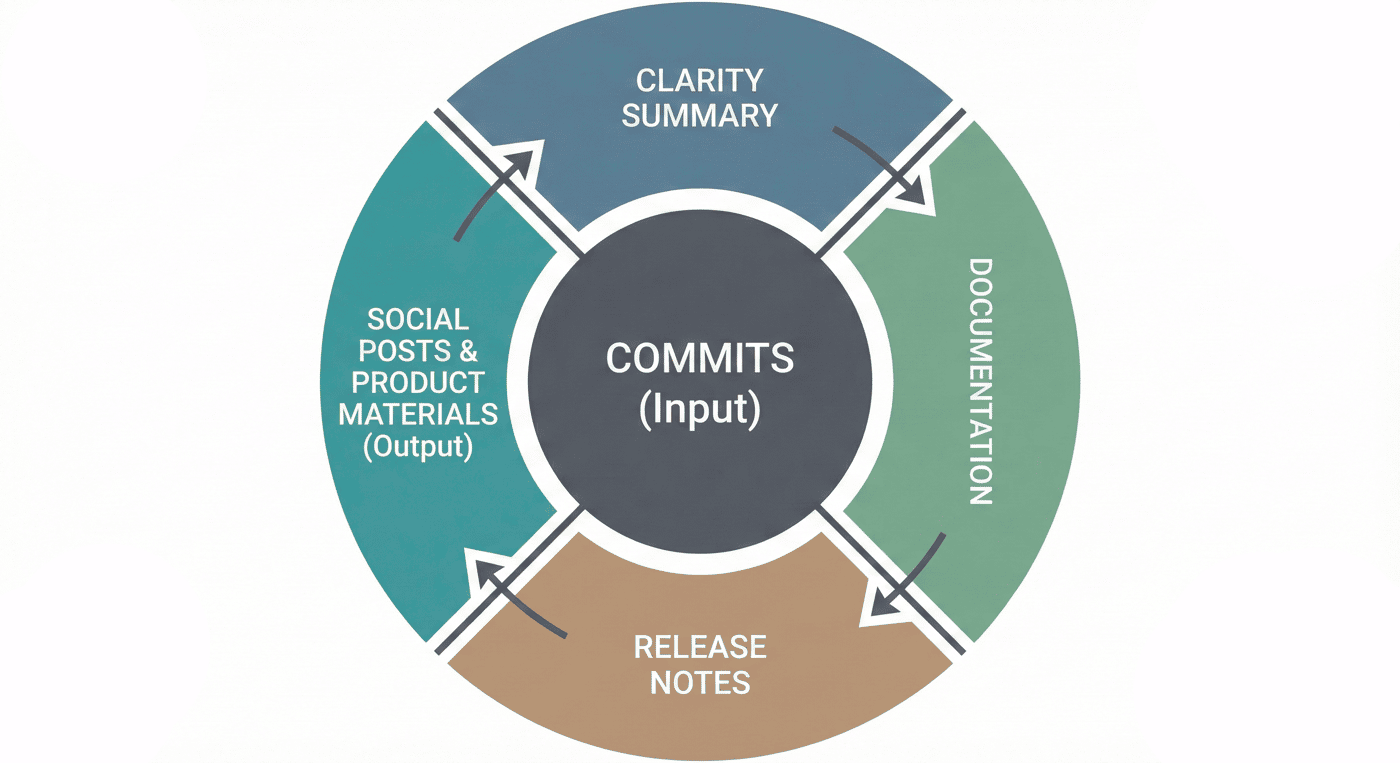
“Commits in → clarity out.”
You push code → it automatically creates:
human-readable summaries
release notes
tiny visuals
shareable social posts
internal docs
No rewriting. No blank pages. Just clarity generated from what you already did.
Curious what’s the one type of “post-shipping work” you always avoid or delay?


This is a smart observation—most dev tools solve coding problems, but the real friction is communication.
A few strategic points:
Documentation as a bottleneck: Developers ship features, but without clear summaries or release notes, value isn’t perceived by users or teams. Automating this solves a high-friction, low-glamour problem.
Multi-output leverage: Generating human-readable summaries, visuals, social posts, and internal docs from commits hits multiple audiences at once—users, internal teams, and stakeholders—without extra effort.
Adoption driver: Tools that save time on tedious but essential tasks often get embedded quickly in workflows. Developers love anything that reduces cognitive load while keeping them “responsible” for communication.
Positioning: “Commits in → clarity out” is concise and instantly communicates the benefit. Framing it as clarity automation rather than a documentation tool could resonate even more with busy teams.
This could become the go-to tool for teams that ship fast but struggle to make progress visible. Curious how you plan to handle formatting differences across platforms while keeping summaries readable and concise.
Really appreciate the thoughtful breakdown. You hit a lot of the underlying assumptions we’re (or me mostly) building on.
Especially the idea of “clarity automation” instead of just documentation. That’s much closer to how it feels in practice.
On formatting: the plan isn’t to dump a generic summary everywhere, but to treat each output type as its own “view” of the same underlying understanding.
The engine produces a structured representation first (what changed, why it changed, impact, surfaces touched), and the formats are generated from that. So a release note, a tweet-sized update, and an internal doc aren’t separate prompts, but different renderings of the same source truth.
This keeps things readable, platform-appropriate, and concise without losing consistency.
There’s still work to do on fine-tuning tone and brevity per platform, but the core idea is:
one understanding → many outputs, rather than rewriting the same thing in different ways.
Curious if there are specific formats you’ve found consistently tricky to get right?