Show IH: Final Technical Audit of Hippo Strategy Engine (FIFA World Cup 2026)
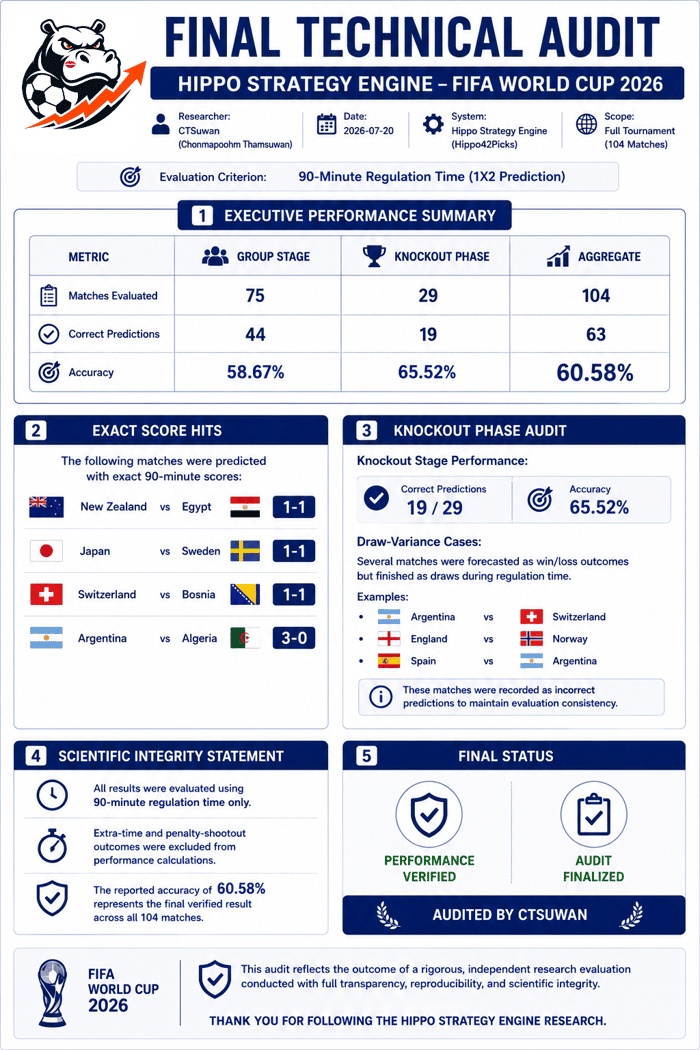
As part of the ongoing evaluation of my predictive analytics frameworks, today I'm sharing the final technical audit of the Hippo Strategy Engine (Hippo42Picks) across the complete FIFA World Cup 2026 tournament (104 matches).
Like my optimization work, this evaluation follows one core principle:
Strict 90-minute regulation time normalization.
No extra-time inclusions.
No post-hoc adjustment.
No over-claiming.
Evaluation Coverage
The published audit covers:
• Group Stage: 75 public matches
• Knockout Phase: 29 public matches
• Total: 104 matches evaluated
Methodological Rigor & Draw-Variance
In the Knockout Phase, 5 matches were forecasted as explicit Win/Loss outcomes but concluded as draws at the 90-minute mark.
Under our strict audit protocol, these matches were recorded as Incorrect Predictions to maintain evaluation consistency and analytical integrity.
Performance Breakdown
• Group Stage: 44/75 correct (58.67%)
• Knockout Phase: 19/29 correct (65.52%)
• Aggregate Accuracy: 63/104 (60.58%)
Exact Score Hits (90-Min Regulation)
The engine also produced exact score matches, including:
• New Zealand vs Egypt (1-1)
• Japan vs Sweden (1-1)
• Switzerland vs Bosnia (1-1)
• Argentina vs Algeria (3-0)
The Bigger Idea
Predictive analytics in sports often suffers from survivorship bias and post-hoc boundary shifts.
My long-term goal is to build reproducible, highly deterministic decision-support systems that deliver verifiable, market-beating predictive stability under complex real-time environments.
Achieving a 60.58% 1X2 accuracy across 104 matches establishes a transparent baseline for the engine's underlying architecture.
🌐 https://hippo42picks.onrender.com
Repository:
https://github.com/CT1-deMo-goG/AI-Research-Portfolio
C.T.Suwan

My bad! 😅
Just noticed while coming back to update the URL that I accidentally attached a screenshot from my GSL project instead of HippoEngine (Audit WC 2026).
Apologies for the mix-up!
I've updated the project URL to: https://hippo42picks.vercel.app
Please update your link if you had the old one bookmarked.
I appreciate that you're being explicit about the evaluation rules instead of adjusting them after seeing the results.
Keeping the methodology consistent across the entire tournament makes it much easier for others to judge the system on its own terms. I'll be interested to see how those same rules hold up across future competitions.
Thanks, Aryan. That's exactly the goal.
Whether the result is good or bad, I try to keep the evaluation framework fixed and reproducible so the numbers can stand on their own.
The real test is long-term consistency across different competitions and datasets, so I'll continue publishing the results under the same audit methodology.
Appreciate you following the work.