Show IH: I built a free tool to find your ICP from LinkedIn profiles
Something I underestimated when starting my SaaS: figuring out your ICP is way easier in hindsight than upfront.
You start with something vague like "we sell to media companies" or "we target agencies" and that feels fine. Then you look at who's actually replying, booking calls, buying, and renewing, and the real pattern turns out to be much more specific than that.
It's not just the company type. The role matters, how senior they are, the industry, how they talk about their own work, what they post about, the problems they're clearly close to, who else is in their orbit on LinkedIn.
LinkedIn actually became pretty useful for us here. Not for cold outreach, but for studying our best fit people. We'd go look at customers, almost-customers, people engaging with industry posts, and people we thought would be a great fit, then try to spot what they had in common.
Worked okay but it was slow and pretty manual.
So we built a small free tool around it: https://linkedpanda.com/tool/icp-finder
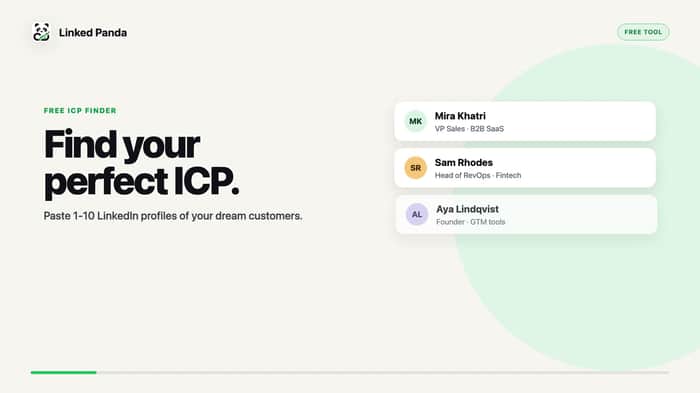
You drop in 1 to 10 LinkedIn profiles of people who'd be ideal customers (current customers, dream customers, warm leads, anyone you keep seeing in your niche). It looks for the common pattern and sends you a report on who your ICP actually seems to be.
The idea is pretty simple. Instead of staring at a blank page trying to define your ICP from scratch, start with real people who already look like great customers and work backwards.
Probably most useful if you're doing founder-led sales, still testing a niche, or getting LinkedIn engagement but not sure who's worth paying attention to.
Also launched on Product Hunt today, would really appreciate an upvote or comment if it feels useful: https://www.producthunt.com/products/icp-finder-by-linked-panda
If you try it, would love to know whether the report matches how you currently think about your ICP.

Full disclosure: I sell in this space — Avery Lin (avrlin). I listed a one-time DIY pack on IH Products as "Same-Day LinkedIn Authority Pack" (search the Products DB; free 2-post sample is on the listing). Sold via an AI assistant storefront — also disclosed.
Cool angle on ICP-from-profiles. The gap I keep hitting with solopreneurs is the step after you know who to talk to: the profile itself still reads like a job-seeker resume, and the first week of posts never ships because blank-draft paralysis wins. Free ICP tooling + a crisp offer sentence on the profile are complementary jobs — one finds the room, the other stops you sounding generic once you're in it.
Curious whether users who nail ICP with your tool still stall on what to publish next, or whether clarifying the buyer already unlocks the posting habit?
This is a really interesting angle on ICP discovery, especially the idea of turning LinkedIn profiles into something more structured and actionable instead of just static data.
I’ve noticed most ICP work still feels overly manual or too abstract, so anything that reduces the gap between “who you think you want” and “who actually matches behaviorally” is valuable.
Curious how you’re handling edge cases where profiles are incomplete or titles don’t really reflect the actual buying role.
Useful tool. The thing most founders get wrong with ICP work is analyzing only their current customers, which encodes whoever happened to find you, not who you should be selling to. If your first ten customers came from your network or one Hacker News thread, your 'ICP' is going to look like 'people who read HN' rather than your actual target. The version of this tool I would pay for is one that lets me drop in 5 current customers and 5 dream-fit prospects who haven't bought yet, and tells me where the gap is. Closing that gap is the actual sales playbook.
Hi @GregoryScottHenson, indeed there is sometimes a mismatch between current and ideal customers. This is free and you can do 5 current customers and then 5 dream fit customers and see the differences. Give it a try and let me know how it works.
(sorry for the big delay on the reply, but I didn't receive the comments notifications)
Interesting concept. How do you validate that the ICP matches reality? Curious about your feedback loop.
Send this direct:
LinkedPanda is useful, but the name may cap how seriously this gets taken.
The product is not just “LinkedIn profile analysis.”
It is buyer pattern detection.
That’s a stronger category than the current name suggests.
If this grows into ICP intelligence, lead scoring, and founder-led sales research, a cleaner SaaS-style .com would age better.
Beryxa.com or Xevoa.com would fit this direction much better.