Show IH: I built a multi-agent AI naming tool that replicates a $50K branding agency process
Hey!
I've been working on Vibelo (https://vibelo.ai) — an AI business name generator that uses multiple AI agents to create names the way professional naming agencies do (think Lexicon Branding, who named Sonos, Pentium, Blackberry).
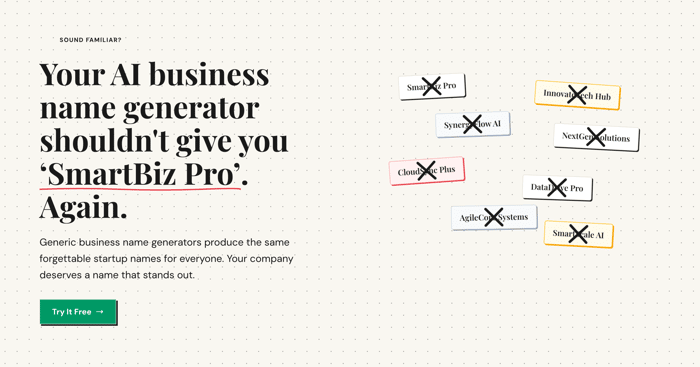
Most AI name generators just prompt GPT with "give me 10 business names for X" and you get the same generic [Adjective][Noun] pattern every time. NovaTech. BrightPath. SwiftFlow. They're forgettable because they're comfortable — and as David Placek (founder of Lexicon Branding) says: "there is no power in comfort."
I wanted to build something that actually applies naming science.
The pipeline
The whole thing runs as a 6-stage pipeline that streams progress to the UI via SSE:
Stage 1 — Discovery Agent (GPT-4o-mini)
Analyzes the business and produces a strategic brief: behavior goals, experience goals, competitive landscape, words to avoid, and semantic anchors (metaphors, foreign roots, etc). It also picks a "tangential category" and a "disguised context" — more on why below.
Stage 2 — 3 Creative Agents in parallel (GPT-5-mini)
This is the core insight. Instead of one prompt, three separate agents generate ~30 names each from completely different angles:
- Direct team — works from the strategic brief honestly
- Disguised team — told they're naming something in an adjacent industry. Frees them from category conventions.
- Tangential team — told they're naming something completely unrelated (like "a premium bicycle brand" when the actual business is a SaaS tool). This unlocks unexpected metaphors and physical, tangible language.
All three have strict constraints: max 10 characters, must have semantic roots (no random syllable soup like "Zafre" or "Lomiva"), and absolutely no generic suffixes (-ify, -ly, -hub, etc).
Stage 3 — Linguistic Analysis (GPT-4o-mini)
The ~90 names get analyzed using actual psycholinguistic principles:
- Sound symbolism — certain sounds carry meaning (V feels vibrant, S feels smooth, K/T/P feel sharp)
- Bouba/Kiki effect — round sounds (b, m, l, o) feel friendly; sharp sounds (k, t, p, i) feel edgy
- Processing fluency — how easy is it to say, spell, remember?
- Distinctiveness — Von Restorff effect, does it stand out?
Each name gets a 0-100 score. Top 25 survive.
Stage 4 — Domain checking (name.com API)
Checks ~280 domains across 7 TLDs and multiple variations (base name, name+hq, name+app, etc). Domain availability influences ranking but doesn't dominate it — a great name with a .io beats a mediocre name with a .com.
Stage 5 — Synthesis (Claude Opus 4.5)
This is where I use Claude instead of OpenAI. The final ranking requires nuanced judgment — balancing semantic relevance, brand fit, boldness, polarization potential, domain availability, and sound symbolism all at once. Claude is noticeably better at this kind of holistic trade-off reasoning.
The ranking explicitly rewards names that are uncomfortable. If a name would make a committee nervous, that's a signal it might be good.
Stage 6 — Trademark screening (USPTO API)
All 10 final names get checked against the USPTO trademark database, cross-referenced with the relevant Nice classification classes detected in Stage 1. Each name gets a clear/caution/conflict status.
The two-model strategy
Using OpenAI for generation/analysis and Claude for synthesis wasn't an ideological choice — it was practical. GPT-4o-mini is fast and cheap for structured output. Running 3 creative agents + a linguistic filter in parallel would be expensive with Opus. But for the final ranking where quality of judgment matters most, Claude is worth the cost.
How it works for users
The whole pipeline runs in 30-60 seconds and streams real-time progress. Users see one name for free, pay $5 to unlock all 10 with full linguistic breakdowns, domain data, and trademark status.
Tech stack
Next.js, Vercel AI SDK, Firestore, Stripe, Firebase App Hosting. The streaming uses Server-Sent Events with a monotonic progress tracker (progress can never go backwards — small detail but it matters for UX).
Happy to answer questions about the agent architecture or the linguistic science stuff. Would love feedback — try it out and let me know what you think of the names it generates vs. what you'd get from ChatGPT.
