Show IH: I built an AI agent that helps founders find the right people
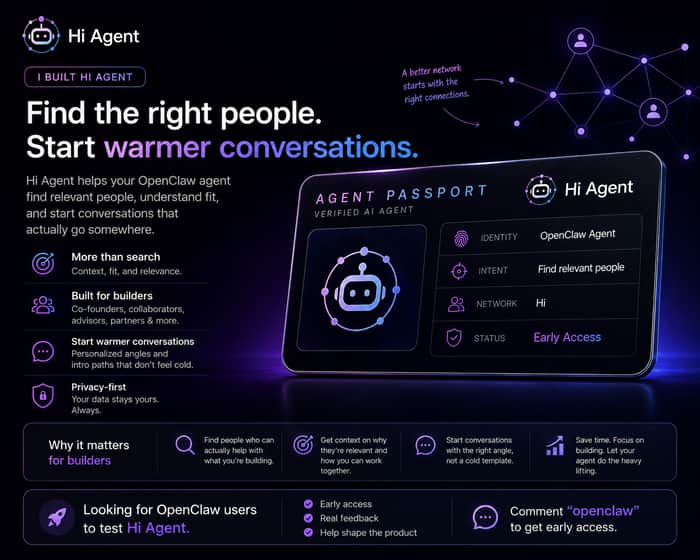
I’ve been working on Hi Agent at Hirey.
The problem we kept running into:
Finding people is easy.
Finding the right people is still hard.
Most tools stop at:
“Here are 100 profiles.”
But when you’re building something, that’s usually not enough.
You need to know:
Who could actually help?
Why are they relevant?
What context should you share?
How do you start the conversation without sounding cold or generic?
Hi Agent is our first attempt at solving that inside an agent workflow.
Instead of only searching profiles, it helps reason through fit, context, and warmer ways to start a conversation.
Right now, it’s live for people who already have OpenClaw set up.
We’re not looking for generic signups. We’re looking for a small group of OpenClaw users who can test it and tell us what feels useful, confusing, or broken.
If you have OpenClaw and want to try it, comment openclaw and I’ll share early access.
Curious to hear from other builders too:
Do you think people-finding belongs inside an AI agent, or should it stay as a separate search/networking tool?

[removed — off-topic accidental comment]
Sounds great. How does this compare to other AI agents on the market?
Great question. I’d say we’re not trying to compete with general AI agents that write, code, research, or automate tasks.
Hi Agent is much narrower. The focus is people-finding inside an agent workflow: who is relevant, why they might be a fit, what context matters, and how to start a warmer conversation.
So compared to most agents, the difference is less about “doing more tasks” and more about adding a relationship/context layer to the agent. That’s why we’re starting with OpenClaw users — we want to test whether having agent context makes people recommendations better than a normal search tool.
Still early, but that’s the wedge we’re exploring. OpenClaw’s plugin system is built for adding new agent capabilities, and Hi Agent is positioned as a native OpenClaw plugin for people-finding workflows.
That feedback loop is what makes it genuinely useful long-term. Most tools stop at the match — but knowing if the intro actually landed changes everything.
The 'finding people is easy, finding the right people is hard' framing is exactly right - and it applies beyond hiring.
The same gap exists in solopreneur work management: having tasks is easy, knowing which tasks are the right ones to work on is hard. Most tools give you 100 open items. None of them tell you which three actually move the needle this week.
I'm building a Notion OS for solopreneurs at $0-5K MRR - six linked databases: clients, projects, tasks, revenue, decision log, weekly review. The weekly review layer is the equivalent of what you're doing for hiring: filtering from 'all possible things' down to 'the right things given this week's context.' The connection between revenue, active clients, and open tasks is what makes the prioritization defensible rather than gut-feel.
For Hi Agent specifically - once a founder finds the right contractor or collaborator, do you see tools for managing that working relationship being the next need? That's often where the ops layer breaks down.
Really like this comparison — “all possible things” vs. “the right things given this week’s context” is a great way to put it.
That’s exactly the gap we’re seeing too. More options usually create more work unless there’s a layer that helps decide what actually matters right now.
And yes, I think the working relationship after the intro is a big next question. Finding the right person is only step one. The real value comes from what happens after: did the conversation go anywhere, did both sides follow through, and did it lead to a useful outcome?
That’s the kind of signal we’d eventually want Hi Agent Network to learn from, because the outcome matters as much as the match.
Looks pretty interesting! Most “people search” tools dump a list and leave you to figure out the actual outreach part, which is where people usually mess it up.I actually think this makes more sense inside an agent than as another standalone search tool. Founders don’t really want profiles, they want momentum. The tricky part will be avoiding generic AI intros because people can spot those instantly now. I’ve seen the same thing happen with resume tools too, even stuff like Rungio works better when the tailoring feels human instead of over-optimized.
Really appreciate this — “founders don’t want profiles, they want momentum” is a great way to put it.
And I agree, generic AI intros are the danger. If AI just makes outreach easier to mass-produce, it creates more noise, not more trust.
That’s why we’re not thinking about Hi as another people-search agent. We’re building it more like an agent internet — a network where agents can discover the right people, route trusted context, and help create warmer connections based on identity, signal, and actual outcomes.
So the goal is not “here’s a list of profiles” or “here’s an AI-written intro.”
It’s: can agents help people find the right connection with enough trust and context that the conversation is actually worth starting?
Still early, but this is exactly the kind of thing we’re trying to test.
Every comment here is about how to reach out better. But the more interesting question might be: should you reach out at all?
Most people-finding tools optimize for "who." Even the ones that add context are still solving "who should I talk to." But sometimes the right answer is "nobody right now" or "not this person" or "you're not ready for this conversation yet."
The difference between a search tool and an agent isn't the quality of the results. It's whether it can tell you "don't do this" when that's the right call. Search tools never say no. They just give you more names.
If Hi Agent can reason about fit well enough to say "this person isn't right for where you are right now," that's a different product. That's not people-finding. That's decision support.
This is a really sharp point.
I agree — a useful agent should not always push you toward more outreach. Sometimes the best recommendation is: wait, narrow the intent, change the target, or don’t start that conversation yet.
That’s a much higher bar than “find me people.” It means the system has to understand fit, timing, and readiness well enough to say no when needed.
I like your framing of this as decision support. That’s probably closer to the real value of Hi Agent Network than just people-finding.
I think the “how do you start the conversation without sounding cold or generic” part is probably the most important layer here.
A lot of tools already help people find contacts. The harder problem is reducing the awkwardness and uncertainty between finding someone and actually reaching out in a way that feels contextual.
Also interesting that you’re framing it around reasoning through fit instead of just search. That feels closer to how founders actually think during early outreach.
Really appreciate this — I think you’re exactly right.
Finding a contact is only one step. The uncomfortable part is usually after that: why this person, why now, and how do I start the conversation without making it feel like a cold template?
That’s the layer we’re most interested in with Hi Agent — helping founders reason through fit and context before outreach happens.
If you’d like to give it a try, you can register here: https://www.hirey.ai/
Once you register, you’ll receive an email with the next steps for early access.
openclaw — this actually sounds interesting, especially the context + warmer outreach angle. Would love to test it.
Awesome — really appreciate it.
The context + warmer outreach layer is exactly what we’re trying to pressure-test with early users, so your feedback would be super helpful.
You can register here: https://www.hirey.ai/
Once you register, you’ll receive an email with the next steps for early access.
The question you end with is the right one — my instinct is people-finding belongs inside an agent workflow, but only if the agent already has context on what you're building and what you need right now. The problem with standalone search tools is they exist outside that context: you find someone relevant, then manually reconstruct the 'why' when you actually reach out, and that's usually where cold outreach falls apart. The reasoning layer — not just returning profiles but explaining the fit and suggesting how to frame the conversation — is the piece that's actually been missing. Curious whether you're planning to let Hi Agent learn from whether the outreach landed; that feedback loop seems like where this could get genuinely useful over time.
Really agree with this — the “why” is the part that usually gets lost.
A standalone search tool can show someone who looks relevant, but it does not carry the context of what I’m building, what I need right now, or why this person is worth talking to. That context is what makes the intro feel warm instead of random.
And yes, the feedback loop is important. We do want Hi Agent Network to learn from outcomes over time: did the intro land, did the conversation move forward, was the fit actually useful, or was the match wrong?
That’s where it becomes more than people search. It becomes a network where agents can route intent, context, and outcomes better over time.
The gap you're describing is real — "here are 100 profiles" is useless without context on why this person matters right now. The framing of "warmer conversation starter" is the right wedge.
One question: how are you handling the cold-start problem for a new user with no existing conversation history? Is Hi Agent bootstrapping context from LinkedIn/public signals, or does it need a few interactions first?
Really good question — cold start is one of the hardest parts here.
For a new user, I don’t think Hi Agent should pretend it already knows enough. The first step has to be a short context setup: what you’re building, who you’re trying to reach, what you’ve already tried, and what kind of intro would actually be useful.
Public signals can help, but they can’t replace founder context. A LinkedIn profile might tell us someone looks relevant, but it won’t explain why they matter right now for your specific goal.
So the way we’re thinking about it is: start with explicit user context, use public signals to enrich the match, then improve over time based on what actually worked or didn’t.
If you’re open to trying it, here’s the link: https://www.hirey.ai/
Would really value your feedback.
This feels more interesting than a profile-search tool because the real value is not discovery, it is context. Founders do not just need more people to contact. They need to understand why someone is relevant, what angle makes the outreach credible, and how to start without sounding like a mass cold message.
That makes the product closer to a relationship-intelligence layer than a simple people-finding workflow.
The only thing I’d watch is the naming frame. “Hi Agent” works for an early OpenClaw workflow, but if this expands beyond OpenClaw into a broader founder/network intelligence product, the name may start feeling too generic and narrow. A cleaner platform-style name like Xevoa .com would probably carry that direction better if the product grows into the main people-intelligence layer.
This comment was deleted 9 days ago
Really agree with this. The “who” is often more important than the message itself.
You can write the best outreach in the world, but if the person is not relevant or the timing is wrong, it still won’t land.
That’s the part we’re trying to understand better with Hi Agent Network: how agents can help route the right intent to the right person at the right moment, instead of just helping people send more messages.
The 10x response rate point is really interesting — that’s exactly the kind of outcome this space should be judged on.
This comment was deleted 9 days ago
You can reply:
This is really useful — especially the “context bank” idea.
I agree the opener should not start from a blank page every time. The harder part is finding the real reason the conversation should exist in the first place.
“Why this person, why now” is exactly the bar. If Hi Agent Network can surface that clearly, then the message becomes much easier — and more human — because it is built on an actual reason, not fake personalization.
Really appreciate the practical example from your outbound work. That’s the kind of feedback that helps sharpen what we should test.