Show IH: I built RamenHire — a job board exclusively for bootstrapped, profitable startups
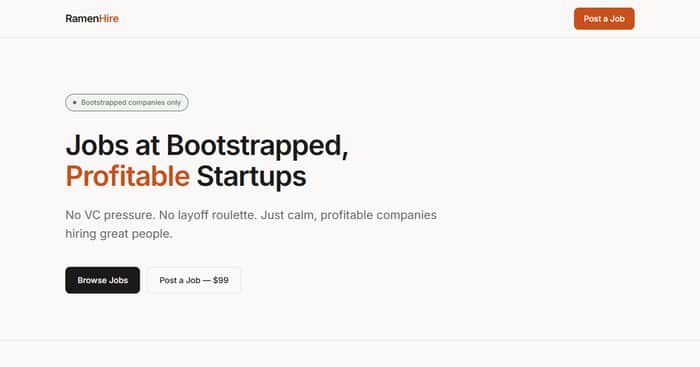
Hey Indie Hackers 👋
I'm currently validating RamenHire 🍜 — a job board exclusively
for bootstrapped, self-funded startups — and would love this
community's honest take.
Here's where I am and what I'm trying to figure out...
The problem
A friend got laid off from his third "high-growth" startup in
four years. Great engineer. Terrible luck with employers chasing
runway instead of revenue.
There are thousands of calm, profitable, bootstrapped companies hiring right now — Basecamp, Plausible, Transistor, Payhip.
But there's nowhere to find jobs at them specifically. LinkedIn
and Indeed are flooded with VC-backed startups. That's the gap
I'm filling.
What I built
A job board where every listing is verified, bootstrapped:
- No VC funding
- Profitable or ramen profitable
- Calm, founder-run culture
Where I am
Launched last week. Currently in validation mode:
- 42 users from 10 countries in the first few days
- 0 paying customers yet (all posts free during early access)
- Built entirely with Claude Code in about a week
The honest tech stack
Next.js + Supabase + Tailwind + Vercel + Resend for
admin notifications. Local development with Docker +
Supabase CLI.
What I'm figuring out
- When to introduce pricing (Stripe is next once validated)
- How to get real bootstrapped companies to post jobs
- Whether the "verified bootstrapped" angle is a strong
enough differentiator
I'd love your honest take
- Would you use this as a job seeker?
- If you run a bootstrapped company and are hiring —
Would you post here? The first listing is free. - What's missing?

42 signups and 0 paying customers isn't the real risk this early, the risk is that you're optimizing for job seekers when your actual ICP is the employers who need to pay to post. Job seekers are cheap to attract and tell you nothing about whether the idea works.
I'd narrow first to solo or small bootstrapped SaaS founders who've already complained publicly about hiring through noisy VC-flooded boards, they're the segment most likely to feel this pain hard enough to pay.
Quick test: DM 15-20 founders who've openly ranted about hiring on X or IH, get them to post one free listing, then track who comes back for a second post without you chasing them. That repeat behavior is your real signal, not the country count.
If you want to see how this exact pain (VC-flooded job boards) ranks against other bootstrapped hiring complaints already out there, worth running it through a pain point tool to check the pattern before you build Stripe in.
This is a good sharpening, thanks. There's already a first wave planned — outreach to 13 companies whose roles I've already curated on the site, starting this week — so I'm not starting from zero on the employer side. But your point about the metric is the part I'm actually taking: I was tracking registrations, and you're right that a second unprompted post is the real signal, not the first one I chased them into.
The DM-founders-who've-already-complained idea is a good second wave once the first round tells me anything. Curious what you'd consider a good repeat-post rate before you'd call the pain real — is there a rough number you'd want to see out of that first 15-20, or is it more "any at all" this early?
I think the strongest part isn't that it's another job board—it's that you're making company funding philosophy part of the hiring criteria.
For a lot of candidates, "bootstrapped" is becoming a signal for how a company operates, not just how it's financed. That's a much more meaningful filter than industry or job title.
This is exactly the reframe I needed to hear — and honestly
a better way to describe RamenHire than I've been using.
"Company funding philosophy as a hiring filter" captures
something real. When a candidate sees "bootstrapped" they're
not just learning how the company is financed — they're
inferring things about decision-making speed, who has power,
whether growth comes from revenue or runway, and whether
layoffs happen because a funding round fell through.
That's a much denser signal than "Series B SaaS startup
in fintech" which tells you almost nothing about what
working there actually feels like.
Going to update how I describe RamenHire based on this.
Thank you for putting it so clearly.
Interesting.
Your reply actually made me think about the consequence of that reframe in a way I hadn't before.
I don't think it's obvious at first glance, and I don't think I can explain the reasoning properly in a thread without flattening it.
If you're open to it, what's the best email to reach you on?
Absolutely — always open to conversations that go
deeper than a thread allows.
You can reach me at ramenhire.contact@gmail.com
Looking forward to hearing your thinking.
Thanks! I’ve just sent it over.
Looking forward to hearing your thoughts whenever you have a chance.
Great, I myself got laid off from 2 early stage startups, They referred me to another company so it wasn't that bad but I understand the pain here.
That's exactly the pain point — and what makes it worse is
that being referred to another company is the exception, not
the rule. Most people just absorb the hit and start over.
The pattern you're describing (2 early stage layoffs) is
actually what RamenHire is trying to solve from the other
direction — if more people could find and choose bootstrapped
companies upfront, they'd be opting into stability rather than
hoping for it.
Appreciate you sharing that. Would you have used something
like RamenHire when you were looking?