Show IH: Most SaaS companies can't explain what their product does in under a minute. I built a tool that does it for them
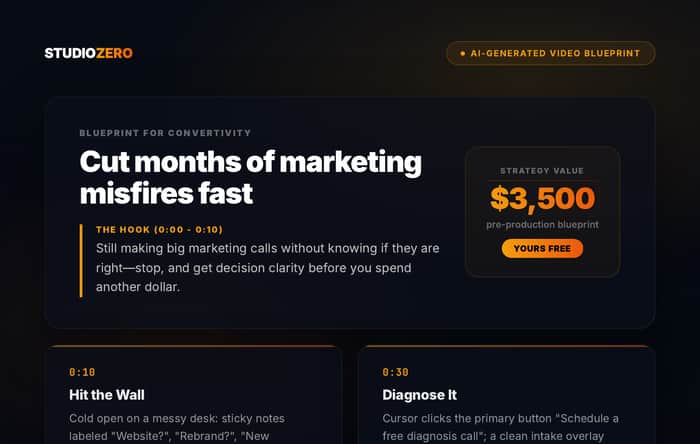
If your homepage isn't converting, the problem usually isn't design. It's narrative. The gap between what your product actually does and how you explain it is where you lose people.
I make product videos for SaaS companies. Before anything gets produced, there's always a research phase - we dig into the client's site, find the gap between what the product does and how it's positioned, then map out the hook, the beats, and the screen flow. This typically runs $3,000-5,000 in the industry.
I kept doing this manually and realized most of it is pattern recognition. So I built a system that does it automatically.
How it works
- You fill a 2-min form (company, website, audience, top flow)
- The system reads your actual homepage - real copy, real buttons, real CTAs
- A heavily engineered prompt generates the blueprint using YOUR terminology, not generic "user sees dashboard" filler
- A styled PDF gets rendered with a hook, 3 beats, timestamps, and a CTA
- You submit the form, go make coffee, and by the time you're back there's a PDF in your inbox
Stack: Lovable (form) → Make.com (orchestration) → Firecrawl (site analysis) → GPT → CloudConvert → Gmail API.
What made it actually work
Early versions were generic. GPT kept producing "User navigates to the dashboard and sees key metrics." Useless.
The turning point was feeding GPT the actual website content. Once it had real button labels, real feature names, real headlines - the output went from "this could be any company" to "this is clearly about YOUR product." That single change was everything.
The business model
Full transparency: the blueprint is our top of funnel. But it's not bait - it's a real deliverable. You can take it to any video studio, hand it to your in-house team, or just use it to rethink your homepage narrative. If you want us to produce the video, great. If not, you still walk away with something useful.
What I learned
The biggest surprise was how much the prompt matters vs. the automation. I spent more time rewriting the prompt than building the entire Make.com flow. Getting AI to be specific instead of generic is 90% of the work. The plumbing is easy. The thinking is hard.
Try it
Two minutes. Free. Does the output feel specific to your product, or does it still read like AI filler? That's the one thing I'm trying to nail.
Bootstrapped from Thailand 🇹🇭
