Show IH: Why I’m building Sitemanifest to stop the Trustpilot pay-to-play game
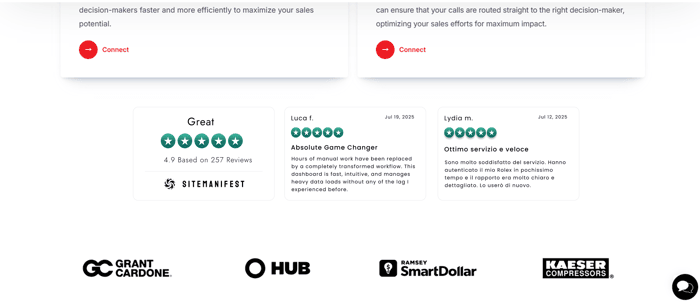
Why I’m building Sitemanifest: A "Closed Loop" for reviews to stop the Trustpilot pay-to-play game
Right now, online reviews are fundamentally broken. Competitors can "bomb" you with fake 1-star reviews, and "verified" status on big platforms often just means the business paid a monthly subscription fee. Your reputation shouldn't be held hostage by a paywall. I’m building Sitemanifest to move reviews from "Open Season" to a strictly verified workflow where integrity is the only currency.
The core of Sitemanifest is an automated verification loop. When a business uploads a customer's email, our system sends out a direct invitation. These invited users can leave a review as a guest with zero friction—they don't need a complex signup because their identity is already tied to a verified contact event.
But the real differentiator is our "Screen-to-Review" system. Businesses can upload screenshots of real chats and interactions directly to our platform (since many businesses get their best feedback in private chats). We then moderate these uploads manually and via AI to ensure the tone of the review matches the actual conversation in the screenshot. If it’s a match, the review is accepted and immediately pushed to our customizable web widgets.
Beyond invitations, every single review—whether from an invited guest or a regular user—undergoes a multi-point security check. We run behavioral analysis, IP integrity checks, and device fingerprinting to ensure that a single bad actor isn't spinning up 50 "guest" reviews from the same machine. To keep everyone honest long-term, we run random monthly audits. If a business can't provide proof of a specific interaction during an audit, those reviews are frozen immediately.
For the SEO side, we’ve built this to be "Google-first." Every verified review is injected into a clean Schema.org JSON-LD graph, so businesses actually get the star snippets in search results that stay there because they are backed by real data. I’ve built the widgets to be ultra-lightweight JS embeds that don't tank your LCP or site speed.
By making proof of service mandatory, we make competitor bombing and review buying mathematically expensive. We are choosing a higher barrier to entry because we believe the highest quality reviews are worth the extra thirty seconds of effort. I’ve built this using a Next.js frontend with a Supabase backend for strict data integrity via Row Level Security (RLS).
I’m Omar, I’m 23, and I’m building this out of Tbilisi. I’m looking for 5-10 beta testers who are tired of the current review traps and want a widget that actually proves they are the real deal. I’d love to hear your thoughts on whether this level of mandatory proof is the right move, or if the friction is too high for the average user.

Really interesting idea — especially the focus on verified reviews and trust.
One thing that stood out is that the concept might feel a bit complex for first-time users.
If users don’t quickly understand the value and how simple it is, they might not engage as much as expected.
There might be a small onboarding/clarity issue affecting that.
Happy to share a quick audit if helpful.
Thank you, I Really appreciate you feedback
Thanks For Sharing Looks very Interesting.
This hits hard. Trustpilot's "pay to play" model has quietly broken trust in review platforms — businesses feel forced to buy ads just to surface genuine positive reviews, while negative ones stay visible regardless. If Sitemanifest delivers a fair, transparent alternative where money doesn't influence visibility, you'll have every frustrated SMB owner on your side. Curious: how do you plan to handle fake reviews and verification without introducing a different kind of paywall? Huge respect for taking this on.
Congrats Omar. The Screen-to-Review angle is honestly the sharpest thing I've seen
in this space. And friction over volume is the right bet. You want trust baked in
from day 1, not patched in later.
FYI we're on the exact same stack (Next.js + Supabase), also solo. Happy to compare
notes on RLS patterns anytime.
One flag for later: once those first beta users land, they'll ping you "is
Sitemanifest down?" at the worst times. I hit that on my own side project and ended
up building StatusPageBuddy for exactly that. Free, 60 seconds to set up, no YAML.
Filing it away in case it's useful later.
Rooting for this.
The “proof over openness” angle is interesting. It makes sense from a trust perspective, but it feels like the trade-off is always friction. The more you tighten verification, the harder it becomes to get volume, especially from users who wouldn’t normally leave a review at all.
The screenshot matching is a clever idea though, that’s probably closer to how real feedback actually happens.
Feels like the challenge is whether you can get enough participation for it to be useful, not just accurate.
Have you seen any drop-off in response rates with the added steps?
Hi Rebecca,
You're absolutely right—verification creates friction, and for Sitemanifest, that is a feature, not a bug.
The 'open-door' policy of traditional aggregators is exactly what enables competitor bombing, review buying, and AI-generated spam. By tightening the gates, we mathematically eliminate the noise that plagues the industry.
We have intentionally shifted the focus toward Direct Invited Reviews and our Screenshot-to-Review flow. While this approach naturally leads to a lower volume of reviews compared to legacy platforms, it results in a significantly higher trust signal.
"Omar, the 'Screen-to-Review' AI moderation is a brilliant way to capture the high-trust feedback that usually dies in private DMs. The 'Trustpilot tax' is a real pain point for lean founders, so a verification loop that prioritizes integrity over a subscription fee is a huge win.
I'm actually building a Tokyo-based ideas competition (Tokyo Lore) where we’re using a similar 'Closed Loop' logic to verify entrants. I’d love to get your eyes on our model—I have a specific question about how we could use Sitemanifest to verify our own competition winners. "
Really appreciate the insight. Since you’re building a high-integrity ecosystem with Tokyo Lore, I want to move beyond a standard 'user' relationship.
I’d like to offer you Founding Partner access: this includes the full 'Trust Tier' for 12 months and, more importantly, direct input into our Roadmap. We want Sitemanifest to solve the exact 'Closed Loop' verification hurdles you’re facing
Thanks Omar! Really appreciate the generous Founding Partner offer.
Before moving into partnership, I'd love to get your direct feedback on the actual model by having you submit a Tokyo-connected idea through the competition.
Would you be open to a quick $19 entry? It gives full visibility into how the closed-loop verification works.
Happy to send you the direct link and walk you through it.
Looking forward to your thoughts.