SignalsHunt one month later —the features you asked for,and the bug that humbled me
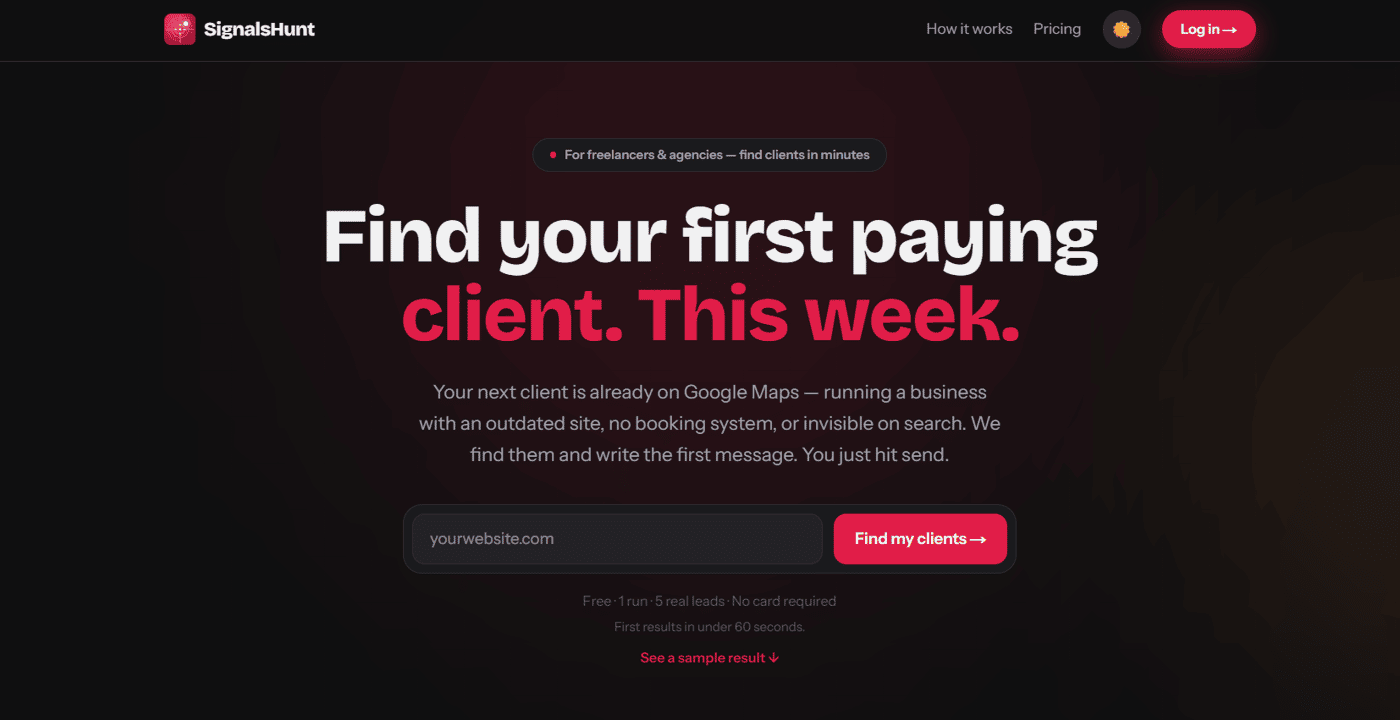
A 4 days ago I posted here about SignalsHunt and honestly didn't expect much. 200+ comments and 100+ likes later, 55 of you signed up. Thank you — genuinely. This post is what happened next: what I built because of you, what broke, and where things actually stand.
What your comments turned into
I read every comment. A bunch of you asked variations of the same thing: "how do you know WHICH business actually needs help, not just any business?" That question alone reshaped the product. Here's what shipped because of it:
Profession-specific playbooks — pick "photographer" and you now see exactly which niches to search and what to look for, instead of staring at an empty box wondering where to start
Actual problem detection — the tool now checks each lead's site for things that matter to your profession specifically: no mobile viewport for web designers, no booking widget for developers, stock photos for photographers, no social links for social media managers. It's not guessing anymore, it's pointing at something real
Call scripts — a few of you said you prefer calling over emailing for local businesses. So now every lead with a phone number gets a 20-second call script too
Tone control — direct vs. curious-question opener, because not everyone wants to sound the same, and neither do your prospects
None of this was on my roadmap a 4 days ago. It's on the product now because you asked.
Where things stand, numbers included
55 signups, 30 have run at least one search
20 of those came back and ran it 3+ times — that's the number I actually care about, because a tool people use once and forget isn't solving anything
I kept using it myself for my agency (dricomm.com): since my last post I sent 21 more messages and I'm currently mid-conversation with another potential client — nothing signed yet, but a real back-and-forth happening right now
Still no dramatic revenue story. But a tool people keep opening is worth more to me right now than one big number.
Now, the part I almost didn't write
Here's something that happened and made me feel genuinely dumb for a few days: the dashboard started randomly showing raw server code instead of the actual page. Like, literally text like :HL["/_next/static/chunks/... where a working page should be.
I "fixed" it four times. Cleared Cloudflare cache — didn't work. Reconnected the domain — worked for two minutes, then came back. Added cache headers — still came back. Each time I thought it was solved, and each time it wasn't.
Turns out the actual bug was one line, in the wrong place, the whole time: I'd added force-dynamic (a setting that tells the page "always render fresh, never cache me") to files marked 'use client' — and Next.js just silently ignores that setting in client components. Every fix I made was patching symptoms around a config flag that was never actually doing anything.
I'm not sharing this for sympathy — I'm sharing it because "building in public" usually gets shown as clean wins, and the real version is more like this: four wrong turns before the actual cause. If you're building something and something should be working but isn't — check the boring, obvious thing twice before assuming it's something complicated.
What's next
No giveaway this time — just an honest update, and the door's open if you want to try it: signalshunt.com. Free plan gets you 5 real leads, no card needed.
If you tried it last month and it didn't click, genuinely curious why — always happy to hear it, good or bad.


great, nice one especially for startups looking for credible leads
Thanks
Hi,
Since you actually run a web agency yourself, I'd love to connect. I'm building an autonomous finance copilot that act as your finance team preventing any cash, recovering the money that you. I'd love to see if this is a pain point you actually face at Dricomm.
I have mailed you at info@dricomm.com, you may check your inbox
The line that stood out to me was "mid-conversation with another potential client, nothing signed yet." That's the exact stage most prospecting tools quietly stop helping with — they're built for the first message, not the week after, when a reply comes in and then goes quiet again. Curious whether you're thinking about anything on the follow-up/tracking side, or keeping SignalsHunt scoped to the find-and-open part of the funnel on purpose.
The detail that stands out: 20 of 30 came back 3+ times. That 67% repeat rate is where the real product-market fit signal is, not the 55 signups. You're shipping profession-specific playbooks and actual problem detection instead of generic lead lists - that's the hard part of sales tools, and most people skip it.
Also, shipping that bug debugging story deserves more credit than it gets. Most build-in-public posts hide the 4-failed-attempts part. The "check the boring obvious thing twice" advice probably saved someone days of debugging this week.
The 20 who came back 3+ times is the right number to obsess over. At SocialPost.ai we ignored raw signups early and tracked who returned in week two, because that cohort told us what to build and later what to charge for. Ask those 20 what they did right before their third session, that is usually your activation moment and your onboarding fix.
I really like that you changed the product because of what users kept asking instead of sticking to the original roadmap I think thats one of the hardest things as a founder because sometimes the feedback completely changes your assumptions I'm curious was there one feature you were convinced people wanted but ended up removing or deprioritizing after seeing how they actually used the product
The line that stood out to me was "20 came back and ran it 3+ times — that's the number I actually care about." Great instinct, and honestly a healthy number this early. The one thing worth watching as it grows: repeat use can come from the leads actually landing replies, or from the search just being satisfying to run — both look the same in a usage graph. The strong signal hiding inside your 20 is how many of them sent a message and got a reply back — that's the bit that tells you it's genuinely moving the needle for people.
One-month updates are often more useful than launch posts because they show what happened after real users touched the product. The bug that humbled you is probably the most interesting part, especially if it exposed an assumption that looked correct during development. Those moments usually improve more than one feature because they change how testing, monitoring, and product decisions are handled. It would be useful to know whether the bug came from scale, user behavior, bad data, or an edge case nobody expected.
This is the kind of update that makes build-in-public content useful. Feature announcements are easy, but explaining the bug that changed the way the product is built usually reveals much more about the founder and the system. It would be interesting to know whether the bug came from an unusual edge case or from an assumption that seemed completely safe during development. Also, did fixing it change only the code, or did it lead to changes in monitoring, testing, or the product roadmap?
The "how do you know WHICH one actually needs help" question is the exact same problem I've been solving in a completely different niche (real estate off-market leads). A single distress signal isn't enough, everyone's already working the same "absentee owner" or "tax delinquent" list. The signal only gets useful when you stack 2-3 of them on the same target, since that's what separates someone who might sell from someone who's actually motivated.
Sounds like your profession-specific playbooks are solving the same underlying problem for services businesses. Curious how you're weighting multiple signals together, is it additive scoring or more of a hard filter?
This is such a smart approach to actually listening to your users. Building exactly what people asked for instead of guessing = 🔥 The profession-specific playbooks idea is genius too. So many tools try to be everything to everyone, but niche focus + solving real problems wins every time. Congrats on shipping!
Thank you!
Love seeing feedback directly shape the product. Those profession-specific checks sound much more actionable now.
Thank you!
Love the transparency, especially sharing the numbers instead of only the wins. I'm at a similar stage where I'm learning that user conversations often change the roadmap more than weeks of planning. Looking forward to seeing where SignalsHunt goes.
Thanks for your honest comment!
I really appreciate the transparency in this update. What stood out to me wasn’t just the new features, but how directly they came from user feedback. That’s often what separates a useful product from one that solves a real problem.
One idea that could make SignalsHunt even stronger is adding a lead priority or buying-intent score. If users can immediately see which prospects are most likely to need their service, they’ll spend less time deciding where to focus and more time having meaningful conversations.
I also like that you’re sharing the debugging process instead of only the wins. Those behind-the-scenes lessons are just as valuable as product updates. Looking forward to seeing how the platform evolves.
Thanks for your feedback!
The buying-intent score idea is a good one most lead tools show you volume, not urgency, which just shifts the decision fatigue instead of solving it. Curious what signals you'd use to build that score though is it based on behavior (site visits, opens) or more explicit stuff (company size, role, budget mentions)?
Great question. I’d probably separate fit from urgency rather than treat them as the same thing. Company size, role and budget signals would help establish whether someone is worth targeting, but the urgency score would lean more heavily on recent behavior and explicit triggers.
So ideally, it wouldn’t be one signal saying “this person is ready to buy,” but a combination of fit + trigger strength + recency. That feels more useful than simply ranking leads by volume. What signals have you found most reliable in practice?
This comment was deleted a month ago