Silent failures in workflow automation: the problem people aren't monitoring
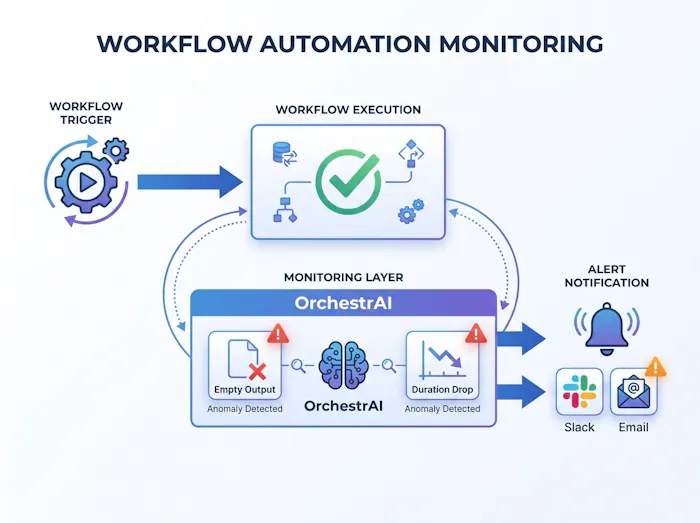
Most people running n8n, Make.com, or Zapier workflows assume that if nothing crashed, everything is fine. That assumption is wrong, and it costs people real time and money.
I have been building OrchestrAI over the past few months, a monitoring layer for workflow automation tools. The core insight that got me started: workflow platforms are built to execute, not to validate. They will happily report a workflow as "successful" even when it processed zero records, returned empty output, or skipped 12% of your users due to a silent edge case.
Here are the five failure patterns I keep seeing:
Execution count anomalies. Your workflow usually runs 40 times a day. Yesterday it ran twice. The platform does not care. You need something that does.
Empty output runs. The workflow completed but did nothing useful. Could be a broken filter, a rotated API key that was not updated, or a schema change on a third-party API.
Execution time deviation. A workflow that used to take 8 seconds now takes 0.2 seconds. It is not faster. It is hitting a short-circuit condition and bailing early.
Partial completion. The workflow reaches a branch that evaluates to nothing and quietly stops. No error logged.
Schema drift. An API upstream changed a field. Your workflow is running. It is just passing garbage data downstream.
The solution is not another uptime monitor. It is a system that learns what normal looks like for each workflow specifically: normal execution frequency, normal output volume, normal duration. Then alerts you when reality deviates from that baseline.
That is what we are building. We have detection rules running in production against a live n8n instance, alert delivery via Resend and Slack, and a React dashboard in active development.
If you are running automations in production and have been burned by a silent failure before, I would love to hear your story. And if you want early access, the waitlist is at: https://orchestrai-site.vercel.app
Happy to answer questions on the technical architecture or the detection approach.
