Simplifying the creator economy with a map
I'm doing my best to understand what's going on in the creator economy as I begin a journey of participation.
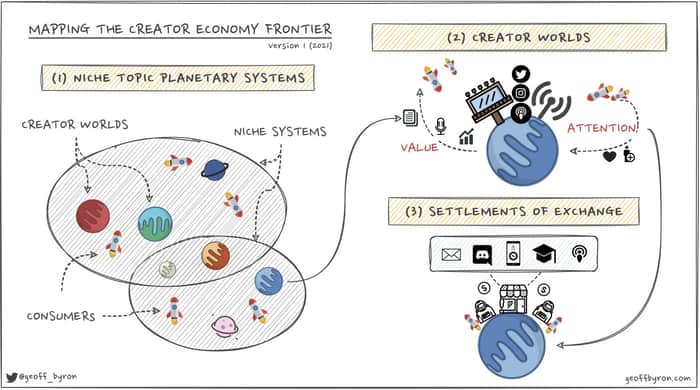
I created a map using a space frontier analogy to help me simplify the ecosystem.
The creator economy frontier map is made up of:
(1) Planetary systems
(2) Creator worlds, and
(3) Settlements of exchange
Planetary systems
- The primary organizing principle is topical niches
- A niche is represented by a system of planetary worlds, each participating in that topical niche
- Ex: Creator economy
Creator worlds
- Creator pioneers build worlds focused on exploring these topics
- A creator world contains both a topic or intersection of multiple topics + a medium to convey value
- They package their value (experience, analysis, network) into a consumable medium and broadcast it out
- In exchange, they attract consumer attention
- Ex: Tweeting best practices about building in public
Settlements of exchange
- Creating an exchange settlement is the path to financial freedom for many creators
- As stronger value <—> attention matches form, so do settlements of exchange
- Consumers (and other creators) settle in the creator’s world and buy services
- Ex: A cohort-based course on building in public
This simplified it for me, and I hope it does for you too!
What did I miss?

I like the analogy to planets. The only one that doesn't work is the last item. Maybe extend the analogy to the third item, as well? An "orbit of value," perhaps?
The exchange of value starts on one platform, aka "system," but it can be continued on another. The fans are the wandering stars. They come in two types: comets and satellites. They orbit creators, but some fans enter orbit one creator more closely, and maybe exclusively -- they are the satellites. The closer their orbit the higher their value to the creator.
The satellite analogy is fruitful in another way. Satellites have an interactive relationship to their planet. Moon causes the tides. And satellite fans influence the products and the contents a creator will produce. And that content is more likely to be consumed because it has a ready audience.
The value delivery can be in two forms: product of service. Some content is one-off, like a course on a specific topic. Other forms of content, like a newsletter, deliver value over time. In the case of the course, the time and effort of the creator precedes exchange of value, so it's more like a product. In the second case, the exchange of value precedes delivery of value, so it's like a service.
Services are more valuable because they yield steady, predictable income. That's why the lifetime value of a service user, aka a satellite fan, is higher to creators. You can keep selling new things to a satellite fan. Satellite fans consume the creator's products as if they were a service. There is a lot of upsell potential to satellite fans. The creators value their satellites much more.
The work of a creator in my mind is defined by these four steps: