Sneak Peak at Compass AI Dashboard
Generic AI advice is a waste of time because it doesn't know your specific product. That's why I built Compass AI to be "context-aware" by default.
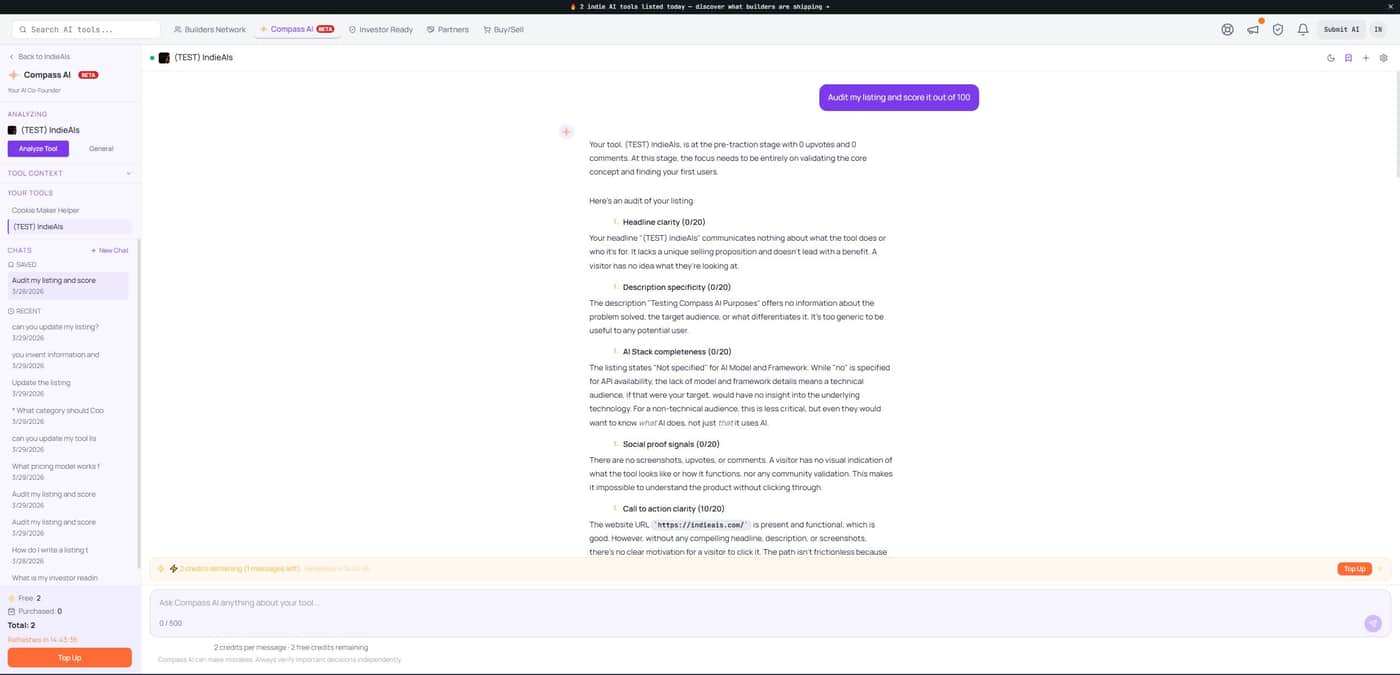
Look at this audit of a test listing. Instead of basic marketing tips, it pulls the actual data—traction, stack, and URL—to give a reality check.
The Problem: Most tools fail because their positioning is a placeholder. If your headline is "TEST," you’re invisible.
The Compass Approach: It scores your listing across 5 key dimensions. It doesn't just say "improve your copy"; it explains exactly why a visitor will bounce based on your current (0/20) clarity score.
The Goal: Moving from "Pre-traction" to "Early Traction" by fixing the friction points that prevent a user from ever clicking your URL.
It’s like having a co-founder who has already read your entire dashboard before you even open your mouth.
How much time are you losing because people don't "get" your tool in the first 3 seconds?
👉 https://indieais.com #buildinpublic #AItools #indiehacker


This resonates deeply. The "generalist AI advisor" problem is real — when you ask a generic LLM to be your CMO and CTO simultaneously, you get mediocre output on all fronts because it has no accumulated context about your specific product or mode.
What you're building with Compass AI is the right direction. The next layer I'd push on: can that specialized context persist and compound across sessions? The biggest pain I've seen is that even well-prompted AI advisors reset every conversation. You rebuild context from scratch every time.
Building something in this space too (AllyHub — an agent platform where your AI builds reusable skills from every task it runs, so it gets cheaper and smarter over time). The compounding memory problem is the core thing we're solving. Would love to compare notes.
The context-aware approach is what actually separates useful AI tooling from noise. Most AI advisors are fundamentally pattern-matching on generic startup advice — which is fine for getting started but useless once you have a real product with real positioning decisions to make.
The 5-dimension scoring framing is smart. Having worked on AntigravityAI (an AI tools directory), I've seen firsthand how listing quality and first-impression clarity are the single biggest drop-off points — not the product itself. Visitors don't evaluate tools rationally; they make a gut call in the first scroll and either go deeper or leave. A tool that scores and explains why someone would bounce is genuinely useful feedback.
One thing worth considering: the scoring output is only as good as the context Compass has access to. If a founder has a nuanced ICP or unusual distribution strategy, there's a risk the system anchors on surface-level signals (headline, description) while missing the positioning intent. Would be interesting if there were a way for founders to optionally annotate their listing with target-audience context before the audit runs — so the scores are calibrated against the intended market, not just general SaaS conventions.
Solid build. The before/after audit demo would be compelling proof for distribution.
This is a clever meta-play — most AI directories just list tools and call it a day, but scoring listings on positioning clarity actually helps founders tighten their messaging. The insight that people bounce because they don't "get" your tool in 3 seconds is painfully true. Would be interesting to see aggregate data over time — like what headline patterns or description structures consistently score highest. That kind of benchmarking data could become a moat for the directory itself.
"A co-founder who already read your entire dashboard" —
that's the pitch right there. Instantly got it.
The 0/20 clarity score example is brutal in the best way.
Most tools just say "your copy needs work."
Showing the exact score with the reason why someone bounces?
That's actually actionable.
The 3-second rule is what kills most indie products silently.
Nobody tells you they didn't get it — they just leave.
Building something similar in concept —
an AI that gives zero-mercy feedback instead of generic validation.
The hardest part is calibrating "brutal but useful" vs just brutal.
How are you handling false positives?
Like when the AI is harsh on something that's actually decent?
The context-aware angle is strong. What I keep noticing though is that even when positioning is “correct” on paper, it doesn’t always translate in the first seconds of a visit.
There’s a gap between:
-how founders describe their product
-and how a cold visitor interprets it under time pressure
And that gap is where most of the drop-off seems to happen. So instead of a positioning problem, it often feels more like an interpretation problem.
--Not “is the message right?”
--but “is it understood instantly?”
The gap between "generic advice" and "this actually applies to my product" is where most feedback tools die. You built the audit that reads the actual data instead of guessing from the headline. That's the difference between critique and guidance.
Finally—a tool that actually gets my product before I even have to explain it. Feels like having a co-founder who’s read all my docs…minus the awkward Zoom calls.
This looks interesting
This is actually really interesting most tools give advice that feels too generic.
The clarity score is a cool idea. How are you calculating it?
This is super interesting. I'm currently building something small as well and trying to understand how to get first real users.
that's so cool
The context-aware angle is strong. What I keep seeing though is that most tools try to fix things after the user has already landed…but the real drop-off happens earlier.
People don’t evaluate products. They scan.
If they can’t instantly map: “what this is”-“is this for me”-“why now” they leave before any scoring or feedback even matters.
Feels like most conversion problems start before optimization even begins.
The context-aware default is exactly right. I keep running into this with AI in PM work — model gives you polished generic output until you force-feed it your actual constraints. Then it is a completely different tool. The 5-dimension scoring + explaining why a visitor bounces is the right framing. What is the hardest context to get users to actually provide?
The context-aware default is exactly right. I keep running into this with AI in PM work — model gives you polished generic output until you force-feed it your actual constraints. Then it is a completely different tool. The 5-dimension scoring + explaining why a visitor bounces is the right framing. What is the hardest context to get users to actually provide?
The "context-aware" angle is the right play - generic AI advice is basically noise at this point. The 5-dimension scoring is interesting but I'd be careful about showing a test listing with 0/20 as the demo. First impression of the tool is "this thing just tells me everything sucks." What if you showed a before/after instead? Listing that scored 6/20, then the same listing after applying Compass feedback scoring 15/20. That tells a story about improvement, not just diagnosis. Also the "co-founder who already read your dashboard" line is strong. I'd lead with that instead of burying it at the end
good
Hi
I provide eligible AI businesses access to GCP/AWS credits for the next 24 months to help reduce infrastructure costs.
If this is relevant, happy to share more details.
https://www.linkedin.com/posts/sai-rithvik-2176302b1_eligible-ai-companies-can-access-up-to200k-activity-7442865181254209536-EiDB
This is really interesting! The context-aware approach is exactly what the AI tools space needs right now.
I'm building something similar in the AI developer tools space (MCP CN DevTools - helping Chinese developers deploy MCP servers). One thing I've learned: the gap between "generic AI advice" and "actionable feedback" is all about context.
Your 5-dimension scoring framework is smart. The clarity score especially resonates - most founders don't realize their headline/description is a placeholder until someone points it out with actual data.
Quick question: how are you handling false positives? Like when the AI flags something that's actually decent but just unconventional positioning?
Congrats on the build! 🚀