Solo-built Pistly for months. Launching on PH this week and I still don't know if the market wants it.
A while back I needed to build a prospect list for my own sales work: businesses in a specific sector and area, with real contact info. Doing it by hand — Google Maps, copy-pasting names, hunting for emails one by one — took most of a day for a list that was outdated within weeks.
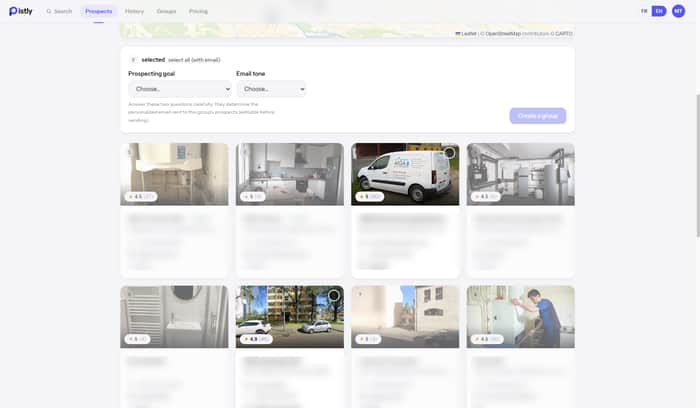
So I built Pistly: pick a sector + area, it scrapes Google Maps for matching businesses, pulls their contact details (email, phone, website, socials), and lets you send a personalized email to the whole list in one click. Quick demo video (2 min, real product, no mockups): https://youtu.be/g4_fJXa3w3U
What started as a tool for my own prospecting turned into a full product over a few months, solo — Next.js/Supabase/Stripe/Resend/Apify stack. Along the way it grew past pure B2B sales: turns out the same "find companies + reach out directly" flow works just as well for job/internship hunting and freelance outreach, so that's now baked in too.
Shipped free tier + Pro/Business plans, automatic follow-ups if there's no reply, CSV/PDF export, MX-record email verification, a lightweight CRM pipeline. Honestly the hardest part wasn't the scraping — it was everything downstream: keeping the emails from feeling spammy/generic, not letting anyone accidentally send an unpersonalized blast, follow-up logic that doesn't nag.
Launching on Product Hunt this week: producthunt.com/products/pistly?launch=pistly. No paid marketing, no network to lean on beyond what I've built posting in relevant communities — genuinely curious whether this resonates outside the handful of people I've talked to so far.
pistly.com if anyone wants to poke at it. Happy to answer anything about the build or the go-to-market side, which is the part I'm least confident about.

The line about preventing people from accidentally sending an unpersonalized blast stood out.
That feels less like adding a feature and more like deciding what kind of product you want Pistly to be.
Yeah, that one was a real fork in the road. It would've been faster to let people edit anything and just show a warning, but a warning you can dismiss stops meaning anything after the first time. I'd rather someone hit a wall and ask "why can't I remove {{name}}" than let one bulk unpersonalized send slip through and burn trust with an entire list. Small line of code, but it's basically the product's stance on what "personalized outreach" is allowed to mean.
That’s an interesting example of how a small product decision can encode a much bigger principle.
I’d like to continue the conversation outside the thread. What’s the best email to reach you on?
Sure — contact@pistly.com works, happy to continue there
Thanks! I’ve just sent it over.
Looking forward to hearing your thoughts whenever you have a chance.
The follow-up part stands out to me more than the lead scraping itself.
Finding prospects is only the first step. In sales, the bigger problem is usually keeping follow-ups consistent without making the outreach feel automated or repetitive.
If you can solve that well, I think that becomes much more valuable than simply generating a bigger contact list.
You're right, and it's shown up in a small way already: the one person actually using this seriously post-launch didn't stick around because of the list, it's because I kept following up on what he specifically asked for. The automatic follow-up feature is basically me trying to systematize that same behavior for people who don't reply the first time. Easy to keep pitching the scraping since it's the flashier demo, appreciate you pointing at the other half.
Preventing people from accidentally sending unpersonalized blasts is a great differentiator. That is exactly what separates a spam tool from a genuine outreach helper.
Since you are launching on Product Hunt this week, remember that PH is great for a temporary spike and a few backlinks, but it is not a sustainable distribution engine. You need a system that keeps running next week and next month.
For a prospecting tool, look for places where freelance service providers (agency owners, copywriters, designers) are actively complaining about how long manual lead sourcing takes them.
I'm working on Octoloops to help founders automate this exact process: mapping out niche, non-spammy distribution channels that fit their product.
Good luck with the launch! Let us know how the traffic converts over the first 48 hours.
Really appreciate the numbers, especially since you didn't have to share them. 91 searches and zero purchases tracks with what I'd guess: the free tier removes the buying decision entirely, so "would run a search" isn't "would pay."
On paid traffic: noted, staying away from it. Cheap clicks converting to zero product activity is exactly the failure mode I was worried about.
The three-audience thing is now the piece of feedback I've gotten from three separate people this week, so I'm treating it as settled: leading with sales for the launch page, job hunting and freelance become a line further down instead of splitting the hero three ways.
On MX verification, yeah, I know it's a floor not a ceiling. Splitting reply rate by address type (named person vs role vs info@) is a sharp way to grade it, hadn't thought to use reply rate specifically as the feedback loop there. Might borrow that.
Good luck with LeadGrid, and thanks for playing it straight given the overlap.
The hard part being emails that do not feel spammy is the actual product, not the Maps scrape. Before Product Hunt, I would run a small, carefully written batch and track reply rate and positive reply rate, not list size or open rate. If personalization quality is not converting cold contacts into real conversations at a tiny scale, a launch mostly amplifies volume of the wrong signal. Market want shows up in replies and booked calls long before it shows up in upvote counts.
That's a sharp way to put it — the scrape is commodity, the not-feeling-spammy part is the actual hard problem. Small honest sample size right now, but that's exactly what I'm watching: replies, not list size. If PH mostly just adds volume without changing that ratio, it hasn't told me anything new
the honest read: the market absolutely wants this, and thats also the trap, because want and will-pay-and-stick are different questions that a crowded category hides. there are a lot of scrape-maps-then-email tools, so the real validation question isnt does anyone need a lead list, its why does yours survive after the novelty wears off. two things usually decide that. first, data freshness, you said your own lists went stale within weeks, if you actually solve THAT you have a genuine wedge. second, deliverability, one-click blasting a scraped list is exactly what torches sending domains and gets people burned, so the customers who stick are the ones you keep OUT of trouble, not the ones you help spray faster. id validate by watching what beta users DO after the first run, not what they say on launch day: do they come back and pull a second list, do they actually send. if they scrape once and disappear, its a vitamin. one heads up too, scraping maps plus cold emailing has real compliance edges depending on region, worth getting ahead of before it bites. whats retention looking like on your beta users so far?
Data freshness is a good callout — dedup-across-searches is something I already built (same keyword+city won't return the same leads twice), but I haven't pushed on 'freshness' as an explicit wedge/selling point, more just an internal fix. Might be worth surfacing. On retention: too early and too small a sample to say anything real yet, single digits of actual external users so far. Deliverability keeps coming up in this thread (a few others flagged the same domain-burning risk) — clearly the thing to fix before scaling sends, not a launch-week problem but a before-it-becomes-one problem.
The part that stood out to me is the uncertainty you mentioned around whether the market actually wants Pistly.
For products like this, the challenge is often not whether the tool is useful — it’s whether the right people immediately recognize that it solves a problem they already care about. A lot of founders build something valuable but describe it from the builder’s perspective instead of the user’s urgent moment.
The interesting question is probably less “does the market want this?” and more “does the first impression make the right user think this was made for them?”
That positioning layer usually reveals a lot before you even look at growth numbers.
That reframing is useful — 'does the first impression make the right user think this was made for them' is a sharper question than the one I was asking myself. Given the three-audience spread that's come up a lot in this thread, I suspect the honest answer right now is no, the first impression is too generic for any one of them. Something to fix before chasing more traffic.
I think narrowing to one primary audience first is the right move.
One thing I've noticed while reviewing SaaS landing pages is that once the messaging is written for a specific person instead of three different personas, the rest of the page becomes much easier to optimize. The biggest improvements often come from making visitors feel, within the first few seconds, "This is exactly for someone like me."
I'd be interested to see how Pistly reads after that positioning shift—I suspect it'll feel like a completely different product without changing the product itself.We work on these type of projects on Quratulain Creatives
You and two other people in this thread landed on the same point independently, so I'm treating it as settled. Sales prospecting becomes the lead persona for the page, job hunting and freelance stay as a line further down instead of splitting the hero section three ways. Haven't shipped the rewrite yet, but it's next up, curious to see if it changes anything now that I have somewhere concrete to point traffic instead of just gut feel.
That sounds like the right experiment. Once sales prospecting becomes the lead persona, I'd resist the temptation to simply swap the headline and call the positioning work done.
The interesting test is whether the whole page now tells the same story.
The hero should make the prospecting use case immediately obvious, then the examples, features, proof and CTA should keep reinforcing that same job.
Otherwise you can have a perfectly specific headline followed by a generic product page that quietly reintroduces the old ambiguity.
I'd also watch the language in the first few seconds of user sessions after the rewrite. If the right visitors start describing Pistly in terms of the problem you're targeting—rather than listing features—that's a pretty strong qualitative signal that the positioning is landing.
Curious to see what changes once you ship it.
Really useful way to frame the test — watching session language after a rewrite hadn't occurred to me as the qualitative check, that's better than anything I would've picked myself.
Honest update: I haven't actually shipped the single-audience rewrite yet. The landing page still leads with sales prospecting in the copy but doesn't fully commit — job hunters and freelancers still get real space on the same first screen. Part of that is a real constraint, not just hesitation: they're existing paying users today, not hypothetical personas, so cutting them from the page even while leading with sales in the headline feels like erasing people who already use the thing. Still not 100% sure if that's a genuine product truth or me avoiding an uncomfortable trim.
If I do commit to it, I'll run your test properly — watching how people describe it in session recordings vs. what the copy actually says, not just eyeballing the page.
Sounds like you’ve got a solid positioning hypothesis to test now.
Once the rewrite is live, I can do a $10 SaaS Homepage Conversion Leak Audit on the new version—looking specifically at the positioning, message clarity, page flow, CTA friction, and whether the page consistently speaks to the sales-prospecting persona.
If the page needs more than diagnosis, I also offer $50 homepage copywriting through Quratulain Creatives.
No need to decide now—once the rewrite is live, you can send it over if you want a second set of eyes on it.
Appreciate it. Since that last reply I actually went the other direction — instead of trimming down to one persona, I leaned into serving the three explicitly: shipped a dedicated job-seeker section on the homepage, and split the blog and email templates by audience instead of by feature. So the "generic first impression" problem is being fixed by giving each visitor a section that's clearly for them, not by cutting the other two personas out.
Curious what you'd make of that version. Might take you up on the audit once traffic actually justifies it.
Straight disclosure before anything else: I built LeadGrid (leadgrid.eu), which is the same thing you just described — trade plus city, Maps, then enrichment off each business's own site. So I'm a competitor and you should discount me accordingly. I'd still rather tell you what I've measured than pretend I haven't.
The market wants the list. That part isn't your risk. Forty-three people have run 91 searches on mine and I have never recorded a purchase event, so trial intent is cheap and the wall sits somewhere after the results render. Focus_operator asked above how you'd tell PH traffic from real usage — that's the number I'd watch, not signups.
The warning: don't buy traffic for this category yet. I ran Bing and Google in July, 483 clicks, and not one of those people ran a single search in the product. About a third of everything that site has ever seen turned out to be parked-domain syndication junk. My targeting was bad, but the specific failure — cheap clicks on a keyword that reads commercial and converts at zero — is a trap this category is full of.
The three-audience thing worries me more than the scraping does. B2B sales, job hunting and freelance outreach are three products sharing a database, and on Product Hunt you get one line. Someone arriving for internship applications and someone arriving for territory prospecting want different first screens, and a tagline that covers both reads as generic tooling. I'd pick sales for the launch and leave the rest as a paragraph further down.
The genuinely hard problem, in case you haven't hit it yet: MX verification tells you the domain accepts mail. It doesn't tell you a person opens it. A one-man plumbing firm whose site email forwards to an inbox abandoned in 2019 comes back clean on every check there is. I don't have a solution — closest I've got is splitting reply rate by address type, named person versus role account versus info@, and letting that grade itself. Crack it properly and you'll have a better product than mine.
Good demo, by the way. Showing the real thing instead of mockups is doing a lot of work in that post.
Really appreciate the disclosure and the actual numbers — that's rare and more useful than most 'feedback' I've gotten this week. The trial-intent-is-cheap point matches what a few others said too, and your paid-traffic numbers (483 clicks, zero searches) are a good concrete warning, wasn't planning to buy traffic yet but good to have it confirmed rather than find out the hard way. On MX: you're right that it's a weak signal, I've been treating it as 'better than nothing' rather than a real trust score. Splitting reply rate by address type (named/role/info@) is a genuinely good idea I hadn't considered — might steal that. And yeah, the three-audience thing is becoming the most repeated piece of feedback in this thread, seems hard to ignore at this point. Good luck with LeadGrid too — this is a generous way to compete
This comment was deleted a month ago
Launching without full certainty is the normal state for most of us. The part that stood out is how the tool grew past the original sales use-case into job hunting and freelance outreach, that’s usually a signal worth watching carefully after the launch.
Curious how you’re planning to measure whether the Product Hunt traffic turns into actual usage rather than just signups.
Watching whether people run a search and come back for a second one, not just create an account — a few others in this thread flagged the same thing, seems to be the consensus metric that actually matters here versus signups or votes
Yeah, that seems to be the cleaner signal.
Signups and votes are easy to celebrate, but they don’t tell you much if people never come back and actually use the core action. Watching for a second search (or whatever the main loop is) feels like a much more honest early metric.
Yeah — the number I'm watching now is that about a third of first-time searchers come back for a second search within a week. Not huge, but more honest than the signup count.
A third coming back for a second search is already a much cleaner signal than raw signups.
Still early, but at least it’s measuring the actual loop instead of just the first click. Curious if that percentage has been stable or if it’s still moving around.
checked again just now - 6 of 20 real users who've run at least one search have come back for a 2nd within a week, so ~30%. pretty close to the ~1/3 from a few days ago, sample just grew a bit (15 to 20). too early to call it truly stable but it hasn't moved much yet.
30% holding steady as the sample grew is a decent early sign.
Still small numbers, but the fact it hasn’t dropped off is more useful than a one-time spike. Worth keeping an eye on as it gets a bit larger.
Haven't rechecked that exact repeat-search number since, but I ran a blunter funnel diagnostic a couple weeks later that made this metric feel almost beside the point: of everyone who signed up, 71% run a search, only 17% ever create a group, 6% send a single email. Zero conversions to paid, over a month post-launch.
So the real leak isn't "do they come back to search again" — it's the search-to-group step. Shipped a contextual hint banner on the results page plus two lifecycle emails (a nudge if you searched but never grouped, a trial-ending reminder) about a week ago to target that gap specifically. Too early to say if it moved anything yet.
Yeah, that tracks. Watching for a second search/run feels like a much stronger signal than the initial account creation. Signups and votes can look healthy while actual repeated use is still missing.
Good luck with the Product Hunt launch, hope you get some clear usage signals from it.
Small real data point since you asked: the one person actively using this post-launch tests something, comes back a few days later with what broke or what he wants next, then goes quiet until the next round. So the "second search" signal you flagged is already showing up, just for one person so far. Not proof of a market, but it's the first time I've seen the loop you described happen for real instead of hypothetically. Thanks for pushing on this, it changed how I'm reading the numbers.
That’s a useful early signal.
Even with just one person, seeing the loop actually happen (test → come back with feedback → quiet → return again) is more meaningful than a bunch of one-time signups. Appreciate you sharing the real data point.
Exactly — that's the framing I'm sticking with over raw signups now. One person isn't a trend, but it's the first time I've actually watched the loop happen instead of just hoping it would. If a few more people run that same test→feedback→return pattern over the next few weeks I'll treat it as real, not just a nice anecdote to point at.
Makes sense.
One person running the full loop is more useful than a bunch of one-time signups that never return. Treating it as a real early signal only once a few more people repeat the same pattern feels like the right level of caution.
agreed, no rush to call it a trend off one person. appreciate the push toward caution instead of just cheering the anecdote.
Yeah, better to stay cautious early on.
One real loop is useful to notice, but waiting for a few more before treating it as a pattern is the cleaner way to read it.
This is exactly the kind of solo founder journey I’m trying to understand.
Turning a tool built for yourself into something others pay for seems like the hardest transition.
Curious what was the first signal that made you believe Pisty could become a real product?
Honestly it was realizing I kept reaching for it myself, weeks after the 'good enough for me' point — I'd built it to solve one search, then found myself opening it again for the next client, then building features I didn't strictly need for my own use (follow-ups, CRM-lite statuses). That's when it stopped feeling like a personal script and started feeling like something worth finishing properly.
That’s a really interesting signal — especially the gap between ‘useful enough’ and ‘I keep coming back to it.’
I’ve noticed many solo founders start by solving a problem they personally experience. The harder part seems to come after that: deciding which parts of the solution are actually worth investing in, and which ideas should be left behind.
Even with frameworks like prioritization models or user feedback, the real trade-offs often seem difficult in practice, especially when you’re building with limited time and resources.
I’m curious when you started adding features like follow-ups and CRM-lite statuses, how did you decide which improvements were worth building versus keeping the product intentionally simple?
Honestly there wasn't a strict framework, it was mostly reacting to a concrete complaint. The status-tracking feature (mark someone interested, not interested, meeting booked, or lost) came directly from wanting the automatic follow-ups to stop nagging people who'd already said no, not from a top-down "let's build a CRM" plan. Follow-ups themselves came from a similar place: in B2B outreach the value is rarely the first email, it's whoever actually follows up, and I kept seeing that gap. So less a prioritization model, more: build the smallest thing that removes a real, specific annoyance, and resist adding anything you can't point to an actual complaint for.
This is really helpful. I like the distinction between building from a product plan and building backward from a specific annoyance someone has actually experienced.
The 'can I point to an actual complaint for this?' test is especially useful. It feels like a much harder standard to rationalize your way around than a prioritization framework.
Thanks for coming back to this and explaining the reasoning behind those features.
Glad it landed — thanks for pushing on it, made me articulate something I hadn't put into words before.
The "least confident about GTM" part is normal — I'm five products in and it never fully goes away. One thing that would have saved me real pain: before betting on a channel, check whether the demand you're imagining exists as search or community behavior at all. I once built a clip tool for a niche where the core keyword turned out to get roughly 10 searches a month — the product worked fine, the market was air. Pistly's demand question is easier (people already pay for lead gen), so your PH launch is less about validation and more about positioning: the follow-ups-without-nagging angle is the most differentiated thing in your writeup, and I'd lead with that instead of the scraping. Good luck this week.
Good call on the positioning — I've been leading with the scraping/Maps part because it's the most visually demoable, but you're right that the follow-up automation is probably the less commoditized piece. Worth testing that as the headline angle instead. Thanks for the perspective, 5 products in is exactly the kind of experience I was hoping would show up in these comments.
How did the launch go?
One thing worth adding now that the day has passed: the PH traffic itself mostly doesn't stick, but the PH page does. It sits there and gets found for years. So the tagline worth optimising is the one that works on someone landing there eight months from now while searching the category, not the one that wins votes on the day. Those are usually different sentences. The vote-winning one is clever. The durable one names who it's for and what breaks without it.
If the follow-up angle tested well, that's also the version that survives on the page long-term, since "scraping Maps" is a phrase a dozen tools will claim and "follow-ups without nagging" is one you can own.
Fair to say the traffic spike came and went the way you'd predict. What's stuck around isn't the list-building pitch, it's the follow-up-and-status-tracking piece, for the reason you named: it's the part someone can point to next week and say "this is still doing something for me," not just "I found some companies." So that's the version I'm leaning into for the page long-term. No major surprises, mostly confirmation of things people in this thread already told me before I even launched.
For this launch I would treat Product Hunt as a recruiting channel for ten observed onboarding sessions, not as the validation event itself. Pick sales prospecting as the primary use case, ask each user to name a real territory and campaign before the demo, and watch where they hesitate from list creation through the first approved draft. The strongest signal would be a user connecting a sending domain, returning to review replies, and paying to run the next campaign without you prompting them. Votes and signups can create attention, but that sequence tests whether the workflow replaces the manual day you originally described.
Really concrete framing, thanks. I hadn't thought about actively recruiting for observed sessions rather than just watching passive usage data — that's a much faster feedback loop than waiting days to see who comes back on their own. Going to try setting a few of those up this week.
That should produce a much faster signal. Keep each session task-based and avoid explaining the product during the run; the moment you feel the need to clarify something is itself a finding. I’d then compare the repeated friction points with who returns for a second campaign.
Makes sense, and it lines up with what I'm already seeing informally from the one person testing this seriously: every time he comes back it's with a specific task he tried and a specific thing that broke, never a general reaction. I'll try to force that structure on purpose with the next few people instead of waiting for it to happen naturally. Thanks for the concrete framing, genuinely useful.
Three audiences (B2B sales, job hunting, freelance outreach) is your go-to-market problem, not a bonus feature. Each one needs different copy, a different landing page and a different acquisition channel, and solo you can fund exactly one, so I would keep the one where you already have your own results to point at and pull the other two off the site until it pays. The thing I would worry about more than launch day is deliverability: sending to scraped Maps addresses from a customer's own domain with no warmup burns that domain, and when it happens they blame the tool, so a hard sending cap for the first two weeks plus forced warmup will do more for your retention than any feature you ship this month.
This is the piece of advice I've gotten most this week, and you're making the strongest case for it — I hear it. The deliverability point is new to me though: I don't currently cap or warm up sending, it's a straight bulk send from the customer's own domain via Resend. Hadn't thought about a customer's domain reputation being at risk on a cold list they built themselves — that's worth taking seriously before this scales further. Appreciate the concrete suggestion (cap + forced warmup for the first two weeks)
I'd focus on proving people will pay before optimizing the feature set. Everything else gets easier once that signal is real.
Agreed, that's the actual open question right now. Feature set is already pretty full — the trial-to-paid conversion is what I'm watching closely this week
"Launching without knowing if the market wants it — that takes guts. I'm building Rallynex and feel that uncertainty every day.
What made you decide to launch anyway? And what's your plan for getting feedback after PH?
Honestly, at some point building in the dark for longer wasn't going to answer the question — only real users would. For post-PH feedback: watching who comes back and runs a second search rather than vote count (a few commenters here made the same point), and reaching out directly to anyone who signs up to ask what almost stopped them. Good luck with Rallynex — same boat."
"Thanks — appreciate the good luck. Same boat indeed.
The 'reach out to anyone who signs up' move is underrated. I've been doing that with Rallynex and it's taught me more than any dashboard ever could.
How did your PH launch go in the end? Any surprises?"
Went the way most PH launches probably go: a burst of traffic that day, not much of it turned into real usage a week later. The one real conversation I've had post-launch actually came from following up directly with someone who'd asked a specific feature question, not from anyone who found me through PH itself, so "reach out to anyone who signs up" matches what I'm seeing too. No big surprises, more a confirmation that PH is a spike, not a channel. Good luck with Rallynex, curious how your launch lands.
The risk I see is that you have 3 different buyer stories now: sales prospecting, job hunting, and freelance outreach. For the PH launch, I would pick one painful ICP and make the first promise extremely narrow, then use the other two as discovery branches. Otherwise positive comments may look like validation while each segment waits for a different product.
This is exactly the tension I've been sitting with, thanks for naming it clearly. You're right that "positive comments ≠ validation" if each commenter is picturing a different product. For the PH launch I'm going to lead narrow with sales prospecting as the primary ICP (that's where the willingness to pay is clearest) and let job-hunting/freelance surface as "huh, I didn't expect that" discovery comments rather than the headline. Appreciate the push to actually commit instead of hedging in the tagline.