SQS as a Service - New Side-Project for Vercel Users. Let's build a prototype
Introduction
I've started a new project 🎉
I'll build an opinionated and abstracted version of SQS as a Service.
The idea is to offer a really easy and still customizable solution for message queues. The target group is developers developing on Vercel, Netlify, or a similar service who probably don't have an AWS Account.
Competitors
- AWS itself -> Too complicated to set up (that is the whole point)
- Quirrel -> Acquired by Netlify and stopped for the public (but open source)
- Zeplo -> Great product but too less customizable for me
Zeplo however is a really valid product and a cool alternative. I am not sure if I can beat it because we have kind of the same target group. But I think more about an abstracted version of SQS but I still want to make it accessible and customizable for SQS power users.
What is SQS?
First of all, what is SQS?
SQS is the Simple Queue Service and it was the first service in AWS. It is a fully managed message queue and allows you to send messages to this queue. Consumers can poll messages and work on that. Consumers are often Lambda Functions or Instances such as EC2 or ECS Containers.
Over the years I saw that most of the event-driven and serverless use-cases are simply an SQS queue connected with a lambda function. Since systems get more asynchronous and event-driven it is a great design and a great service for that.
Some service (e.g. a Vercel Serverless Function) sends an event to SQS. SQS passes it to Lambda, and Lambda executes some business logic. This is the typical pattern.
The Problem to Solve
The Problem is AWS itself
I identified three main problems:
- Overhead
- Separating business logic
- Understanding SQS
Overhead for Creating a Simple Queue
Working in an AWS environment means there are certain prerequisites. I saw this problem multiple times while either onboarding new developers to an existing project or teaching them how to implement such use cases. If the only goal is a message queue and no AWS Account exists you need to do (at least) the following things:
- Create an AWS Account
- Set up a credit card with your AWS Account
- Understand IAM (root user, MFA, dedicated users, roles, policies)
- Named profiles locally
- Create budget alerts
- Create an SQS queue
- Create a lambda function
- Orchestrate all of that somehow in code (CDK, Terraform Pulumi)
- Understand SQS (long polling, visibility timeout, FIFO, idempotency)
These are way too many steps for a simple thing like sending messages to a queue. That is why I wanted to build a service for abstracting this away.
Especially for users from Vercel (Zeit) or Netlify, it is super easy to deploy your website and build APIs and serverless functions without even having an AWS Account. They don't even need an AWS account most of the time.
Separating Business Logic
Another problem comes with separating the business logic. If you have a Vercel account you can simply have a serverless function in pages/api/executor.ts that can work on your business logic. But if you implement it with SQS -> Lambda you have a separate system and a separate codebase.
A simple message queue could allow them to send messages from their various backend APIs, queue them, and let another serverless function work on that.
There is no need for an additional AWS Account.
SQS is Hard
If you need a 1x1 thread to build a simple message queue it is probably a bit too much.
SQS is not super straightforward to learn. I struggled a lot with understanding many things and setting good default parameters. For most of the use-cases, you don't need to be an SQS pro just for a simple queue. But without studying it you almost cannot use SQS properly.
You need to learn many terms like:
- Short polling vs. long polling
- Dead letter queues
- Redrives
- Visibility timeouts
- ... and much more
Time to Touch Business Logic
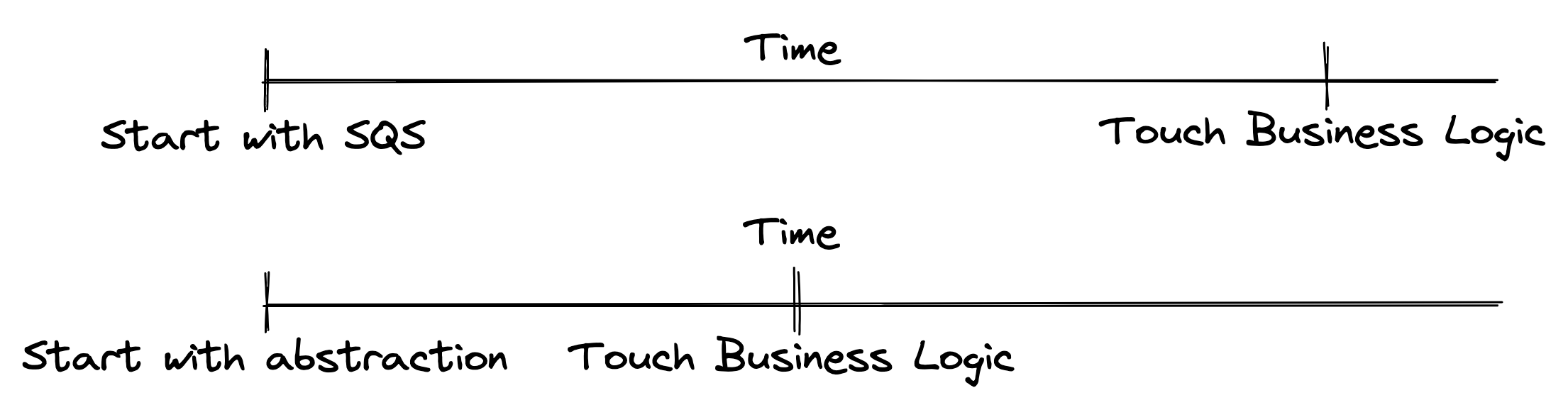
A good indicator for me to see that there is an opportunity for making things easier for developers is to take a look at the time it takes someone to touch the business logic. With AWS it takes a lot of time till you reach the point of actually developing your logic in Lambda. With my proposed solution, you simply create a queue and build your business logic in a second.
That's why I build an opinionated and abstracted version of SQS.
Prototype
I wanted to start out with a simple prototype to prove if it is even possible to build what I want to build. I gave myself a time restriction of one weekend for that.
The prototype should show that it is possible to have a simple use case like that:

- User creates a queue with good default parameters
- User sends a request to the queue including parameters like the target and my system queues the request and forwards it to the target
The goals for the weekend were to prove that this is technically possible.
The AWS Architecture
My initial ideas were prototyped on a whiteboard. Sorry for my handwriting.
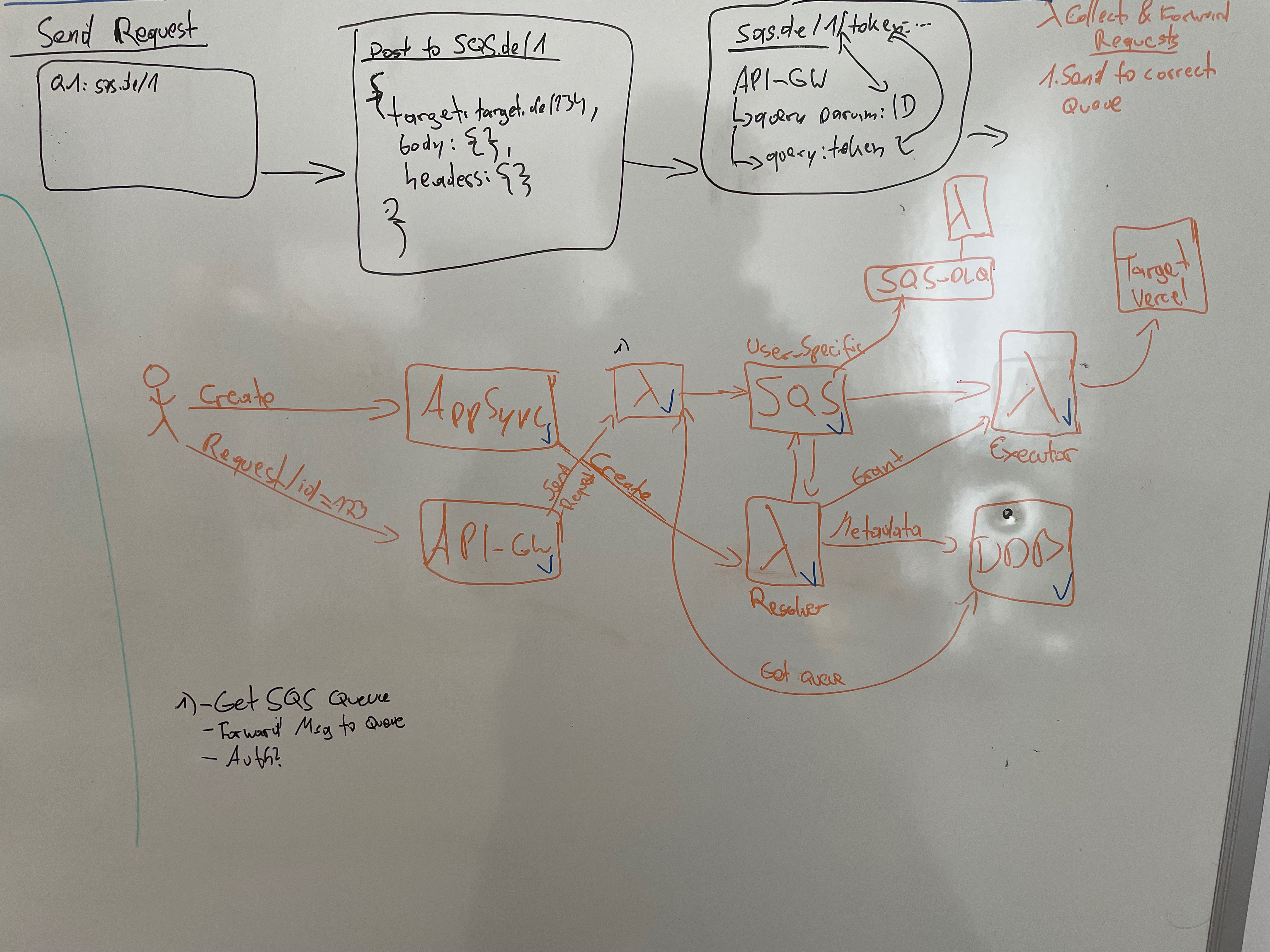
The two major flows that need to be implemented are:
- Create a queue
- Receive messages, queue them, and forward them
Let's go through both flows in detail
Creating a Queue
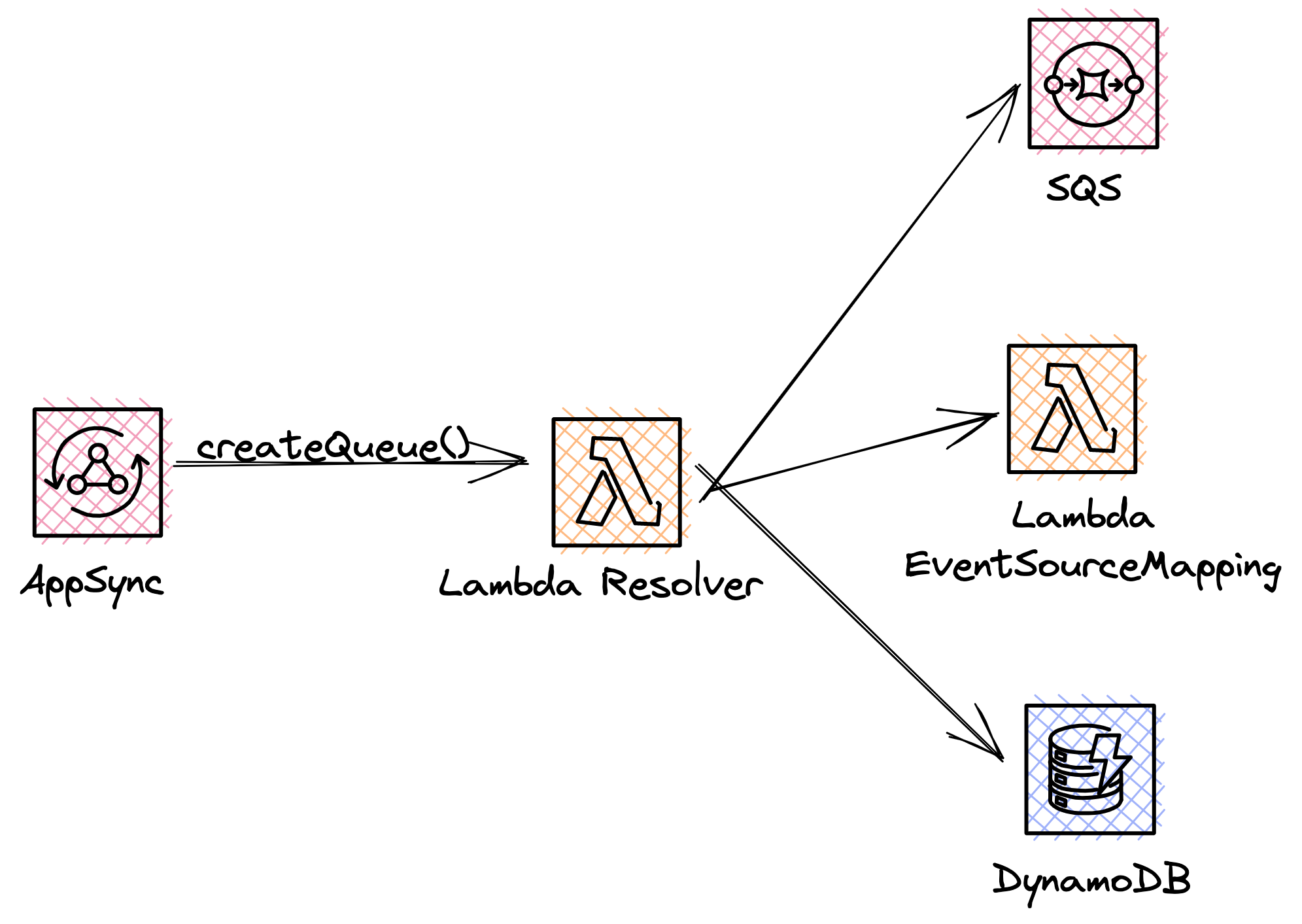
The following services are involved here:
- AppSync - GraphQL API
- SQS - Actual Queue
- Lambda - Mutation for creating the queue & Executing the
EventSourceMapping - DynamoDB - Saving Metadata
AppSync
First of all, we've got AppSync which is a fully managed GraphQL API. In AppSync I've got the following schema. I've included only the important parts for the prototype:
type Queue {
  id: ID!
  name: String!
  user: User!
  sqsUrl: String!
  arn: String
  createdAt: AWSDateTime!
  updatedAt: AWSDateTime!
}

type Request {
  id: ID!
  queue: Queue!
  body: String!
  status: String!
  createdAt: AWSDateTime!
  updatedAt: AWSDateTime!
}

type Response {
  id: ID!
  request: Request!
  body: String!
  status: String!
  createdAt: AWSDateTime!
  updatedAt: AWSDateTime!
}

type Mutation {
  createQueue(input: CreateQueueInput!): Queue!
}

input CreateQueueInput {
  name: String!
  userId: ID!
}
The main part of the prototype is the type Queue and the mutation createQueue. Only for the mutation createQueue a lambda function is used as a resolver because more business logic is needed for that. All others are resolved with VTL.
Lambda
Calling the mutation createQueue calls a lambda function.
The lambda function is doing 3 things:
// 1. Create queue in SQS with default params

// 2. Add lambda as EventSourceMapping

// 3. Add Metadata to DynamoDB
The node.js SDK from AWS can do all three things. Every time a user creates a queue these three things are happening.
Creating a queue is now as easy as that:
  createQueue(input: {name: "q1", userId: "123"}) {
    id
  }
After that we'll have the following:
- Queue with a random name
- Item in DynamoDB with the URL, arn, user, and name
EventSourceMappingto the lambda function
Sending a Request
The second flow is sending a request.
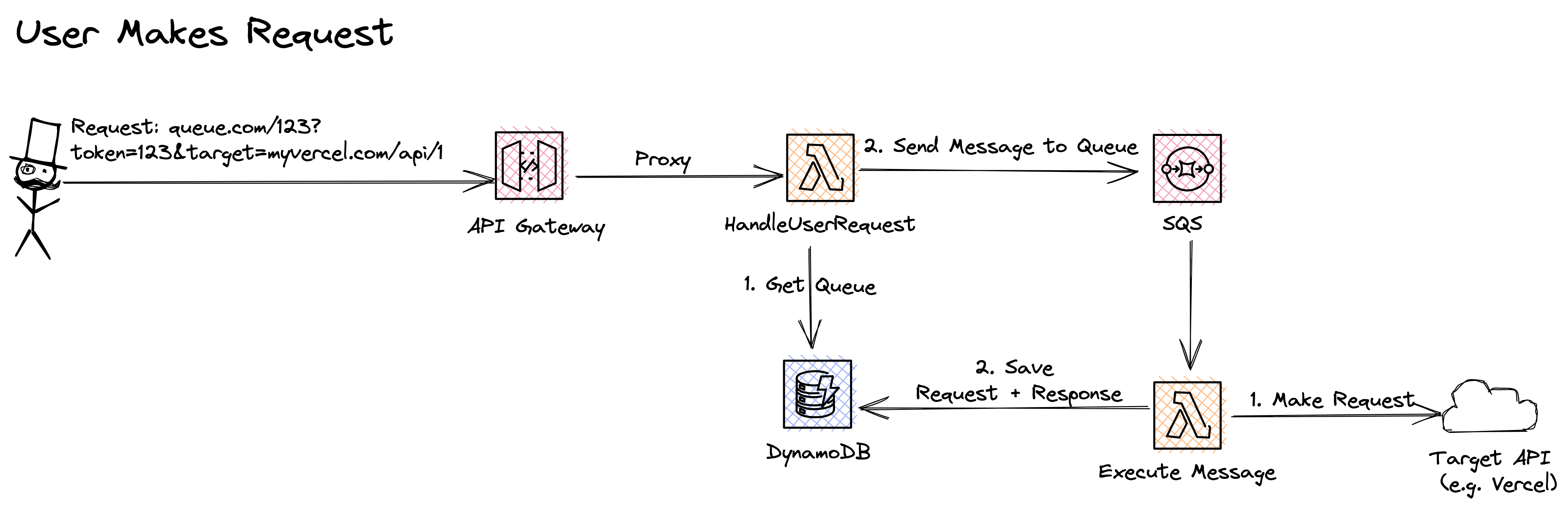
This time these services are included:
- API Gateway - REST API for user requests
- DynamoDB - Getting the correct queue
- Lambda
- Handling user requests
- Executing the request
- SQS - Queue from the User
API Gateway
For the REST API I use the service API Gateway. With API Gateway I simply create a REST API with a Proxy to Lambda. In CDK it is simple like that:
 const handleUserRequest = new NodejsFunction(this, 'HandleUserRequest', {
 	entry: path.join(`./lambda/handleUserRequest/index.ts`),
 	handler: 'main',
 	runtime: aws_lambda.Runtime.NODEJS_14_X,
 	environment: {
 		QUEUE_TABLE_NAME: queueTable.tableName
 	}
 });

 new apigw.LambdaRestApi(this, 'UserRequestApi', {
 	handler: handleUserRequest
 });
Lambda for handling user requests
This Lambda handles all user requests. It is directly behind the API Gateway.

The lambda is doing the following steps
// 1. Deconstruct Query Params

// 2. Build SQS Message (including filtering headers)

// 3. Get Correct Queue

// 4. Send SQS Message
For all error or success codes, we can use the callback function API Gateway is passing to the lambda function. So, this function passes the message to the appropriate SQS queue.
Execute Final Business Logic
The final lambda function is getting all requests from SQS. Its job is to call the target system (e.g. Vercel Function) and save some metadata.
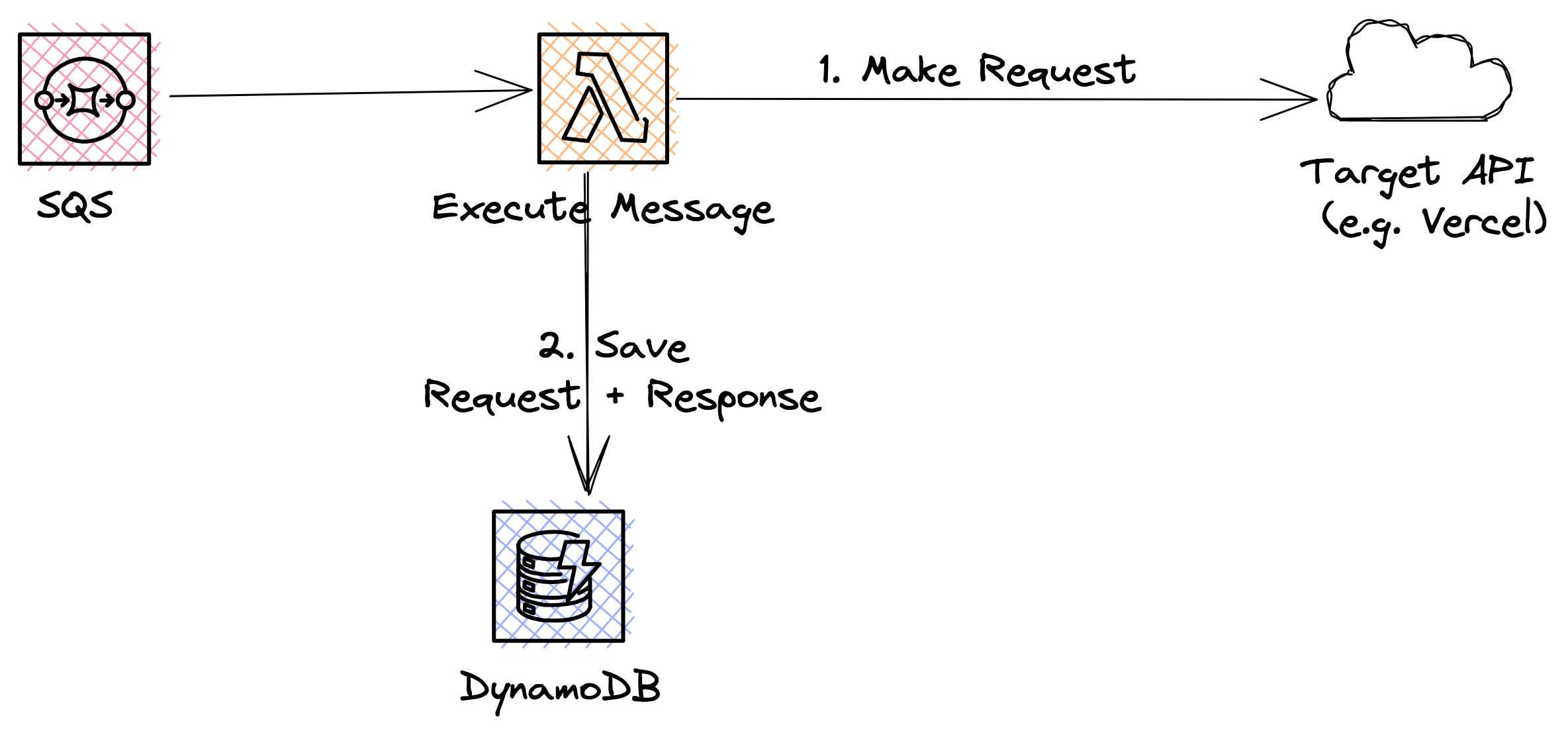
This lambda is doing the following jobs:
// 1. Mapping over all Records

// 2. Deconstructing the message

// 3. Making the request to the target

// 4. Saving request and response in DynamoDB
These are both complete flows. And it shows that the prototype is working very well! With that, I am able to queue a lot of messages, let them run asynchronously and work on the final business logic on my existing system.
Dashboard
One thing that is completely missing here is the UI. I am building this project together with a friend who bootstrapped some of the initials of the UI. The UI will be implemented with:
- Next.js (React)
- Tailwind CSS
- Hosted on Amplify
- TypeScript
I'll go into more details on the dashboard later.
Open Points
There are still a lot of open points of course. Some random thoughts here:
- Is this really a valid problem? -> I do experience this problem a lot so I think it is
- Is SQS the right service for that? SQS is in nature a polling and not a pushing system. Still, it is the go-to service for message queues.
Technical things I already solved:
- How many SQS queues can I create per account? -> Indefinite
- How many
EventSourceMappingscan I add per account -> Indefinite - What happens if I redeploy my CDK stack. Do I lose all mappings since they are created via the SDK? -> Won't be overridden, if overridden -> Get ARNs from DDB
Next Steps
- Building the dashboard
- Building authentication (AppSync + Auth0)
- Building a dead letter queue
- Give people the opportunity to customize SQS parameter
- Build a landing page
- Look into Vercel integrations
Final Words
I know there are a lot more things to do. I am not 100% sure if the setup works out like I intend to do it. I am misusing SQS of course a bit since SQS is a polling system and not a pushing system. So it is completely possible that other services are better suited for that. However, SQS is the standard go-to for these use cases so I want to build a better abstraction for that. I do experience this problem a lot myself so I want to try out building this solution and start using it for various use-cases in my daily work.
Thanks for reading the article. If you want to follow my journey make sure to follow my Twitter Account

Hey Sandro,
Really interesting update! Building in public takes guts, especially when you are experimenting with architectural boundaries.
Regarding your note on misusing SQS and worrying about the setup—you hit the nail on the head. SQS is great, but when it interacts with serverless layers like Vercel, handling timeouts, ingestion latency, and state transitions (like your future DLQ plan) can become a real bottleneck, especially with polling limits.
Since you mentioned looking into Vercel integrations and building a DLQ, I thought I’d share a lightweight alternative architecture that might save you some implementation headaches.
I recently engineered ATRI—a self-hosted webhook proxy layer built in C++20 designed specifically to act as a reliability shield right before serverless execution layers.
Here is how it covers your "Next Steps" natively:
Built-in Dead Letter Queue (DLQ): It handles failed upstreams via exponential backoff with full jitter, drops bad requests into a DLQ, and allows one-click replays via a Unix socket control plane (atrictl).
Sub-0.5ms Ingestion Latency: Built with an io_uring backend on Linux and a lock-free MPMC ring buffer, so it ACKs the webhook instantly without blocking your downstream services.
Crash-Safe WAL: Uses a Write-Ahead Log with fdatasync() so events survive process crashes and auto-reconstruct on startup.
Edge-Triggered Circuit Breaker: Uses EWMA health scoring to stop sending traffic to downstream targets if they start choking or hitting Vercel timeouts.
It's packaged as a tiny ~60MB Docker image, completely free and unlimited to self-host, and requires zero application code intrusion. It could easily sit in front of your stack to handle the ingestion and validation, while you focus on the AppSync/Auth0 dashboard grind.
I’ve documented the full architecture and setup guide here: atri-ui-ux-design.vercel.ap
Would love to hear your thoughts on this approach, and good luck with the landing page launch!
Hey Sandro, very detailed post! Congrats on that. I’m the founder of stormkit.io (similar tool to Netlify and Vercel except we integrate with custom storages) and i recently seen netlify users asking for a built-in sqs service. I was wondering what’s the use case. Because usually message queues are used by backend applications to process long lived tasks. For instance Stormkit uses a message queue to process deployments. My question when I also saw that post is, what’s the use case? Why a frontend app may need a queue? Lambdas are already infinitely scaling so putting a task into a lambda can already act like a queue processor. Am I missing something?
I had a long answer and accidentally clicked on cancel 😃
My main reason for using message queues is to build an asynchronous system and to decouple the main API of messages.
For example. In hashnode (a big blogging platform) I've implemented the badge assignment. A user publishes a post, an event will be sent to SQS and Lambda will assign different badges (e.g. post with many words or first post).
If this would have been implemented without a message queue in between the caller would have to await the API. With the message queue, it is completely asynchronous.
So building proper async systems is the main argument for me.
Other reasons are definitely scale, reliability, and performance.
Scale:
Reliability: Find errors, make retries
Performance: Sending messages to a queue directly instead of the caller is often way faster since the queue distributes the workload. This however is with Vercel not always true.
And long-running processes is also correct of course! This is not the only use case but also a valid one. For example, if you have a really long-running process you can split it up into many jobs, give it into a queue and combine it in the end. With that, you make it faster and let it run in parallel.
I hope that helps, if not let me know! 🙂
I see! Thanks for the explanation 🙏🏻