Steal Notion’s strategy to create personalized landing pages
Hey👋, Rafiqul here. Welcome to Content Marketing VIP that delivers actionable insights, the latest updates, & free resources.
Today, I'll breakdown Notion's strategy behind creating 10+ landing pages for the single product.
And, how you can replicate the same strategy in your business.

Let's get started.
Chances are you’ve already used Notion.
-
For remote workers → Notion helps in project management and real-time collaboration.
-
For managers → Notion helps in managing the team and planning people.
-
For designers → Notion helps in managing the design assets.
Can you see the difference?
Notion is not meant for one specific audience, and it doesn't only have one use case, but many.
This is kind of the same situation for almost every SaaS company.
A SaaS product has multiple use cases and can be used by multiple audience personas.
But the mistake most of the businesses make is that they don't create enough landing pages targeting different audience profile.
Instead, they go for a one-size-fits-all approach (which means one landing page for all).
For example:
For example, if you’re selling task management software then creating one landing page for the product isn’t always enough.
Instead the same product can be turned into multiple landing pages (targeting different industry, use case, solutions, etc.) such as:
- Task management software for small startups
- Task management software for freelancers
- Task management software task for lawyers
As you can see, creating multiple landing pages for the same product will give you the opportunity to rank on multiple search queries and provide personalized content experience to different user profile.
Hence a higher chance of conversion.
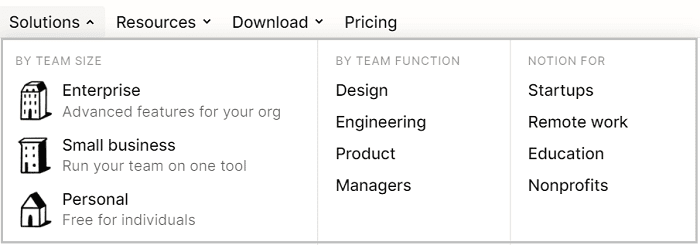
Likewise, Notion has 10+ landing pages based on audience profiles, function, and even team size 👇
The Benefits?
With this approach, Notion provides a super personalized product experience to every audience category and gets SEO traffic for various search queries.
That could've never been possible if they had opted for a one-for-all approach.
Ultimately, higher conversion for the product.
Action Items →
1/ Create a list of audience profiles, use cases where your product can be a perfect fit.
2/ Do keyword research to prioritize the list of keywords. Get metrics like estimated traffic, search intent, etc.
3/ Create landing pages for these different profiles and use cases.
4/ Ensure that social proofs and testimonials are relevant to the specific audience. This means a page built for startup founders will have testimonials from other startup owners.
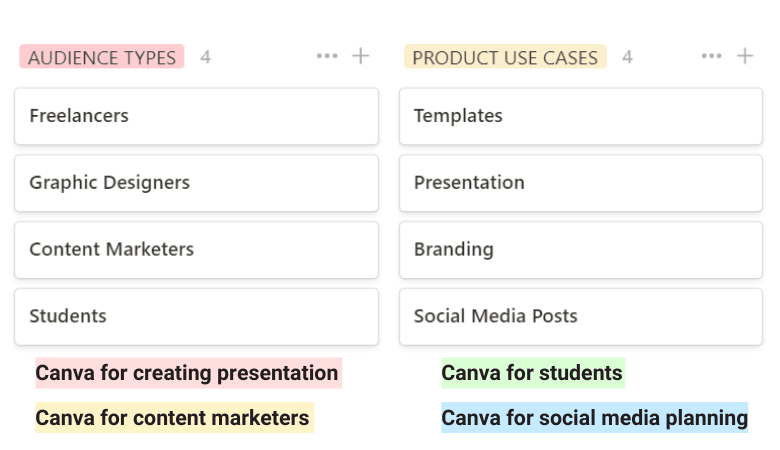
Here’s an example of finding landing page ideas for Canva:
Liked this so far?
Subscribe to content marketing VIP and get more content marketing breakdowns like this.
TL;DR
- Identify different audience profile relevant to the product/service
- List down different use cases/ function of the product
- Prioritize the list by demand, estimated traffic, and competition
- Create separate landing page for each of the profiles
Have questions or suggestions?
Please let me know. I'd be happy to help.

Cool breakdown! But here's something I'm curious about: Did Notion have this one-size-fits-all approach from day one? Or did they start by targeting a single niche and then expand their targeting from there?
For example:
So the question is: should day-one branding and landing pages also follow this one-before-many approach?
I prefer starting with the core business offerings.
For instance, if a brand offers web and mobile app development services then creating the service pages for both of the service is a must have.
Later they can diversify more into something like:
web development for healthcare/real estate/etc. And, the opportunity could be endless.
In fact Shopify have built 200+ landing pages for the same platform targeting different niches.
And, it is generating tons of additional traffic that wouldn't have possible if they stick to only a few landing pages.
In most cases, the brand use this approach by identify different angles of their product.
Pretty obvious that a brand will have multiple user persona, target multiple industries, have many product use cases, and so on.
But obviously, the initial and must-have is to set the foundation (setting up the landing pages for core business offerings). Next, diversify for SEO benefits too.
I hope this makes the point clear.
Good point.
I love Notion.
I have laid out plan like this for my business https://tradly.app
It’s very interesting planning like this sort of things but actually the truth is not easy for any indie project to build a quality pages like this. It takes lot of effort. Let me tell why
Am not saying we shouldn’t do. But it takes minimum two weeks for each use case to have full packaged landing page.
Once I was crazy, I created a URL called 75 use cases you can build with Tradly and put it in many places I can and promote wherever I can. Not a single purchase
But when I did how to build a app like “brand” , and the landing page has the exact story of it , it worked. People said clearly “I want to build like that”
As you said, am going to try something but may be share back here how much time it took to finish all this like the above.
Obviously it takes a lot of time crafting the message and tone of the copy as many landing pages will be similar to each other.
You should also do the keyword research to prioritize which one to go first.