Stop losing deals in the gap between "sounds good" and getting paid
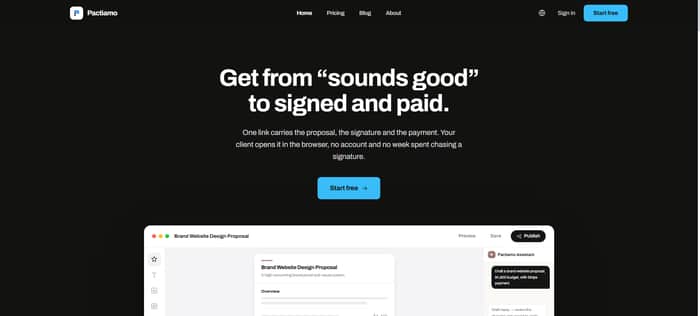
The slowest part of freelancing was never the work. It was the gap between a client saying "sounds good" and money actually landing in my account.
The pattern never changed. Good call, then "send me a proposal", then I spend an evening on a PDF and hear nothing back. No idea if anyone even opened it. When someone did say yes, the deal still had to survive printing, signing, scanning, and a separate invoice in a third tool. The work was never the slow part. The gap between yes and money was.
So for the last two months I built Pactiamo. A proposal or contract becomes one link. The client opens it, reads, signs in the browser, and pays through your own Stripe, PayPal, or bank link. No account for them to create, and I never touch the money. AI writes the first draft, there is a legal check that flags the clauses working against you, and view tracking plus reminders do the chasing so you stop refreshing your inbox.
Two honest things about how I built it.
What I'm glad I did: I used it for my own work before showing anyone, which kept me from adding features nobody asked for. And I put real effort into the client-facing side, because the person who signs never sees my dashboard, they see one page, and that page is the whole product.
What I skipped and now regret a little: I did almost no market research up front. I asked an AI what a solo dev could build, it suggested this space, the reasoning sounded good, and I just started. There were nights I wondered if I was building something nobody wanted. I still don't fully know. Today is the first real test.
It's a solo full stack build on Next.js and Postgres, nine languages, and I'm figuring out SEO from zero at the same time.
If you send proposals for a living, I'd genuinely like to know: what would it actually take to move you off PDFs? Honest teardowns welcome, that's more useful to me today than a nice word.
We're live on Product Hunt right now if you want to see it: https://www.producthunt.com/products/pactiamo
Or if you'd rather just try the thing itself, it's at https://www.pactiamo.com

Full disclosure: I'm Avery Lin (avrlin). I've been packaging a Get-Paid Chaser Kit ($49 — freelancer invoice follow-ups: polite day+3/+7/+14 ladder + stop-when-paid) with AI assistance, so take this as adjacent interest, not neutral advice.
Most late invoices aren't "won't pay" — they're buried in inbox fog. A calm written cadence (nudge → firm → final) beats rewriting one awkward email three weeks late, and it keeps the relationship salvageable.
Curious — do you have a fixed chase sequence after due date, or is it still ad-hoc when cash gets tight?
The PDF is probably not the real enemy here. The risky part is that a proposal can look "sent" while the deal has no next owner.
I would treat each proposal as a state, not a document:
Sent -> Opened -> Client-side review -> Decision blocked -> Won / closed / no response
The important field is the next date attached to the state. If a proposal is "waiting" with no date, it is not waiting, it is dropped.
The feature that would move me off PDFs is not AI drafting by itself. It is the moment the client reaches the end and has only one obvious next action: approve, request a change, or decline. Anything that turns silence into a named state is doing real work.
State not document is right, and the date is the piece I don't have. What exists today is the event trail, sent, opened, viewed again, signed, plus a day counter and a single line telling the sender what to do next. It looks like a state machine but it isn't one, because nothing in it is owned by a date. "Waiting" is just my label for nothing happened, which by your rule means a chunk of what I show as waiting is dropped and I'm displaying both the same way.
The last paragraph is the one that lands hardest. The end of the client's page offers approve and sign, and that's it. There's no named way to request a change or to decline, so anyone who isn't ready just closes the tab, and I convert that into silence and a reminder email a few days later. Naming those two exits needs no AI and no new plumbing, it just needs me to stop treating no as an absence of a yes.
The honest teardown: it is not the PDF that keeps people on PDFs, it is that switching feels like a process change on top of an already busy week. The thing that would move me off it fastest is not more features than a PDF, it is fewer decisions than a PDF. Right now I still have to think about who signs first, whether the payment link goes before or after signature, and what happens if they only read halfway and go quiet.
If the one link handles all of that in a fixed order and just tells me where the deal is stuck, that removes the actual reason people stay on PDFs, not the file format but the mental tracking underneath it. Worth testing whether people churn because Pactiamo asks them to trust a new tool with money, versus because nothing is chasing the client after the link is sent. Those are two different problems and only one of them is solved by the product as described here.
Good luck with the Product Hunt run.
Fewer decisions than a PDF is the better target, and it's not what I've been pitching. On your three, I only settle one. Signing order is fixed, sender signs first and the client after. Payment before or after signature is still left to the user and probably shouldn't be. Read halfway and went quiet is the weak one. I can see it happened and a reminder goes out, but the deal has no state for it, so nothing tells you it's different from never opened at all. That tracking is still in your head, just with better data behind it.
On the churn split, one thing worth knowing: I don't hold the money. Payment goes to the user's own Stripe or PayPal or bank link, so it isn't trust me with your cash, it's trust me with the page your client sees. The chasing half I can fix in code and mostly have. Which one actually causes churn I can't tell you yet, not enough people through the door for the number to mean anything.
That is a fair place to leave it, you do not have enough volume yet to split the two theories apart. One proxy worth watching before volume arrives is time on page before drop off, not just the drop off itself. A read halfway and gone in under a minute says the page itself did not read as safe. A read halfway and gone after ten quiet minutes looks identical in your data but probably means they left to ask someone else before paying. Same number, two different fixes.
Time on page is one of the few things I already have. Every visit is logged with an average dwell time next to the view count, so a 40 second read and a ten minute read are sitting there as different numbers right now. I just don't do anything with the difference. Both collapse into "opened, not signed" and the same reminder fires either way.
Your split turns it into a design question instead of a metric question, which is the useful part. Under a minute means fix the page. Ten quiet minutes means they went to ask someone, and the right move there is probably giving them something they can forward rather than nudging the same person again. That's the first cut I'll actually make, mostly because it doesn't need volume. One deal at a time already tells you which kind it was.
Good instinct starting with the one deal you can actually see rather than waiting for volume. Once you have a handful tagged by which fix applied, page problem versus process problem, that split itself becomes a chart worth showing people, which is a nice side effect of not needing volume to start.
Your PH launch honesty resonates. You spent two months closing the yes-to-money gap for freelancers, but you hit the same gap on the launch side: built the thing, skipped the audience buildup, then wondered why nobody walked in. It's the same insight from the other direction — the friction isn't the product, it's the step before. For freelancers it's proposal-to-paid. For builders it's shipped-to-discovered. The cure is probably the same: meet people where they already talk about the pain, one conversation at a time, before you need them to click a link.
Shipped-to-discovered is uncomfortable to see written down, mostly because the excuse was the same too. Building felt like progress and outreach felt like a second job, so I kept picking the one that felt productive. Which is exactly what a client does when a proposal slides down the list in favor of something already on their plate. I built a tool for that behavior and then did it to myself.
The part I'm still resisting is the one conversation at a time bit. I keep looking for something with leverage, a channel, a keyword, a post that goes wide, because the slow version doesn't feel like it scales and I'm starting from zero audience. But everything useful this week came from threads like this one, ten replies deep with people who actually send proposals. That's one week of evidence, not proof, and it's slow. It's also the only thing that's produced anything.
Difference is that on the freelancer side I could close the gap with code. Here there's nothing to build, I just have to go do it, which is probably why I've been slower to start.
the bit everyone keeps postponing is the stuff that can reject them. you can make 20 pages and feel like you shipped. sending 10 messages to freelancers who might say “nah” is less fun lol.
i’d make the off-page bit stupidly small. pick one freelancer type and spend a week replying where they already talk about “they said yes then disappeared.” no campaign, no generic link asks. just see what wording gets a real “yep, this happens to me.”
if that gets you even 3 people willing to run a live deal through it, that’s probably more useful than another stack of pages. then the SEO pages have something real to say.
"the gap between yes and money" is such a specific pain and honestly the best kind of thing to build on, you clearly lived it. and admitting you skipped the research and still don't know is more convincing than any validation story would've been.
Thanks. Pretending otherwise wouldn't survive the first real user anyway.
The interesting part to me is that you built this from a very specific personal pain point rather than just adding another proposal tool.
One thing I’m curious about: since you skipped formal market research early on, what signal are you planning to trust most now people saying they like the idea, people actually trying it, or people paying for it?
I think that gap between "this is useful" and "I need this enough to change my workflow" is usually the hardest one to validate.
People paying, and specifically people who aren't me. Saying you like the idea is the easiest thing in the world, I've had plenty of that this week and it doesn't tell me much. Even trying it is soft, someone can click around out of curiosity and wander off. The one signal I trust is a freelancer putting a live client deal through it and actually getting paid, because that only happens once they've trusted it with real money and their own reputation in front of a client. That's exactly the "useful versus need it enough to switch" gap you're pointing at, and there's not much of it yet, which is uncomfortable. But it's the number I'd rather watch crawl than talk myself into believing the easier ones mean something.
That's the harder, more honest bar and I like that you're not softening it just because the easier signals would feel better right now. I'm actually chasing the same signal on my own thing (a task-handling service for founders) plenty of good conversations, zero real transactions yet, and I've had to admit those aren't the same thing. Respect for naming that discomfort directly instead of dressing it up.
Random tangent since you mentioned figuring out SEO from zero solo, across nine languages that sounds like exactly the kind of grind that's necessary but eats hours you'd rather spend on the actual product. Curious how you're handling that side right now, doing it all yourself as you go, or is there some part of it you've already had to let slide?
Same boat on the conversations versus transactions thing, so no notes from me there, just solidarity. It's a weirdly lonely number to sit and stare at.
On the SEO grind, I'm doing all of it myself and letting a fair bit slide. I built the on-page side, landing pages for each use case, a stack of template pages, a blog. That part I can do because it's basically writing and shipping. What I've let slip is the off-page half, the outreach and link building that actually makes any of it rank, because it's slow and unglamorous and every time I sit down to do it I drift back into the product instead. The nine languages mostly just multiply the surface, the UI and templates are localized but the marketing depth is still English first. So the honest shape of it is I'm doing the part that feels like building and avoiding the part that feels like a second job.
That last part is interesting because I think a lot of founders hit that wall building feels like progress, but the operational stuff that helps growth feels like a second job. Out of curiosity, what’s the one task you keep postponing the most right now?
This comment was deleted a month ago
The "the page they sign on IS the whole product" framing is the sharpest insight here — most tools in this space (yourself included, probably, before you built this) treat the client-facing view as an afterthought and pour all the polish into the sender's dashboard. But the sender already trusts you; the stranger deciding whether to type their card number into a link from someone they just met is the actual conversion risk. Nailing that page first is the right call.
On your actual question — what would move me off PDFs — honestly the biggest friction isn't the signing step, it's the awkward middle: "did they even open it?" You mentioned view tracking, which is the right instinct, but I'd push further: a soft nudge back to me the sender when a client opens but doesn't act within, say, 48 hours, would save the manual "just checking in!" follow-up email that everyone hates writing and everyone hates receiving.
One thing I'd stress-test before scaling: you said you skipped market research and let an AI suggest the space. That's fine for validating "can I build this," but for a market this crowded (DocuSign, PandaDoc, Bonsai, HelloSign all live here), the real question is a wedge, not a feature list — what's the one workflow where switching from a PDF to Pactiamo is a no-brainer today, for one specific type of freelancer? Nailing that would matter more for early traction than adding more features to the general pitch.
Good luck with the PH launch — the honesty in this post is rare and it's working in your favor.
You've got the reason exactly right on the client page. The sender already trusts me, all the risk sits with the stranger deciding whether to type a card number into a link from someone they just met. That's why I've been reworking what that page shows in the first second before anyone reads a word. It has to read as safe, not just convenient.
The soft nudge back to the sender is already in there, I should have said that up front. When a proposal has been sitting unsigned for a few days, opened or not, it pings me in the app and sends one low-key email, with a one click stop so it never turns into nagging. The "just checking in" email everyone hates is mostly off my plate already. Where you're actually pushing me is the trigger. Right now it fires on how long the thing has been sitting, not on the open itself, and an opened-but-idle proposal and one that was never opened are two different silences that deserve different nudges. Making it react to the open, and treat those two cases differently, is the part I don't have yet and it's the right refinement.
The wedge point is the one I most needed. In a market with DocuSign and PandaDoc already sitting there, competing on features is a way to lose slowly. My current bet on the one no-brainer workflow is the solo freelancer who just got a verbal yes on a mid-size fixed-price project and today handles it with a Word doc, a PDF export, and a separate invoice plus chase emails. No tool in their stack for this, no process, just friction they eat on every deal. For them one link isn't a nice-to-have, it swaps three clumsy steps for one. That's narrower than "freelancers" and it's the group the whole pitch should be aimed at. Thanks for the launch wishes.
Strong framing. I would move off PDFs if the link reduces buyer decisions, not just seller admin.
For me, the must-haves would be: scope, terms, signature, and payment on one page; no client account creation; immediate paid/accepted state; and a clear recovery path when payment succeeds but kickoff/setup fails.
The tracking and reminder part is useful, but I would trust it more if the product makes the state transitions explicit: opened -> accepted -> payment_started -> paid -> kickoff_ready. That makes it feel less like a proposal doc and more like a checkout flow.
One useful Product Hunt question might be: where do freelancers actually lose clients now: proposal unread, legal hesitation, invoice/payment friction, or internal approval? The answer probably tells you whether the wedge is contract review, payment, or follow-up automation.
The buyer-decisions point is the one that reframes it for me. Almost everything I built cuts the freelancer's admin, but what actually stalls a yes is the number of small decisions still sitting on the client's plate. A link that removes those is a different product from one that just saves me time.
The explicit state machine is right too, and it's where I'm partway there. I track opened, accepted, and paid, but they're not surfaced as one visible spine, and kickoff_ready basically doesn't exist. The recovery path when payment goes through but setup stalls is a real hole, that's a case I don't handle. Treating the whole thing as a checkout flow instead of a proposal doc is the correct mental model and it exposes the states I'm still missing.
On where deals actually die, from everything I've heard this launch it's the unread proposal and the follow-up, well ahead of legal or approval. So for my user the wedge is follow-up, not contract review. Legal hesitation and internal approval are real but they show up more on bigger B2B deals, which sit outside who I'm building for.
This is a really good point. The state transitions idea is interesting because it changes the mental model from "proposal software" into more of a deal workflow.
I think you're right that the biggest value isn't just reducing admin, it's making the next step obvious for both sides. A lot of deals probably don't die because the proposal was bad, they die because nobody knows what stage things are actually in.
Curious have you seen this problem more from the freelancer side (sending/closing deals) or from the buyer side (reviewing and approving them)? Feels like the friction might look very different depending on which side you're sitting on.
The “yes → money” gap is painfully real — I’ve lost more evenings to proposal PDFs that never got opened than to hard technical work.
Glad you dogfooded it first. The client-facing page being the whole product is the right instinct; if that link feels clunky, none of the dashboard features matter.
Honest answer on leaving PDFs: I’d move for (1) one link that doesn’t make the client create an account, (2) clear “they opened it” signal, and (3) pay in the same flow so I’m not chasing a separate invoice. Legal check is a nice bonus; the trust-breaker would be anything that feels heavier than emailing a PDF.
Curious what you’re seeing on PH so far — curiosity clicks vs people who actually send a real proposal through it?
Losing evenings to PDFs that never got opened is the exact thing that got me building this, so that line lands. And you're right that the client link is the whole product, the dashboard is just where the freelancer watches it happen. Your three are basically the spine of it, no account, a real opened signal, and pay in the same flow, and those are the parts I actually have working. Legal check I agree is a bonus, not the reason anyone moves.
On PH, not much, and that's on me. I didn't warm up an audience or line up any upvotes before launching, no build-up, no email list, nothing. I basically just hit publish. So the traffic has been thin, a trickle of visits rather than a launch-day spike. The threads I have gotten, like this one, are better than the numbers, but the number I actually care about, someone who isn't me running a real proposal through it end to end, is still basically zero. Hard to send real proposals through it when almost nobody's walked in the door yet. First lesson of launching is apparently that you have to do the work to get people there, and I skipped it.
What's the longest you've personally waited between a client saying yes and actually seeing the money?
About seven weeks, and the frustrating part is nothing actually went wrong. Client said yes on a call, I sent the PDF that afternoon, and then it just went quiet. Not a no, not a negotiation over price, just a proposal sitting in an inbox while both of us got busy with other things. I sent three or four "just checking in" emails across those weeks and hated writing every one of them. When he finally paid he mentioned he'd meant to do it the first week and it kept sliding down his list. The money was never in doubt, the momentum just drained out of it. That exact stretch of nothing is most of why I ended up building this.
Curious if this matters more for bigger deals ($10k+) where the friction
actually costs real money, vs small gigs where people just wire cash and move
on. Might be worth asking users what deal size made them bother using every
step (signature + payment) instead of just sending a Venmo request.
My hunch is the value isn't linear with deal size, it's a band. Below some floor nobody bothers, a $150 gig gets a Venmo request and that's correct. Way above it, the $50k enterprise deal, they already have contracts and legal and a procurement process, so I'm not adding much there either. The pain lives in the middle. The deal that's big enough that both sides want it written down and signed, but small enough that there's no lawyer and no process, so it's just a freelancer and a Word doc and a payment they're nervous about. That's the band I'm built for.
"Band" really is the right word for it. And I'd guess the edges of that band
aren't fixed — they shift by person, by org, even by mood on a given day. So
it's less a hard line and more a gradient. Packaging that exact fuzzy, awkward
middle into a product feels like genuinely new territory, and my gut says
there's real need for it.
Curious — have you found a good way to describe that band to someone who
doesn't know yet if they're in it, or does it mostly click once they see the
product itself?
Not yet, and it's a real weakness. If the band only clicks once someone sees the product, that's a marketing problem, because most people decide whether to click long before they get that far.
The closest I've gotten is to stop describing it by size and describe it by a moment. A dollar range makes people do math about themselves. But "you sent a proposal and then spent two weeks wondering if they even opened it" gets a nod way faster, because they're remembering a specific time it happened to them. The band is really defined by whether you've felt that, not by the number on the invoice. So the recognition I'm going for is the pain, not the price. Still working out how to fit that into a headline though.
Honest teardown: the friction that keeps people on PDFs usually isn't the signing, it's that a PDF plus a bank transfer is boring, and boring clears the client's finance check first time. Your one link wins the signer, the person who says "sounds good." But on B2B deals there's a second gate right after the yes, and it's where the second silence comes from: the client's AP or finance person, who never saw your page and only ever sees the invoice. If that invoice doesn't fit their books it bounces back, and you're chasing again after you thought you'd closed. Selling cross-border in the EU makes it worse: reverse-charge VAT, a valid VAT ID on both sides, the right legal entity on the document. Get one wrong and AP won't release payment however good the signing felt. So what would actually move me off PDFs: make the pay step produce an invoice that survives someone else's accounting software, not just your client's goodwill. You already own the moment of yes. The quieter win is owning the moment their finance team says yes too.
Sharpest teardown I've gotten, and you're completely right about the second gate. On a real B2B deal the signer saying yes isn't the finish, there's an AP or finance person who never saw the page and only ever gets the invoice, and if it doesn't fit their books it bounces. Reverse-charge VAT, valid VAT IDs, the right legal entity, get one wrong and the payment never releases no matter how good the signing felt. That's a real second silence and it's one I don't touch.
That's where I'll be clear about who this is for though. I'm not building for that buyer. My user is the individual professional, the freelancer or solo operator whose client is usually the person actually paying, not a finance department two desks over. In that world there's no AP gate, the invoice mostly needs to satisfy one human, and "mark as paid" on goodwill is roughly how those deals already close. The moment I chase the finance-team yes and full cross-border VAT compliance, I've quietly turned into an invoicing product for companies, which is a different thing than the one I want to make.
So I'll take your point as a hard edge rather than a to-do. It marks exactly where Pactiamo stops being the right tool. If someone's real pain is the AP bounce, they need proper accounting software, not me.
Fair line, and scoping by who-actually-pays is the sharpest cut you could make. One thing worth flagging inside your own niche, not as a nudge back toward the enterprise buyer: the AP gate doesn't fully vanish for solo clients, it just shows up late. When your user's client is a one or two-person company rather than a private individual, "mark as paid on goodwill" works fine in the moment, then their bookkeeper surfaces at year-end with "can you reissue this as a proper invoice." Same second silence, months delayed, landing back on your freelancer. So the real sub-question inside your ICP might be consumer client versus micro-company, because only the second one carries that deferred reissue. Not a VAT engine, just a sequential number and the right legal name on the document usually kills it. Anyway, clean boundary, and thanks for engaging with the teardown instead of nodding at it.
That's the exact line I care about, and you've put a cheap feature on the useful side of it. The consumer versus micro-company split is a distinction I wasn't drawing and should be. Thanks for pushing it instead of letting it go.
This resonates hard. The "proposal → silence" gap is the exact same problem I've been debugging on the seller side — 251 people visited my Shopify tutorial landing page, 7 clicked "Buy Now" and reached payment... and then zero completed. No feedback, no rejection, just silence.
The difference is I can't tell if it's a payment gateway issue or a proposal problem. You're solving the freelance version with a single link that closes the loop. For digital product sellers, something similar would be a payment page that also captures "why didn't you buy?" — one click, anonymous, no friction. Curious if Pactiamo has any post-rejection analytics baked in, or if you're thinking about that layer.
The "gateway or proposal" ambiguity is the whole problem, and I don't think I can help you close it, because I have the same blind spot you do. I don't process the payment, the link hands off to whatever the freelancer already uses, so anything that happens on the payment page is as invisible to me as it is to you looking at a gateway you didn't build. Post-rejection analytics on the checkout itself is exactly the layer neither of us owns.
Where I think it's actually solvable is one step before the money. The reason a decline reads as silence is that nobody's attached to answering it. Your buyer is anonymous and gone. My sender isn't, they know the client by name, so the version I'd build is a way for the client to say no with a reason instead of vanishing. That doesn't recover your case, but it's why I think the "why didn't you buy" prompt lands differently for named deals than for anonymous traffic. For you it's the only signal you can get. For me it's a fallback for when asking directly fails.
I think the biggest challenge is not replacing PDFs. It is fitting into the way people already work. Many freelancers already have their own proposal process and payment tools. If switching feels like extra work they will probably stay where they are. The all in one approach is interesting but I think the onboarding experience will decide whether people actually make the switch.
Agreed, and "all in one" oversells it in a way that works against me. It sounds like "move your whole process here", which nobody's doing to close one deal. The reason it's actually a small switch is that I don't touch the payment side at all, you keep your Stripe or bank transfer, the link just hands off to it. It's one document that knows how to be signed, not a new stack.
Onboarding is where I'm weakest right now. I built the editor first and the first-run flow last, so the bar I'm missing is: new person sends a real proposal in one sitting, configuring nothing. And you're right that people with a process they like won't move. The person this is for doesn't have one, just a Word doc and a follow-up email they hate.
This feels familiar. Getting the signature can be frustrating, but in agency work the mess often starts earlier. You have to turn a fuzzy client conversation into clear scope, assumptions, options and a price everyone understands. That is usually where the back and forth begins.
I would consider leaving PDFs if I could show a clear baseline, add optional items and handle changes without rebuilding the whole proposal. Are you designing this mainly for solo freelancers doing fixed price work, or for agencies where several people may review the scope before the client sees it? Agencies probably need more structure, but the pain is definitely there.
Solo and fixed price. There's no internal review or sign-off step, so the multi-person agency version is a no for now.
Of your three, changes-without-rebuild already works, the link points at the live doc so editing it updates what the client sees, no v3_final.pdf. Baseline plus optional items is the gap, my pricing is a flat list with a total and no concept of an optional row that moves it. You're the first to name that and it's a good one, it turns a proposal from one number you accept or reject into a small menu where every path is a yes.
The part that sticks though is "the mess starts earlier". Someone who ran an MSP for twenty years told me the same thing this week, the deal starts dying when you say "I'll send a proposal". I built for the moment after the scope is agreed, which is the easy half, and I don't have a real answer for the fuzzy upstream part yet. One question back: when you say optional items, is it the client picking to close faster, or you floating a choice without committing to it? Those are different features to me.
Twenty years of running an MSP taught me the deal starts dying the moment you say "I'll send a proposal." What worked for us was building the proposal on the call: scope, price, and start date on one page before hanging up. Your one-link flow fits that motion, so I'd sell it as speed to signature, not proposal software.
That point about "the deal starts dying the moment you say I'll send a proposal" is probably one of the strongest insights in this thread.
It makes me wonder if the real workflow isn't proposal → signature → payment, but actually conversation → agreement → instant execution while the momentum is still there.
Curious, when you built proposals during your MSP days, was it usually something you created live with the client during the call, or did you still prepare it afterward and send it over?
Twenty years of that beats anything I've got, and "the deal starts dying the moment you say I'll send a proposal" is going to stick with me for a while. It also exposes a hole in how I've been measuring. My main number is time from sent to paid, which quietly assumes the clock starts when I hit send. You're saying it starts when they say sounds good on the call, and everything between that and me hitting send is decay I'm not even counting.
The uncomfortable part is that my product currently assumes you write the thing after the call. There's AI drafting to make that faster, but faster after the fact is still after the fact. Building it live while you're still on the phone is a different shape entirely. One page, scope price start date, sent before anyone hangs up. That's not a huge lift technically, it's more that I've been designing for the wrong moment.
Speed to signature is also sharper than anything on my page right now, and you're the second person this week to tell me I'm leading with features. I'm taking it. One thing I'd like to know since you actually ran this motion, did you build the page in front of the client on a screenshare, or just fill it in while talking and send the link before the call ended? I'd design those two pretty differently.
The real insight here is that you've identified friction as the actual cost in deal-making. Most teams optimize for getting to "yes" but they miss that every email back-and-forth, every tool-hop from proposal to signature to payment, is a chance for buyer's remorse to set in. Pactlamo removes that theater - one link, one interface, one journey. That's elegant.
The fact that you skipped market research upfront concerns me less than it would for other ideas because you were literally living this problem. Your own pain is usually a stronger signal than surveys. But the next test is critical: does the friction reduction actually move the conversion rate, or was the friction masking something else (like pricing, product-market fit, or wrong buyer persona)?
Thanks, though I don't want to take more credit than the friction fix actually earns. Removing friction only does anything for a deal that was already won. If a client is stalling because the price is wrong, or because I'm talking to someone who can't sign the check anyway, one link doesn't fix that and shouldn't pretend to. That's why I keep the scope this narrow. I'm not trying to convert people who never really said yes.
Which is why your test question is the right one, and my honest answer is I don't know yet. The way I plan to find out is to only look at deals that already got a verbal yes, and measure sent to paid. That number is either short or it isn't. If it stays long with the friction gone, then the friction was cover for something else and I'd rather find that out in two weeks than talk myself out of it for two months. There's a nice side effect too, taking the theater away makes the no arrive faster. Someone who won't sign a one click link isn't confused about the process, they're just not buying.
The buyer persona version is the one that actually worries me, because it's the slowest to show up. Somebody who sends two proposals a year feels none of this. Somebody who sends four a week feels all of it. So if the numbers don't move, my first suspicion won't be that the gap isn't real, it'll be that I built for the wrong frequency of user. Good problem to have compared to the alternative, since that one's fixable.
The "no idea if anyone opened it" part hits close to home. I run a marketplace where payment friction shows up differently — clients who pay by bank transfer have to wait for manual confirmation before their balance is usable, and that dead time between "money sent" and "money confirmed" kills momentum the same way an unopened proposal does. Ended up pushing people toward instant card payment for exactly that reason. Does Pactiamo handle payment methods with a confirmation lag (bank transfers etc.) any differently from instant ones, or is it card-only for now?
Right now it's actually the opposite of card-only. Everything runs on the confirmation-lag model, on purpose. Whatever method you use, a Stripe or PayPal link, your own payment link, a QR code, the client pays through it, marks "I've paid", and you confirm you got it from your dashboard. I don't hold the money and I don't auto-unlock on a webhook, so there's no instant-confirmed path yet and no per-method difference.
You're pointing at something real though. That dead time between "money sent" and "money confirmed" is a momentum killer, same as the unopened link. The one thing working in Pactiamo's favor is that the person confirming is the freelancer who actually wants the deal done, so the lag is usually just however long it takes them to glance at their account and hit confirm, not a bank's batch cycle. But it's still a manual step, and you've got me thinking about whether the client should at least see an expected "usually confirmed within X" so the wait doesn't feel like a void.
Down the road, wiring up a real instant gateway for the card-and-done crowd is on the list. For now the honest answer is every method is manual-confirm, and I'd rather be upfront about that than pretend there's an instant path that isn't built yet.
The “sounds good” → money gap is painfully real. Browser sign + pay in one link is the part freelancers actually feel.
Respect for dogfooding it on your own client work before launch — that’s usually what kills feature creep. On the research regret: what would “first real test” success look like for you in the next 2 weeks — signed deals through the product, or just reply volume here?
Signed deals, easily. Reply volume here is nice for my mood but it's a vanity number, none of these people have to actually trust the thing with a real client. The comments tell me the positioning resonates, they don't tell me it works.
So the two week bar is small and concrete: a handful of freelancers who aren't me send a real proposal through it and get paid, and I can look at the time between sent and paid and see it's short. Even three or four of those is more signal than a hundred upvotes. If nobody does that, the idea is validated in theory and dead in practice, and I'd rather know that in two weeks than pretend for two months.
Honestly your point about the research regret lands here too. I skipped the upfront research, so this launch is my research, and the only version of it that counts is money actually moving through the product.
Congrats on shipping. I think you've identified a real pain point it's rarely the proposal itself, it's everything that happens after the client says "yes."
The biggest selling point to me isn't the AI. It's having proposals, signatures, and payment all in one place without making the client create an account. That's the kind of friction that actually kills deals. One piece of feedback: I'd lead with the outcome instead of the features. Something like "Get from 'sounds good' to signed and paid in one link" is more compelling than listing AI drafting, legal checks, and reminders. Those are nice bonuses, but the faster payment is what grabs attention.
As for moving away from PDFs, I'd switch if the experience felt more professional than sending a PDF + invoice, not just more convenient. Clients need to trust the process immediately. Wishing you a successful Product Hunt launch. Hope you get plenty of honest feedbac it's the fastest way to find out what people actually value.
This is the most useful comment I've gotten, thank you. You're right that I've been leading with features. "Get from sounds good to signed and paid in one link" is better than anything I've written, I might just steal it outright.
The trust point is the one I'm going to sit with. I've been optimizing for convenient, and you're saying the real bar is professional, because a client's first reaction to a link they didn't expect is suspicion, not relief. Convenient helps the freelancer, professional is what makes the client comfortable clicking sign. Those aren't the same thing and I'd been treating them like they were.
That actually reframes a bunch of small decisions for me, like how the page looks the second it opens before anyone reads a word. Really appreciate you spelling this out, and thanks for the launch wishes.
Closing the gap between "sounds good" and an actual deposit is one of the biggest friction points in freelancing. Combining proposal, e-signature, and direct payment into a single seamless link completely removes the drop-off that happens when juggling PDFs and separate invoices. Brilliant execution!
Thanks, that's exactly the drop-off I was chasing. One honest clarification though, I don't actually hold the money. The link carries the proposal and the signature, then hands off to whatever payment method the freelancer already uses, and they mark it paid on their side. I stayed out of being a middleman on funds on purpose, partly so people aren't waiting on me to release anything, partly because I didn't want to become a payment processor overnight.
The part you nailed is the juggling. One link instead of a PDF plus a separate invoice plus a chase email is most of the win. Appreciate you taking a look.
I send proposals for a living. PDFs are a nightmare — especially when you're chasing down the signature while still trying to write copy for the next client.
The one thing that would move me off PDFs? Not the signing process. That part you solved. It's the follow-up. If your tool could also nudge the client automatically when they open the link and haven't signed yet — that would close the gap you're talking about.
The 'yes' to money gap is real. You're building in the right direction.
Good luck with the launch. I'll be watching
Yeah the follow-up is exactly the part I keep hearing, and honestly it's what I'm building next. Signing was the easy half. The awkward half is that a proposal goes out, the client opens it, gets pulled into something else, and it just sits there. Nobody wants to send the "hey did you see this" email for the fourth time.
So the plan is pretty much what you described. The tool already sees when a link gets opened and whether it's been signed. Turning that into a quiet automatic nudge when someone opens but doesn't sign is the obvious next step, and it closes the exact gap I was talking about instead of just tracking it.
You're the second person who sends proposals full time to point straight at this, so it's moving up the list fast. Appreciate you spelling it out. And thanks for watching, I'll try to make the follow-up worth the wait.
That gap is where so many freelance/sales deals quietly die — someone's genuinely interested, then momentum just evaporates before a contract or invoice ever gets sent. What's the biggest cause you've seen — is it more about slow follow-up, unclear next steps, or something else entirely?
From what I've seen so far it's mostly the boring one. Slow follow-up. The deal is basically won, both sides said yes, and then the proposal just sits in an inbox because everyone got busy. Nobody wants to be the person sending the fourth "just checking in" email, so it drifts.
The honest caveat is that not every stall is that. Some of them are stuck upstream, budget approval, someone internal has to sign off, the client wasn't actually ready. No tool fixes those, and I don't want to pretend it does. What I can tell apart is the two: a deal stuck upstream usually still gets opened and read, a buried one never even gets opened. That difference is what I'm leaning on.
So the short version, the biggest fixable cause is momentum leaking after a yes, not people saying no. Curious if that matches what you see on your end.
"Momentum leaking after a yes, not people saying no" is a really sharp way to frame it — it reframes the whole problem from a sales issue to more of a process/friction issue. The distinction between "stuck upstream but still opened" vs. "buried and never opened" is a great diagnostic too. On my end, I've seen the same pattern — the deals that die quietly are almost always the ones where nobody owned the follow-up, not the ones with a real objection behind them.
The product only works if it shortens already-won deals, not if it tries to rescue prospects who were never truly committed. I’d focus onboarding on freelancers with frequent proposals and track whether Pactiamo reduces days-to-payment, because that is the clearest proof the workflow solves a costly problem.
This is the clearest version of the thing I've been circling all thread. Already won deals, not rescuing prospects who were never in. Days to payment is the right metric too, better than the engagement numbers I was tracking, because it maps straight onto money the person actually feels. And the freelancer with frequent proposals is exactly who feels every day of that delay, so that is where onboarding should point. Saving this one, it basically wrote my next month for me.
That’s exactly the right metric to build around. If Pactiamo can consistently show that freelancers get paid several days faster, the value becomes concrete enough to justify the product without leaning on vague productivity claims.
The "sounds good" gap is one of the most expensive leaks in freelancing and nobody talks about it because it doesn't feel like a problem — it feels like the client being slow. But you're right, it's a process problem.
The fact that you dogfooded it before showing anyone is exactly the right call. Most proposal tools are built by people who've never spent an evening formatting a PDF that the client opens once and forgets.
One question: do you track where in the flow clients actually drop off? The sign → pay conversion might be less interesting than knowing whether they opened the link at all. A lot of "I'll review it this week" just means the email got buried — and that's a different fix than reducing signing friction.
The distinction between "never opened" and "opened but stalled" is actually fascinating. They sound like the same problem from the outside, but the fix is completely different.
Makes me wonder if most founders are optimizing the wrong part of their funnel because they don't have visibility into where the silence actually starts.
Have you found any other cases where tracking the exact drop-off point changed how you approached the problem?
You are pointing at the thing I care about most. Yes, I track opens and how far people scroll, and the single most useful signal so far is not the sign to pay step, it is whether the link got opened at all. Your read on "I'll review it this week" is right, most of the time it just means it got buried, which is why the automatic reminders matter more than I expected them to. Reducing signing friction only helps the deals that were already moving. Surfacing the ones that silently never got opened is a different and probably bigger fix, and I am honestly still learning which one moves the needle more. Good question to keep me honest.
The thing that jumps out is that you're solving a mechanics problem, not a psychology problem. Most "proposal delays" aren't about the PDF sitting in someone's inbox - they're about budget approval, internal sign-off, or the client not being actually ready.
But you're right that for the deals already won, the process is pure friction. The self-serve signing part is genuinely underrated. Clients signing in the browser and paying without account creation removes commitment friction that most B2B tools miss.
My question: how do you validate whether the delays you're solving are real blockers, vs. a symptom of deals that were stalled for reasons upstream? That's where I'd worry the product gets hit - you solve the flow, but the real deals still wait on budget cycles.
You have named it more precisely than I had. It is a mechanics problem, and I am not going to pretend the mechanics fix a deal that stalls on budget or internal sign off. Those were never mine to win. What I am going after is narrower, the deal that already had a yes in it and then leaked time and certainty on the way to money.
On how I validate it, honestly and imperfectly so far. The one thing I lean on is the open and attention data. A deal stalled upstream usually still gets the proposal opened and read, while the buried ones never get opened at all, and those two cases look completely different in the tracking. The complaint I heard most as a freelancer was never that my price was too high, it was that it got lost. That is the pile I am betting on. You are right that if that pile turns out to be small, the product gets hit, and that is the real risk I am watching.
One thing I'd flag from the payment side, since I built something similar (a one-time-purchase flow for a Mac app: Stripe checkout, webhook, then deliver a license, no server the customer ever sees).
The gap that bit me wasn't the workflow, it was trusting the wrong signal for "the client paid." checkout.session.completed fires when checkout finishes, not always when the money has actually settled. Delayed payment methods go through the same event before the charge clears, so if delivery is wired purely off that webhook you can end up granting access before you're actually paid, or double-processing if Stripe retries the webhook and the handler isn't idempotent.
Two things that saved me: checking payment_status explicitly instead of trusting the event type, and making the "unlock this" step idempotent (a unique constraint on the session or payment id) so a retried webhook, or the client refreshing the page after signing, doesn't fire twice.
Given Pactiamo also lives at the "did they actually pay" moment, this seems worth a deliberate look before it's the thing that quietly loses a deal you thought had closed.
This is the most useful comment on the thread, thanks for taking the time. You are describing the exact trap. I treat the paid event as a claim, not proof. The actual unlock keys off the provider's settled status plus a unique constraint on the payment id, so a retried webhook or the client refreshing the page after signing cannot double fire. The delayed method case you mention is the sneaky one, because in testing everything settles instantly and you never see it until a real bank transfer or some slow method walks through weeks later. It also helps that the provider is merchant of record here, so the settlement signal comes from them rather than me guessing from an event type. Keeping your payment_status point right at the front of my mind, that is the kind of bug that only shows up once real money is moving.
The gap between client approval and payment is a clear workflow problem.
What would convince you that the main reason deals stall is the proposal-to-payment process itself, rather than a broader issue around client trust, budget approval, or buying friction?
You'd be right to push back, and I'm not going to pretend the process is the main reason deals stall. Trust, budget, and internal approval kill far more deals than a clunky handoff, and most of those were dead before the proposal ever went out.
Where the process actually bites is narrower. It's the deals that already had a yes in them and then leaked time and certainty in the gap. The client was in, but the PDF sat unopened for a week, or the signature waited on a printer, or the invoice got buried under everything else. Honestly I can't measure that pile cleanly yet, which is the real answer to your question. The one signal I trust is that the complaint I heard most as a freelancer was never that my work cost too much, it was that it got lost in someone's inbox. That is the failure I'm building against, not the decision to buy. If that pile turns out to be small, that is a genuine risk to the whole idea.
Appreciate the honesty and context.
Would be good to continue the conversation as you learn more about that gap and how customers experience it.
What's the best email to reach you on?
Easiest is X, I'm @leomiller_dev and my DMs are open, that's usually the fastest way to reach me. If you'd rather do email, support@pactiamo.com works too. Either way I'll be digging into how real users hit that gap over the next while, so I should have more worth comparing soon.
Thanks! I’ve just sent it over.
Looking forward to hearing your thoughts whenever you have a chance.
This comment was deleted 2 months ago