Stop Wasting AI Tokens: How to Build Systematic AI Workflows with Prompt Chaining
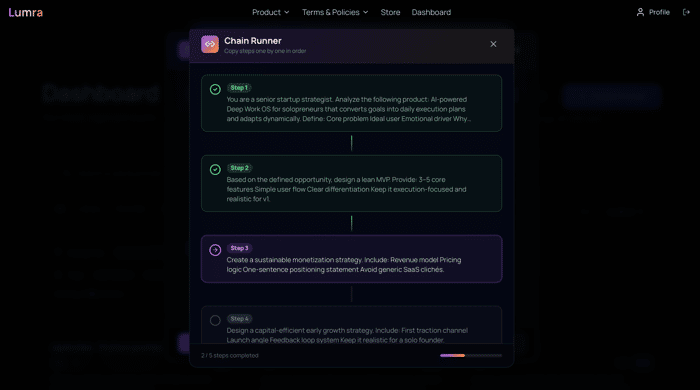
As developers and indie hackers, we’ve all been there: you have a complex task, you send a prompt, the AI misses a detail, you send a follow-up, then another, and before you know it, you’ve burned through your daily quota with mediocre results.
The secret to high-quality AI outputs isn't just "better prompting"—it's systematic workflow management.
The Power of Prompt Chaining in Lumra
Most AI interactions are transactional and shallow. With the Prompt Chain feature in Lumra, you can design a multi-step logic where instructions are linked together. This allows you to:
- Solve Complex Requests in One Go: Break down a massive task into logical steps that the AI processes sequentially.
- Boost Output Quality: By providing structured instructions at each stage of the chain, you guide the AI toward the exact result you need without hallucinations.
- Optimize AI Quotas: Instead of back-and-forth messaging that consumes tokens for every context reload, a well-structured chain in Lumra gets it right the first time, making your credits last much longer.
Stay in the Flow with the VS Code Extension
Context switching is the ultimate productivity killer. Jumping between your IDE and a browser tab to tweak prompts breaks your "deep work" state.
Lumra solves this with its dedicated VS Code Extension. You can now:
- Access your entire prompt library.
- Execute complex prompt chains.
- Manage your AI assets as if they were part of your codebase—all without leaving your editor.
Treat Your Prompts as Infrastructure
In Lumra, prompts aren't just snippets; they are infrastructure. By organizing your instructions systematically, you ensure consistency across your projects and team.
Whether you are automating content creation, generating complex code modules, or refactoring legacy logic, Lumra provides the architectural framework to do it efficiently.
Stop "chatting" with AI and start building workflows.
Check it out here: Lumra

Interesting way to look at it, breaking things into steps instead of back-and-forth prompts probably saves a lot of time and frustration.
Absolutely! You can check Lumra and it's all features -> https://lumra.orionthcomp.tech
Sure Thank you, will check it out.
Prompt chaining is a valid concept, but this reads more like a feature announcement than a build-in-public post. What would make it more compelling: show a real example. Take one complex task (say, generating a full blog post from research to final draft), walk through how you’d chain it in Lumra step by step, and compare the token usage vs doing it in a single prompt. Without a concrete before/after, it’s hard to evaluate whether the tool actually delivers on the promise.
Agree with you. I will take that into consideration. Thank you for the advice
"Eliminating the context switch between the IDE and browser to tweak prompts is the exact kind of productivity win devs need right now. Prompt chaining inside VS Code is a clever way to protect that 'deep work' state. This is a solid contender for this competition; it’s $19 to join and the winner gets a Tokyo trip. Prize pool just opened at $0. Your odds are the best right now."
Round is live 👉 tokyolore.com