Tech is done. Marketing is hard. Is a 6-month free period a valid growth hack?
Hey IH,
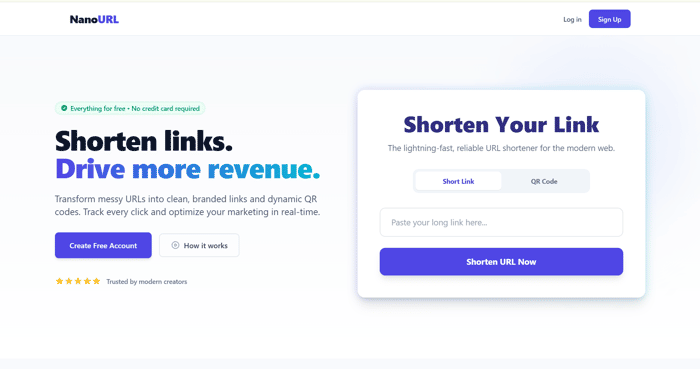
I’ve spent the last few months head-down building NanoURL. I finally got all the technical hurdles ironed out—secure JWT HttpOnly cookies, Google Auth, dynamic QR code generation, the works. The product is solid.
But as a developer, I’ll be honest: my marketing muscle is weak.
To overcome the cold-start problem, I'm considering a "loss leader" strategy: giving away the absolute best version of the product completely free for the first 6 months.
Instead of spending money on ads or struggling to convince people to pay $X/month right out of the gate, I’m thinking of using the product itself as the marketing tool.
The goal: Give early users an amazing, unrestricted experience in exchange for raw feedback, bug reports, and word-of-mouth growth.
Click here : https://nanourl.link/
Is 6 months too long? Does giving it away for free devalue the product in the eyes of the user, or is it a smart way to bootstrap a community when you don't have a marketing budget? Would love your raw thoughts.

The market question is the real one here, and honestly, I'm facing the same thing with my own product right now. URL shorteners are a category where the free tier IS the product for most users. Bitly has conditioned people to expect free links forever. So the 6-month question is secondary to: what does NanoURL do that makes someone switch and then stay paid? What's the use case where you're meaningfully better than what they already use?
At NanoURL, I am focusing on offering premium features at a lower price point, making it more accessible for users who want enhanced capabilities without breaking the bank. After all, it’s all about taking that leap and learning along the way! 🚀
im doing something similar right now actually. launched my app this week and the free tier is basically fully usable — pro is only $8/mo for the extra AI stuff. my thinking was the same as yours, get people in the door, let the product sell itself.
6 months feels long tho. i'd say 1-2 months free then flip the switch. if people haven't given you feedback or told anyone about it in 2 months they probably weren't going to anyway. and honestly free users treat products differently than paying ones — less invested, more likely to ghost.
what i did was make a promo code for my product hunt launch (100% off first month) so people feel like they're getting a deal rather than just "its free." weird psychology but a $8 thing for free feels more valuable than a free thing thats free.
the real marketing problem isnt price its attention. nobody knows we exist lol. thats the hard part.
Thanks for sharing your insights! 🚀 I just deployed updates to my app and am now offering a 2-month free trial instead of a longer period. This way, users can fully explore the features while I work on adding even more exciting functionalities! 🎉 I believe this approach will help create a sense of urgency and encourage feedback. You're right about the challenge of gaining attention—it's all about getting our product in front of the right audience. Let's keep pushing forward! 💪✨
Fellow dev-turned-founder here. I went through the exact same "tech is easy, marketing is existential dread" phase.
Here's what I wish someone told me earlier: free doesn't fix distribution. If nobody knows your product exists, making it free just means zero people use it for free instead of zero people paying for it.
The 6-month free window also creates a weird psychological dynamic — users mentally file your product as "the free thing" and the transition to paid feels like a bait-and-switch, even when they knew the terms upfront.
What worked better for me was having a permanent free tier with real limits. Users on the free plan become your distribution channel (they share links with your branding on them, in your case). And when they hit the ceiling, the upgrade feels natural rather than forced.
The other underrated move: instead of spending 6 months giving the product away, spend those 6 months writing about very specific problems your tool solves. Not "NanoURL is great" content, but "here's how I set up UTM tracking for my newsletter campaigns" type posts. Each one is a tiny SEO asset that compounds. A year from now, those posts bring you more qualified traffic than any free period ever would.
The marketing muscle is like any other muscle — it only grows if you exercise it consistently. Delaying it with a free period just delays the learning.
Thanks for sharing your insights! 🙌 I completely agree that just making something free doesn’t solve the distribution challenge. That's why I’ve decided to offer a 2-month free trial instead of a longer period while I work on adding some exciting new features. 🚀 This way, users can experience the value firsthand without getting stuck in the "free" mindset, and we can also focus on creating content that addresses specific problems our tool solves. This approach should help build a community around our product while setting the stage for a smoother transition to a paid model! 💡
Facing the exact same thing with my project. What I've found is that "free forever" attracts the wrong crowd — people who will never pay. A time-limited free trial (14-30 days) converts better because it creates a natural moment to decide.
Also found that community-first beats any growth hack. Getting 10 real users who talk about your product is worth more than 1000 who signed up and forgot.
Absolutely, I couldn’t agree more!
Let's focus on quality over quantity! 🚀
Thanks Rahul! That's the mindset. Quality conversations > quantity of signups at this stage.
"Hey Rahul,
First of all, congrats on shipping NanoURL — the tech sounds solid (JWT HttpOnly + Google Auth + dynamic QR is clean work).
About the 6-month free period: I think it’s too long.
Here’s my honest take:
Pros:
It solves the cold-start problem well.
You’ll get real users + feedback fast.
Good chance for organic word-of-mouth.
Cons / Risks:
6 months is a very long time. Many users will get used to “free forever” mentality. When you eventually switch to paid, you’ll likely see high churn + complaints.
It can slightly devalue the product in users’ minds (“If it was free for half a year, why should I pay now?”).
You’re burning 6 months of potential revenue with almost zero monetization data.
My suggestion:
Instead of 6 months completely free, consider one of these shorter + smarter versions:
3 months free (still generous but much safer)
Lifetime deal for the first 200–300 users (cheaper than 6 months free)
Free forever for basic plan + paid for advanced features (this is what most successful URL shorteners do)
A lot of indie products that gave away too much for too long struggled hard when they tried to flip the switch to paid.
Quick question:
What’s your planned pricing after the free period? And how many users do you realistically need before you feel comfortable charging?
Wishing you the best with NanoURL.link — the product looks useful!
Thank you for your thoughtful feedback! 🙌 I am excited about NanoURL and appreciate your insights on the free period. After considering the potential risks, I am leaning towards a shorter free trial of 2-3 months (probably less than month) to better balance user acquisition and future monetization. I am also exploring throttling the free service to ensure a sustainable model. Your input is invaluable as we shape our pricing strategy, so stay tuned for updates! 🚀
I'm in this exact place right now. Six years as a developer, shipped my first product (Flowly) in about a month with AI assistance — and the product side felt straightforward compared to what came after. On the free period question: I went with a reverse trial instead — 14 days of full Pro access, no card, then drops to free. The logic was that free-forever trains users to expect free, but a time-limited full experience creates a real before/after. Too early to say if it's working but the thinking felt sounder than indefinite free.
This is the real conversation. I shipped a physical product and the supply chain part was actually the easier half — manufacturing, quality control, sourcing are solvable with the right partners. Marketing to a cold audience with zero brand history? That's where the real work lives. Everyone says "just post on social" like that's a strategy. The founders who figure out distribution before launch are the ones who survive.
That’s an interesting dilemma to be in. A 6-month free period is definitely a bold move, but the biggest risk is that you might end up attracting users who are just looking for a freebie rather than people who actually value the tool.
Instead of a blanket free period, maybe try a "free until you reach X" model? That way, users get to see the value as they grow, and it creates a more natural transition to a paid plan. Another option is to offer the 6 months for free specifically in exchange for a detailed case study or testimonial - that way, you’re at least getting some marketing "fuel" out of the deal while you're not making revenue.
The "tech is done, marketing is hard" phase is where most developer-founders get stuck, and I think the instinct to make it free is actually a symptom of the problem rather than the solution. Here's what I mean:
Free doesn't solve discovery. If people can't find your product, making it free doesn't help -- it just means the people who do find it don't pay. The bottleneck isn't price resistance, it's awareness.
What I'd try instead of 6 months free: pick ONE distribution channel and go deep. For a URL shortener, I'd look at content marketing around specific use cases. Write detailed posts about "how to track UTM parameters for your Substack newsletter" or "QR code best practices for physical product packaging" -- hyper-specific problems where NanoURL is the natural answer. Each post becomes a long-tail SEO asset that compounds.
If you really want a free tier, make it permanent but limited. Something like 50 links/month free, unlimited paid. That way free users become your marketing (they share shortened links with your branding) and you still have a natural upgrade path when they hit the limit.
The 6-month clock also creates a weird incentive: users know the free ride ends, so the engaged ones leave before the deadline and the unengaged ones never convert anyway. A permanent free tier with clear limits is more honest and more effective.
What specific use case are your current users gravitating toward? That's where your marketing angle probably lives.
Thanks for your insightful comment! 🙌 I love the idea of creating targeted content that addresses specific use cases; it can really help us connect with our audience. 🌟 I'll definitely consider implementing a permanent free tier with limits to encourage sharing and growth. Your feedback is invaluable—thank you! 😊
Six months free is a real commitment, and I think the logic is sound — especially for a developer-built product with no marketing budget. The risk worth watching is less about devaluing the product and more about the quality of the feedback you attract. Free users often have different pain points than paying ones. One thing that can help: be explicit that you are in a feedback-focused beta. Ask for a specific exchange — their honest usage data and one 15-minute conversation — rather than just open-ended word of mouth. That framing attracts users who are invested in helping you improve, which is more valuable than pure growth at this stage. The 6-month window also gives you enough time to iterate based on real behavior, not just survey responses. Good luck with NanoURL.
Thanks for your insightful comment! 😊 I really appreciate your thoughts on the importance of attracting the right feedback during our growth phase. I’ll definitely consider your suggestion about creating a specific exchange for honest usage data and a brief conversation. It’s crucial to engage users who are genuinely invested in helping us improve. Your input is invaluable as I move forward with NanoURL! 🚀
URL shorteners are a market where the free tier IS the product for 99% of users. Bitly gives away billions of shortened links. Your 6-month question is really a positioning question: what does NanoURL do that makes someone switch from the tool they already use and then stay at a paid tier? If the answer is QR codes and analytics, you are competing on features Bitly already ships.
Hey there! 😄 It’s definitely a crowded market out there with the big players like Bitly and TinyURL.
Please read this post why and how this started,
https://www.indiehackers.com/post/from-system-design-hobby-to-saas-founder-did-i-pick-the-wrong-battle-b6ac643e8c
The free period doesn't solve the distribution problem — it just lowers the conversion barrier for whoever finds you organically. You still need a way to find those people.
Before committing 6 months of unrestricted access, I'd run a small paid acquisition test first. Something like $10-15/day on Meta Ads for 1-2 weeks. Not to scale — just to test whether a specific audience actually cares about your value prop when it's competing with other things in their feed.
The reason: organic and community traffic (IH, HN, Reddit) self-selects heavily. People who click a link in a forum already have some interest and context. A paid cold audience doesn't. Getting a click and signup from someone who had zero prior exposure to you is a fundamentally different signal than getting one from someone who read your IH post.
URL shorteners have a real targeting angle: SMBs and solo marketers managing multiple link sources, people running UTM tracking for campaigns, e-commerce teams doing affiliate link management. Those audiences exist on Meta and are identifiable. A few hundred dollars testing 3-4 creative angles against them will tell you more about product-market fit than 6 months of free access to the wrong crowd.
If you get zero traction at $10/day after testing, that's meaningful signal before you've given away 6 months of value.
Happy to help you think through what an initial campaign structure might look like if you want a second opinion.
free can definitely get people in, but the bigger question is who you’re attracting, free users don’t always turn into the right users. Might be worth thinking about a small barrier (even minimal) so the feedback you get actually reflects future paying behaviour
Giving early users a great experience for feedback can work well, especially at the start. Six months might be a bit long though. Sometimes a shorter window keeps urgency while still helping you gather insights.
6 months free is a long time to give away something you've already built. The risk isn't that people won't use it. It's that free users behave differently than paying users. They'll use it casually, they won't give you the kind of feedback that shapes a real product, and when the free period ends you'll have a conversion problem on top of a marketing problem.
What worked better for me: I built AI automation tools for my own dealership, got real results, then started writing about those results publicly. Blog posts, LinkedIn articles, community posts. The content became the marketing. People who found the content were already interested in the problem I solved.
If your product is done, your next move isn't giving it away. It's finding 5 people who have the exact problem it solves and getting them to use it at full price. Even $5/month. That first dollar of revenue teaches you more than 1,000 free signups.
Why do you think making it free is going to make it sell, my bro? I won't give you even free products without visibility; struggle to even amass users, then talk about the time you invested in it to just make it free like that...
Marking being hard is becoming a thing of the past now ... People like myself are already building a distribution engine
if you open to suggestions, let me know
It depends on your sales cycle. If your product is complex and users need time to understand its value, a 6-month trial is fine. If it’s a simple product, this long free period can hold back revenue. But if you're still looking for product-market fit and your goal is to refine your app after, it's fine.
As I am currently focused on refining my app and ensuring it aligns with our users' needs, I believe that a longer trial period will provide valuable feedback and insights. Your understanding of this approach is greatly appreciated!