Growing a talent marketplace to $2.5M+/yr after two years of losses
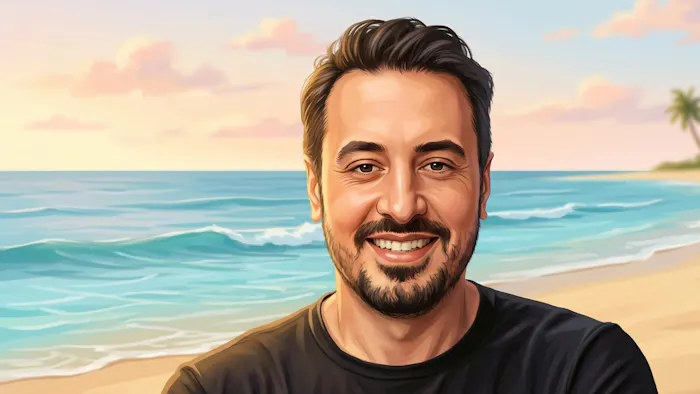
David Stepania is the founder of ThirstySprout, a bootstrapped talent marketplace that's bringing in over $2.5M in annual revenue. He's also the founder of ChoppingBlock.ai. And it all started with a beach, an idea, and a lot of credit card debt.
Here's David on how he got here. 👇
Make it work
I'm David Stepania, a two-time bootstrapped founder. I was born in the Republic of Georgia as the Soviet Union was collapsing, attended 13 different schools across multiple countries growing up, and eventually landed in Seattle, where I went to the University of Washington. That upbringing taught me one thing above all: resourcefulness. During some periods, textbooks were a luxury, so "make it work" became my default operating mode — excellent founder training.
Today, I run ThirstySprout, a talent marketplace that places remote AI and engineering talent — mostly from Latin America, Eastern Europe, and Asia — with funded US startups and enterprises. Companies like The Real Real, Hopper, Mailchimp (Intuit), Rover.com, and a wave of VC-backed startups have used us to build their tech teams.
I also built ChoppingBlock.ai, an AI salary and jobs intelligence platform with a 40K+ subscriber newsletter and a podcast, which doubles as our audience engine.
ThirstySprout crossed $2.5M in annual revenue a while back — and our growth since then put us at #247 on the Inc. 5000 in 2024. This year, we aim to double that and push past the $5M mark with a dramatically leaner team than we had the first time around.
Born out of failure
ThirstySprout was born out of failure. I was coming off a sabbatical in Hawaii after my previous venture, nursing a few product startups that hadn't worked out. The realization that hit me on that beach was simple — to build an extraordinary startup, you need an extraordinary technical team, and finding one you can trust is brutally hard. I didn't have a product idea, so I decided to solve the problem I knew firsthand.
We started as a two-person product development agency, and we made every mistake in the book. We took on underbudgeted projects and over-delivered just to earn testimonials. After enough of those, we realized the model didn't scale, and a friend suggested we focus on staffing remote technical talent instead.
The pivot validated itself almost immediately: A single cold email landed us Rover.com during their hypergrowth phase in 2018. A six-figure engagement and a reference from a hot startup changed everything. Suddenly, we could win clients of that caliber repeatedly.
At the time, I had close to $0 in cash reserves. I funded the gap on personal credit cards — we ran at a loss for the first year or two, peaking somewhere between $50K and $100K in the hole, while I paid myself no salary. I don't recommend that path, but stubbornness is a real business asset.
Building the initial product
For years, the "product" was a service run on top of other people's tools. No custom platform, no code. We deliberately refused to build technology until we had 50–100 actively engaged freelancers and proven, repeatable processes — because automating a process you haven't proven by hand just scales your mistakes.
The initial version was WordPress, then low-code tools like Webflow. The real "build" was the supply side: We went country by country looking for deep talent pools, and found our strongest footing in Georgia — the country I was born in. The cultural fit and engineering work ethic were exactly right, and today we're one of the top talent players there, competing directly with Toptal and Turing.
The initial build didn't cost money — it was those two loss-making years on credit cards, and the time to learn an industry I'd never operated in. The people who helped most were early clients who took a chance on us, and the founder communities I leaned on for advice.
Cutting back on the stack
Today, the spine of the company today is Claude — and I mean that literally, not as a buzzword. Candidate screening and ranking, financial analysis, contract drafting, content, strategy: Most of the real work runs through dedicated Claude workspaces, one per business domain, each loaded with custom instructions. For agentic builds, I use Claude Code.
Around that: Google Workspace and Slack (Slack also runs our community), Beehiiv for the newsletter, Riverside for the podcast, Deel for international contractor payments (team across four continents), Calendly, Fathom for call transcription, BetterProposals for proposals, and Attio as the CRM.
We're also building our talent marketplace product on Next.js, Postgres, and Supabase — anonymized candidate cards, a lightweight ATS, and a Slack notification loop.
The biggest stack change we made was subtraction: Earlier this year, I audited our subscriptions and found 50+ tools, including five overlapping AI subscriptions. We cut aggressively. One tool used at 90% depth beats five used at 10%.
Two fee models — and natural expansion revenue
We have two fee models, and their mix reflects the business's current state.
The first is staff augmentation — clients contract vetted engineers through us, and we take a markup of around 30% on the engineer's rate. For context, competitors like Toptal run markups closer to 100%. This gap is our business model. Because we run lean, we can pay engineers more and charge clients less than the big platforms, and still make healthy margins.
The second is direct placement — a contingent fee of 20% of the candidate's annualized base salary, paid only upon a successful, lasting placement, backed by a guarantee period. We exclude signing bonuses, equity, and benefits from the calculation, which keeps it clean and client-friendly.
Historically, staffing engineers has been the bulk of our business, rather than direct placements, though it's currently split about 50/50.
We started charging from day one; as a bootstrapped company, we never had a free-work phase to graduate from.
The model includes natural expansion. First, land-and-expand: a client who hires one engineer and has a good experience often hires more — most of our revenue comes from repeat placements, not new logos. Second, we also run contract/hourly engagements for clients who want flexible capacity rather than direct hires, which smooths revenue between placement fees.
We are building a bigger expansion play around the placement business: ChoppingBlock serves as an audience and data asset (salary data, jobs intelligence, newsletter sponsorship potential) for the supply side. And a marketplace product reduces our cost per placement. Recruiting fees fund the flywheel; the flywheel makes each fee cheaper to earn.
Owned audience is the only moat
For years, we primarily used high-volume cold email for growth. Early on, we sent a few hundred emails daily with open rates in the high 50s. At its peak, we sent thousands daily — but open rates dropped to the low 20s and reply rates to 2–3%, indicating the channel's declining effectiveness. It worked. It built the company. But it is now dying. AI-generated outreach will soon bury every inbox, and you cannot out-automate spam.
Over the last two years, we deliberately rebuilt our engine around inbound. Three channels:
Community and relationships. We built founder communities (around 6,000 founders at the peak) and joined strategic ones like Hampton. Trust is the entire product in recruiting — word-of-mouth referrals are still our highest-converting source.
Programmatic SEO. ChoppingBlock employs programmatic SEO for AI salary and jobs data, creating thousands of pages that target long-tail queries our exact buyers search for. It compounds while I sleep.
LinkedIn content. I post contrarian, data-grounded takes on the AI talent market: salary data, hiring trends, and which roles are rising versus on the chopping block. That positioning as the "data guy" in AI hiring drives inbound conversations that cold email never could.
The lesson: Rented channels (cold email) got us to millions in revenue, but owned audience is the only durable moat in a world where AI makes outreach free.
Challenges and solutions at every stage
The early challenge was survival. Two years operating at a loss, funded by personal credit cards, no salary, in an industry I'd never worked in. The mistakes were classic — underpriced projects, no niche, no systems.
The mid-stage challenge was self-inflicted: we overhired. Growth felt like headcount, so we scaled to 50+ contractors and drifted from the lean operation that made us work. Unwinding that — getting honest that a smaller, AI-augmented team could produce more than a bigger one — was operationally and emotionally hard.
We deliberately made three changes.
We restructured around single owners of whole domains instead of teams. One person owns our entire programmatic SEO surface. One person owns community and data infrastructure. Each is heavily AI-augmented
We moved the grunt work to AI and kept humans on judgment. AI now handles candidate screening, first-pass matching, call recaps, proposal drafting, financial analysis, and contract drafting, with a human making the final call. Instead of forwarding thirty resumes and hoping, we send clients three to five that are exactly right, each scored against their actual hiring rubric. Fewer people, better output.
We changed the revenue engine itself. Cold email at volume required more people for list building, sequencing, and follow-up. Inbound doesn't scale with headcount: Programmatic SEO, LinkedIn content, and our newsletter compound whether or not anyone is working that day. Higher-quality demand, near-zero marginal labor.
As a result, the company runs dramatically leaner and produces more per person than we ever did at peak headcount.
The current challenge is the industry itself: AI agents are commoditizing exactly the part of recruiting (volume sourcing, resume matching, mass outreach) that most firms live on. We've responded by deliberately abandoning that layer and moving up to the judgment layer — deep vetting, fit, retention.
If I started over, I'd niche immediately instead of being a generalist for years — the riches really are in the niches. I'd start building an owned audience from day one instead of renting attention through cold email. And I'd set a 6–12 month window to test hypotheses instead of letting stubbornness fund losses on credit cards for two years.
Books and AI as unfair advantages
Books shaped the foundation. I've listened to over 200 on Audible — most of the business and self-help canon, from Zero to One to Deep Work to Essentialism to Principles. My takeaway after all of them: Many ideas are regurgitated, and you often read an entire book to find the one moment that unblocks you. But that one moment can be a game-changer, and sometimes an idea I picked up five or ten years ago clicks when I'm stuck today. So I can't name a single book that changed everything — cumulative reading provides a library to draw on at the right moment.
But the biggest resource shift in my career happened recently: I stopped reading about leverage and started using it. AI — Claude specifically — has been the single greatest advantage of my founder life. I did CFO-level financial analysis that found real margin issues in our books. I rebuilt our entire legal stack (MSA, contractor agreements) with AI drafting and a lawyer reviewing. I built an AI coach in Claude Code that pressure-tests my decisions before I commit. As a solo CEO, that's the closest thing to a cofounder I've found.
With that said, never automate a process you haven't proven manually. We successfully scaled every process by doing it manually first, painfully, until we understood it. Every automation disaster came from skipping that step.
Niche down, build manually, and build an owned audience
Here's my advice:
Pick a niche where you have unfair context, and go embarrassingly narrow. I spent years as a generalist agency earning generalist money. The business only grew significantly when we became the people for a specific thing. If you're starting today, niche opportunities in AI are everywhere and mostly unclaimed.
Do things manually before you build anything. Your first "product" should be you, doing the service by hand, learning what actually matters. Code written before that understanding is usually a waste.
Start building an owned audience on day one — a newsletter, a community, a data asset, anything people intentionally visit. Cold outreach still works today, but AI will soon make every rented channel worthless. The founders who own audiences will be untouchable.
Know the difference between stubbornness and strategy. Stubbornness kept me alive through two unprofitable years — but a 6–12 month testing window with clear kill criteria would have led me to the same place faster and cheaper. Persistence on the mission, ruthlessness on the tactics.
What's next?
Our headline goal is to grow ThirstySprout past $10M in annual revenue — and achieve it as we've always done: bootstrapped, with a lean AI-native team, rather than a bloated one.
Beyond this number, we have two tracks.
For ThirstySprout: Productize the marketplace — move from a services company using software to a software-enabled marketplace with service margins, without taking VC money. The AI-native talent niche is exploding, and we intend to own it.
For ChoppingBlock: Become the Levels.fyi of the AI era — the default place people check what AI-era roles pay and which skills are rising or dying. The flywheel involves user-submitted comp data unlocking aggregate insights, wrapped in a newsletter and podcast people enjoy.
And a personal goal. Right now I'm working from the beaches of the Riviera Maya near Cancún, which I'm not complaining about — but the real goal is to someday run all of this from Hawaii. The idea for ThirstySprout came to me there, so building it into something that lets me work from there would close the loop, which means a lot to me.
The overarching goal: Prove that I can build a modern, AI-native company of consequence with a tiny team and zero outside capital.
You can follow along on X, LinkedIn, and my personal site. Or check out The AI Chopping Block podcast.

Leave a Comment
Great founder story. The strongest lesson here is: prove the process manually before trying to automate it.
I also like the shift from cold outreach to owned channels like SEO, community, and content. Those channels take longer, but they create a much stronger moat over time.
Funding two years of losses on credit cards and coming out the other side at $2.5M+/yr takes real conviction — that’s a story a lot of “overnight success” posts skip. Curious how you tracked burn during those loss years — informally, or did you keep tight books even when things were bleak? That discipline usually pays off later, whether you’re raising, selling, or just trying to sleep at night.
This is one of the few founder stories that focuses on durable competitive advantages instead of vanity metrics.
Three takeaways stood out:
• Manual before automation. Validating processes before building software prevents scaling inefficiencies.
• Owned audience over rented channels. As AI commoditizes outbound, newsletters, communities, SEO, and thought leadership become long-term growth assets.
• AI as leverage, not replacement. The biggest gains come from augmenting human judgment rather than automating every decision.
The shift from high-volume cold outreach to an AI-native inbound engine is particularly relevant. Companies that combine specialized expertise, proprietary data, and audience ownership will have a much stronger moat than those relying solely on automation.
Excellent breakdown of what sustainable, bootstrapped growth looks like.
very enggaging content
This really stood out to me — especially the shift from cold outreach toward building an owned audience through community, LinkedIn content, SEO, and a newsletter. The idea of turning distribution into an asset instead of constantly renting attention is powerful.
Its a very inspiring journey
Such an honest, zero-BS founder story, David.
The transition from $100K in personal credit card debt to #247 on Inc. 5000 is proof that stubbornness + high-conviction iteration actually works. Love the operational philosophy here: cutting 50+ tools down to a single deep AI stack (Claude) and keeping humans strictly on judgment rather than grunt work.
I was particularly impressed by the point that "a secured customer base is the only moat." While cold calling can yield some results, it is entirely understandable that customer interest and trust become far more critical once AI makes outreach virtually free.
Additionally, the advice not to automate processes before verifying them manually was excellent. Developers, in particular, may be tempted to build a platform first, but I learned that understanding the process firsthand before writing automation code prevents a tremendous waste of time.
Overall, it was a great story. The journey of growing from a two-person agency into a much more efficient, AI-driven enterprise was especially impressive.
The shift from cold outreach to owned audience is especially interesting. Building an audience that compounds over time seems like a much stronger long-term strategy.
Really enjoyed this story—especially the shift from a service business to building an owned audience and an AI-native operation. The point about proving processes manually before automating them is a great reminder that AI can scale a good process, but it can also scale a bad one very quickly.
With AI making recruiting outreach and candidate matching increasingly commoditized, do you think deep vetting and retention will be enough to remain a strong moat long-term, or will talent marketplaces eventually need to build an even deeper data advantage?
Really interesting growth story. Reaching $2.5M/year after going through two years of losses shows how important persistence, product-market fit, and learning from mistakes can be for a startup. I also like how this kind of journey highlights that sustainable growth usually takes time rather than happening overnight. The 7 Brew Menu is another example of building a focused online resource around a specific audience and topic.
Refusing to build a platform until the service worked manually is a powerful discipline. The real product was the repeatable process for sourcing, vetting, matching, and retaining talent. Once those handoffs were proven, software could reduce cost and variability. Automating before that point would only have made the mistakes harder to see and faster to repeat.
Very inspiring read. “Make it work” mindset and building your own audience seem to be core lessons here. Curious how you balanced running two different businesses at the same time. Thanks for sharing full revenue numbers openly.
This is something I’ve been thinking about a lot lately. Getting the first few customers seems less about having a perfect product and more about finding the right people who actually have the problem.
This is great, I would love to hear some good tips on how to scale my new business.
The cold email section is the part I keep rereading. I'm building an outbound engine for my SaaS right now, so "it worked, it built the company, it is now dying" is not what I wanted to see. My current read is that low volume with heavy research still clears the bar the spam wave keeps raising, and the death is mostly at the thousands-per-day end you were running. David, do your reply rates back that up, or did quality drop across the board regardless of volume?
The part I keep coming back to is the markup comparison — Toptal at ~100%, ThirstySprout at ~30%. That's not just a pricing detail, it's the entire thesis: run lean enough that you pay talent more AND charge clients less AND still have healthy margins. Most marketplace advice tells you to raise prices, but this is a rare case where the lower markup IS the moat — it attracts better talent and makes switching costs real on both sides. Curious whether that 30% gap has held as you've scaled, or if operational costs creep up and eat into it.
Awesome read, super helpful
Great story and very useful lessons. The idea of proving a process manually before automating it really stood out to me. Founders often rush to build software before fully understanding the problem.
I also liked the shift from cold outreach to owned channels like SEO, content, and community. Those assets take longer to build, but they seem much more durable in the long run. Thanks for sharing the honest parts of the journey, especially the years of losses and the lessons learned from them.
With AI making mass outreach easier than ever, I can absolutely see why community, SEO, and useful content become increasingly valuable. Also loved the point about proving a process manually before automating it. Lots of good lessons here! <3
Good story really thanks
story is a masterclass in resilience and resourcefulness. Superb!
Yet another great read. I see myself while reading this. Easy success won't last, and its always good to strive for the best results even when results are not in one's favor.
Two years of losses before profitability is a good reminder that marketplaces are a liquidity game, not a product game. I'm building a zero-commission local marketplace in Senegal ,the chicken-and-egg problem between buyers and sellers is brutal early on. Curious how you cracked the first side of your marketplace.
Owned audience is becoming a real asset. SEO, communities, newsletters all compound while cold outreach gets harder every year.
The strategic shift to focus on a specific niche market has been very enlightening for me. Congratulations on your achievements, and thank you for sharing.
The "never automate a process you haven't proven manually" rule is the one worth sitting with, it's the same discipline running through the WordPress-before-custom-platform decision, the two loss-making years before pivoting, and even the current AI stack (screening, drafting, analysis all layered on top of processes the team already understood by hand). Every mistake he names as "automation disaster" traces back to skipping that exact step.
The subscription audit detail (50+ tools down to a lean stack) is a small thing, but "one tool used at 90% depth beats five at 10%" is a sharper way to think about tool sprawl than most cost-cutting advice, which usually just says "cut costs" without naming what the actual tradeoff is (depth of usage vs. breadth of coverage).
The owned-audience argument lands hardest given the numbers: cold email open rates going from high-50s to low-20s in a few years is a fast decay for a channel that built the whole company. Worth remembering that a channel working today isn't evidence it'll keep working, it's evidence it hasn't been arbitraged away yet.
Congrats on the growth journey! What stood out to me is how much patience and iteration it takes to build a successful marketplace. Many people focus on revenue numbers, but the real challenge is creating a platform that users trust and want to keep coming back to.
I think these lessons apply to many online projects, not just marketplaces. Understanding your audience, improving the user experience, and continuously refining the product based on feedback are key factors behind long-term growth.
It's interesting to see how you managed the difficult phase of early losses and still kept improving the business. I’d love to know — what was the biggest change or decision that helped improve retention and accelerate growth?
2 years of losses is a long runway to stick with something , so what kept you going during that stretch when the numbers weren't there yet?
loved this
The 30% markup against Toptal's 100% is the whole business, and it is also the hardest thing to defend. I ran a services company on the Inc. 5000 for two decades, and every time we added headcount the pressure to raise rates showed up within two quarters, which means the overhiring cycle you already unwound is not a one-time mistake, it is a temptation that returns with every good year. The operators who hold that line do it structurally, by requiring a written case tied to gross margin per head before any hire, not by trusting themselves to stay disciplined.
The most interesting part here isn’t just the use of AI, but where you’ve drawn the line: AI handles screening and first-pass matching, while humans remain responsible for judgment. That feels like the right defense against recruiting becoming a commodity.
As you productize the marketplace, the real moat could be the feedback loop between each client’s hiring rubric and what happens after the placement. If retention, performance, and client satisfaction feed back into the matching system, it becomes much harder for a generic sourcing tool to replicate.
Are you already collecting post-placement outcome data to improve future matches, or is that part of the next phase?
What attracted me was that this sounds more of a persistence story than a growth story. ~
Many founders think the initial traction curve indicates if the business is functioning successfully or not. In fact, the economics of marketplaces often look worse for a long time before they look better.
A framework I have found useful is traction, economics, and positioning. Profits can be increasing while the business still feels fragile. Improvements in economics can happen post-market narrowing. Positioning often becomes clearer much later than what people think.
What signal was it that made you continue during the two-year phase of losses? Was it keeping customers, getting returning customers, supply-side growth, or something else entirely?
I enjoyed the focus on marketing as well. It is one of the few things that helps both acquisition and operations simultaneously in our case.
I liked the emphasis on solving the operational problem first rather than treating software as the starting point. In many small businesses, the biggest improvements come from documenting the workflow, removing unnecessary steps, and only then deciding what should be automated. Another takeaway for me was the value of building channels you control, such as search traffic and email subscribers, because those assets continue to grow even when outreach performance changes. The discussion about reviewing dozens of tools was a good reminder that a lean system is often easier to manage, cheaper to run, and more productive for the team.
For anyone interested in practical SEO and content growth examples, I found this resource useful: juxiangapparel
crazy!
One lesson that really stood out is building the process manually before trying to automate it. A lot of founders rush into building software without fully understanding the workflow, which usually creates more complexity instead of solving real problems. I also agree that owned audiences are becoming much more valuable as cold outreach gets noisier. Programmatic SEO, newsletters, and consistent content seem like assets that keep paying off over time. The part about auditing 50+ tools was also a good reminder that adding more software doesn't always make a business more efficient. Sometimes simplifying the stack creates the biggest gains.
The most compelling part of this story is the willingness to sit through two years of losses. Most founders pull the plug way before they reach the inflection point because they mistake a lack of immediate traction for a fundamental failure of the product. Staying in the game long enough to fix the unit economics is an underrated skill. Regarding the transition, I am curious about how you handled the client acquisition shift. When moving from general talent to a more specialized market, did you find that your churn rate decreased significantly, or was the primary benefit simply higher contract values?
I 'm soo launching my own product and would love to hear some tips from you on how tto scale
That's exciting—congratulations on your upcoming product launch! 🎉
One thing that can really help with scaling is building consistent organic traffic from day one. Focus on SEO, create helpful content, and make it easy for people to discover your product through search.
I've shared a few practical tips and guides on website my that might be useful as well
Best of luck with your launch! 🚀snackdlhub.
This comment was deleted a month ago