Hitting $15k/mo six months after getting sued and acquired

Steven Goh's business was making $10M ARR until LinkedIn sued them. He settled out of court, sold the business, and built a new product in two weeks. Six months later, NinjaPear is at $15k/mo.
Here's Steven on how he did it. 👇
Lawsuits, injuries, and launches
I’m a software engineer and serial entrepreneur — 20+ years behind the keyboard. I've sold two companies.
Proxycurl was by far the largest LinkedIn scraping API on the market, with $10M ARR. But then, LinkedIn sued Proxycurl in January 2025. We settled out of court, and I sold Proxycurl to a competitor.
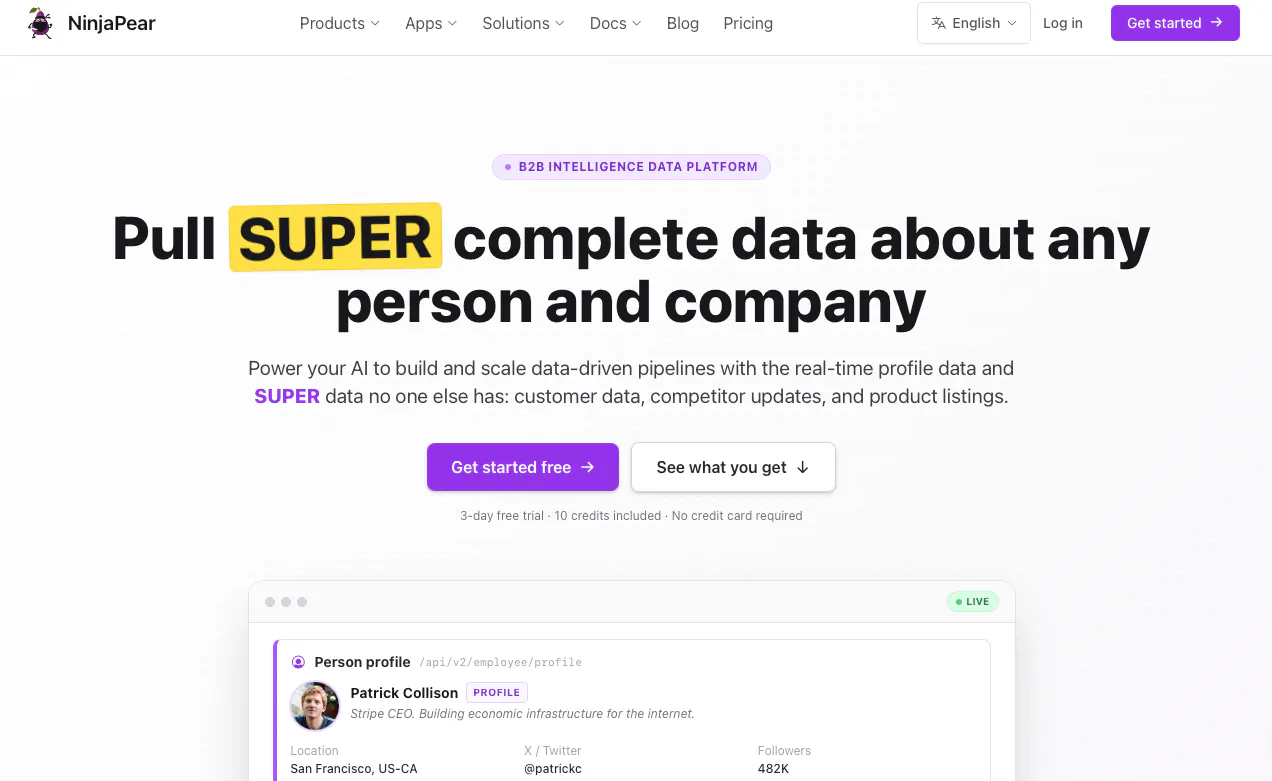
After the acquisition, I fractured the metatarsal bone in my right foot and found myself immobile — with Claude Code. Two weeks later, I prototyped and launched NinjaPear, a B2B company intelligence and data enrichment platform.
That was six months ago. We did over $15k in gross revenue last month.
Picking the idea
I built NinjaPear because I knew the B2B enrichment data market so well. I wanted to build a Proxycurl with my own data instead of LinkedIn's. I wanted to build something that could scale for the next ten years without fear of the Microsoft legal war machine.
So, I prototyped an API with LLM + Deep Web Research that provided rich and complete B2B data. The data is not sourced from LinkedIn, and it includes many data points that LinkedIn simply does not have, such as customer list data, competitor research, and product lists.
I work on NinjaPear as a solo, full-time founder. All it took was two weeks of time and a Claude 20x Max subscription.
But money isn't really an issue anyway. I’m an early investor in cryptocurrency, and I have sold two companies. My past successes allow me to work on NinjaPear indefinitely without needing to turn a profit — and like I said, it's already profitable.
The tech doesn't matter
In the post-AI world, the tech does not matter. My stack is boring:
Python (type hints enable free bug catching via mypy, which you want because of AI)
Typescript/Tailwind (frontend)
Kubernetes
Redash for business intelligence
Grafana
I also own all the servers and co-locate them at my house, powering them with solar power.
Wrestling with churn
NinjaPear users pay for data with credits. Users purchase credits through subscriptions (which are cheaper) or pay-as-you-go top-ups. We rely on users integrating NinjaPear data into their workflow. We grow with them.
The biggest challenge I'm experiencing right now is churn, and I have hypotheses about why it is happening. Our data processing is being compared to LinkedIn's, and it's slower because LLMs perform web-scale research in real-time. Product messaging is also an issue. I'm iterating constantly and working to fix both.
There will always be a challenge. That’s what makes venture building fun! It’s the “IRL” game that I play.
Every failure is a step closer to success. I’d hate for anyone to skip the hurdles and get straight to success — they wouldn’t savor it when they inevitably get there.
A two-pronged GTM strategy
As far as marketing, I focus my attention on:
Emailing my 20k+ newsletter subscribers.
SEO efforts on the domain I retained despite selling Proxycurl.
Posting on reddit — though this is more recent.
I'll continue wearing the GTM hat for the next six months.
Getting okay with failure
These days, I take nothing personally — including failures and haters.
In fact, I frequently tell myself, "Let’s set out to fail 10x." Then, I keep failing and recalibrating as I go.
The cadence of the output is what matters. Just keep going. And keep failing.
For example, a few days ago, I spent a couple of hours knocking out this article on Reddit, and I barely got any traction on it. Younger Steven would be very upset. Now, I know it means to try again and again, and eventually something will go viral.
Try again tomorrow.
Commitment and introspection
Here are two pieces of advice I give my brother, who has tried a couple of times but is still stuck as an employee.
Introspect! Don't just do. Do, ship, and seek feedback to improve. Stop, think, then iterate. Introspection is a crucial skill.
Commit. Once you start, keep going. Even if it's just one hour a day, keep going. Eventually, lightning will strike, and things will work out.
What's next?
From here, my goal is $1M ARR as a solo founder. TOTALLY DOABLE!
Follow me on X and subscribe to my 1MO Solo Founder Newsletter! Or check out NinjaPear.

Leave a Comment
Thanks for sharing the journey
Thanks for sharing your journey. I really liked the mindset of treating failure as part of the process rather than something to fear. Building a profitable business after such major setbacks is inspiring, and your focus on consistency and iteration really stands out. Wishing you the best on the road to $1M ARR!
The shift from relying heavily on platform scraping (like LinkedIn API) to building an LLM + Deep Web Research engine is a masterclass in risk mitigation. When Microsoft/LinkedIn comes after you, it’s a terrifying wake-up call, but building NinjaProw without their data is a massive moat.
Question on the technical side: How do you handle the latency when combining LLMs with live deep web research for data enrichment? Usually, real-time scraping and processing take time compared to cached databases. Congrats on the insane pivot!
That’s a huge amount of change in six months. What helped you stay focused while dealing with the legal situation, acquisition, and rebuilding at the same time?
The strongest part here is choosing a market you already understood deeply instead of starting from zero. Rebuilding around proprietary data rather than depending on a platform-controlled source also seems like the real strategic shift. I’d be curious whether churn is driven more by slower data delivery or by users not integrating the product deeply enough into their workflow.
Really enjoyed this. What stood out to me most wasn't launching in two weeks—it was how quickly you moved on after such a massive setback. A lot of founders would spend months looking back after something like that, but you immediately started building again.
I also liked your point about introspection. Shipping is important, but taking the time to understand why something worked or failed is what compounds over time.
One thing I'm curious about: if you were starting today without your existing audience or newsletter, what would be your first move to get the first 10 paying customers?
coool
Steven's bounce-back with NinjaPear is an incredible masterclass in founder resilience and strategic asset retention, proving that keeping an owned newsletter and domain after an exit is the ultimate distribution cheat code. While pivoting from platform scraping to real-time LLM web research successfully mitigates major legal vulnerabilities, it introduces a tough UX hurdle where users compare AI latency against cached databases like LinkedIn. How is he tackling this perception of slowness to curb early churn, and how confident is the legal framework that this deep-web enrichment model safely sidesteps the compliance landmines of the previous setup?
The "keep failing and recalibrating" mindset comes through clearly here, and it's a refreshing way to frame the Reddit post that flopped — most people would quietly bury that instead of naming it as just another data point on the way to something working. Going from a $10M ARR business through a lawsuit and sale, straight into building and shipping something new in two weeks, says a lot about treating the failure/setback cycle as normal rather than as a crisis each time.
The churn hypothesis is interesting too — comparing speed against LinkedIn's cached data versus your real-time deep research is a genuinely hard problem, since users feel latency immediately even when the underlying data is better. Have you experimented with showing users a partial result fast (even a rough first pass) while the deeper research finishes in the background? Might help the "waiting" feel less like slowness and more like the product actively working for them.
Also appreciate the advice to your brother at the end — "introspect, don't just do" is easy to say and much harder to actually build into a routine. Rooting for NinjaPear to keep climbing past the churn issue.
Hosting your own servers at home (powered by solar, no less) while running a $15k/mo data enrichment platform is the ultimate solo builder flex. Massive respect, Steven.
Getting sued by the Microsoft/LinkedIn war machine would crush most founders, but pivoting to LLM + Deep Web Research in two weeks is insane resilience.
I completely feel your pain on the churn tied to processing speed. When you transition from structured, instant APIs to real-time AI research, users still expect millisecond API responses but get LLM latency instead. It's a brutal UX hurdle, but it's the absolute right trade-off to bypass the walled gardens.
Your "fail 10x" mindset is exactly what keeps bootstrapped founders alive in the trenches. Keep shipping, keep failing, and keep recalibrating. Rooting for your sprint to $1M ARR! 🚀
Loved your story !
do you guys have VDP ? i have something.
What an absolute rollercoaster of a story, Steven! Getting sued by a tech giant after hitting $10M ARR would make most founders quit, but bouncing back and building NinjaPear in just two weeks is pure indie hacker grit.
I love the detail about you being immobile and just grinding with Claude Code. It really shows how modern AI tooling changes the game for software engineers, allowing us to prototype and push to production at lightning speed.
Wild turnaround time.
We've been building out our own modular pipelines using Python + Claude Code, and it's insane how fast you can ship when you ignore bloated enterprise platforms. I totally agree that the tech doesn't matter anymore.
Definitely going to test out the NinjaPear API for some intelligence research we are doing right now. Love seeing the bounce back from the LinkedIn lawsuit, tbh. Keep going!
What struck me most wasn't the two-week build — it was the line about money not really being an issue because of the crypto gains and prior exits. That's probably a big reason you can say "let's fail 10x" and actually mean it. It's a lot easier to treat failure as pure data when rent isn't riding on it. Genuinely curious: for someone on their first business with no cushion at all, do you think the "don't take it personally, just keep failing" mindset still holds up the same way, or is it a luxury that only kicks in once you've already banked a win?
What an absolute rollercoaster of a journey! Going from 10MARR,gettingsuedbyaplatformgiantlikeLinkedIn,settling,sellingthebusiness,andthenspinningupNinjaPearto10MARR,gettingsuedbyaplatformgiantlikeLinkedIn,settling,sellingthebusiness,andthenspinningupNinjaPearto15k/mo in just 6 months is the ultimate definition of founder resilience.
Your story highlights one of the biggest fears for many indie hackers: platform risk. For those of us building products that integrate with, scrape, or enhance third-party platforms, the threat of a giant closing the gates is always in the back of our minds.
When you designed and launched NinjaPear, did you intentionally build it to minimize dependencies on external platforms to avoid a repeat of the LinkedIn situation? Or do you believe platform risk is just an inevitable cost of doing business at scale that we shouldn't worry about too early?
Thanks for sharing your story. Keep crushing it!
WOW IT REALLY LOOKS GREAT
The "set out to fail 10x" framing is one I hadn't heard put that way before. Most people say "embrace failure" which feels abstract. Setting a failure quota makes it concrete and almost gamifies the process.
The churn problem you're describing sounds like a trust gap more than a speed gap. People tolerate slow when they believe the output is worth waiting for. What does your messaging say about why real-time web research is actually better than a static LinkedIn snapshot?
The automation piece is underrated. Most founders spend 80% of their time on ops that could be templated. Did you build the automation yourself or use Zapier/Make?
great resilience
What stood out to me is that the real advantage wasn’t building the product in two weeks. It was the years of industry experience, plus the distribution he had already built through SEO, his domain, and newsletter. AI accelerated development, but experience and distribution made the business work.
how did you avoid the legal stuff?
The line that jumps out to me is "the tech doesn't matter" - but I'd argue the sourcing strategy is the actual product moat here, more than the LLM layer on top of it. Proxycurl's ceiling was that its entire value chain ran through one company's ToS, so the real fix isn't just avoiding LinkedIn specifically, it's building enrichment on a source graph diverse enough that no single platform's legal team can end the business with one filing. On the churn side, I'd bet the perception-of-slowness problem is solvable without actually being faster: showing users a live trace of what's being researched (sources checked, data points found) while they wait reframes the wait as depth instead of lag, similar to how flight-search sites show "checking 200 airlines" instead of a blank spinner. Curious how you're thinking about source diversification concretely: are you already pulling from enough independent sources that losing any single one wouldn't meaningfully dent the product, or is that resilience still a work in progress?
what are your some insights in organic marketing that people should definetnly follow, and legal things are becoming quite complex now days so I think we need a startup that handles the legal work of a startup / company
I really liked your point about not taking failures personally. Most people only see the wins, but they don't see the dozens of launches, experiments, and posts that didn't work. Appreciate the transparency.
amazing
I have had the same problem with reddit. Write a long post - and they will flag it as AI. I got one of my posts flagged by some readers and I had to fight them tooth and nail that it is not AI.
Loved your story !
Great Idea!
As someone who currently makes about $6 MRR after having spent 4 years developing my product, all i can say is... wibble... lol.
Your 20k newsletter is obviously a massive asset. How long did it take you to build that up? I've just joined signed up BTW.
That's quite a journey. What stood out to me is that legal challenges don't always define a business. Sometimes they become a catalyst for building stronger systems, making better decisions, and creating a more resilient company. Congratulations on turning a difficult chapter into meaningful progress.
Good shit my guy
Loved the transparency around the lawsuit, rebuilding, and dealing with churn. It's refreshing to see someone talk about the challenges instead of only posting revenue screenshots. Wishing you the best on the road to $1M ARR
Getting sued by LinkedIn at $10M ARR, settling, selling, breaking your foot, and launching a new product in two weeks is genuinely one of the more insane founder timelines I've read.
The churn problem you described is interesting because it sounds like a perception issue as much as a product one. Users are benchmarking against LinkedIn's speed without accounting for what real-time LLM web research actually gives them that LinkedIn can't. Have you tried making the research process visible while it runs so users feel the depth rather than just seeing the wait?
The sued and acquired part hit me hard - that's the kind of thing that makes most people swear off entrepreneurship altogether. Bouncing back to $15k/mo in just six months is a hell of a recovery.
Incredible resilience, Steven. The 2-week MVP turnaround with Claude Code is definitely the flashy headline, but the real masterclass here is your negotiation on the asset carve-out during the sale.
Retaining your 20k+ newsletter subscribers and the original domain gave you an immediate distribution cheat code that most solo founders spend years trying to build from scratch. It perfectly proves that while code has become deeply commoditized, an owned audience and deep domain expertise remain the ultimate unfair advantages.
Good luck on the road to $1M ARR!
is it?
Nice
Yes this is a best brand
This feels so nice to read!
Impressive resilience. Looking forward to seeing where NinjaPear goes
That's an incredible turnaround! Reaching $15k/month just six months after dealing with a lawsuit and an acquisition shows a lot of resilience and determination. It would be really interesting to hear what strategies, lessons, or changes had the biggest impact on your growth during that period. Congratulations on the impressive milestone, and thanks for sharing your journey!
perfect comeback
The most instructive detail here is buried: he kept the domain and the 20k newsletter when he sold Proxycurl. Having architected a merger and advised on several exits, I can tell you the assets you carve out of a sale often matter more than the headline price, because distribution you keep is a head start on the next company. The two-week rebuild gets the attention, but the years-old email list is doing the work.
You're correct :) This was a non-negotiable for me.
One thing that stood out to me is that the real advantage wasn't building an MVP in two weeks—it was spending years developing deep domain expertise before writing those two weeks of code.
It's easy to read stories like this and focus on the speed of execution, but the foundation was already there: understanding the market, knowing the customers, and having distribution through an audience and SEO.
I also appreciated the point about separating yourself from failure. Shipping, reflecting, and iterating consistently seems like a much healthier mindset than expecting every launch or marketing experiment to succeed.
A lot of practical lessons packed into this interview.
Incredible resilience story. Getting sued AND acquired in the same timeframe is wild. The fact that you pushed through to 5k MRR within six months speaks volumes about execution focus. What was the single most important decision you made post-acquisition that accelerated growth?
I'm still figuring it out. But there isn't ONE thing. It's really a constant iteration of the product, marketing, product messaging, ICP, etc.
Exactly — there's no silver bullet. It's the relentless iteration across product, marketing, messaging, and ICP that compounds over time. Thanks for distilling that truth.
LinkedIn scraping has always been a tough space... LinkedIn keeps fighting scrapers, APIs break, workarounds stop working, and there are constant legal and compliance concerns.
We explored a similar problem internally for company intelligence, candidate research, and risk assessment workflows. In the end, we moved away from relying on LinkedIn data and started combining information from multiple sources instead. It's more complex and takes longer to build, but it's far more stable in the long run.
The direction you're taking with independent data collection and enrichment feels like the right one. Good luck with NinjaPear.
You are right. But more importantly, you won't get sued or have LinkedIn shut off your supply; which means you can scale without fear. Unlike how it was like when I was with Proxycurl, for which I was always trying to exit the company for fear of lawsuit, until I actually got sued.
By obtaining comprehensive data on our direct competitors, we gain a significant market advantage, provided we know how to leverage it at the right time and understand what to do and when to do it with this concrete data. Now, with AI, everything becomes easier. Congratulations on your execution and good luck on your journey.
Wow, how did you grow a newsletter to 20K? And isn't that enough to help you go viral?
I write a lot, see nubela.co/blog, and also past users. Nah, 20K readers won't get you viral. Assuming 10% open rate.
You settled with LinkedIn and sold Proxycurl, then built a direct replacement using LLM web research instead of LinkedIn scraping. The legal risk isn't necessarily gone though, it's just shifted. If NinjaPear's "deep web research" is pulling data that originated on LinkedIn profiles even indirectly, through third-party aggregators or cached sources, that could still be in contested territory. Have you had legal counsel specifically review the data sourcing chain, or is the assumption that LLM-based research is clean by default?
Really enjoyed reading this. I like how you turned a tough situation into something positive and just keep shipping. The "fail 10x" mindset is something more founders should try. Good luck on the journey
I honestly envy you; I see you've grown quite a bit, and I'm really curious—which cryptocurrencies did you sell, and which ones are you buying now?
I bought a bunch of BTC/ETH/Monero. I sold it all the moment I made a million bucks from it. I consider cryptocurrencies a scam.
Great article on the journey to $15k MRR. I especially appreciated the focus on introspection and how you navigated through the legal challenges. The point about consistency and commitment resonates—it's easy to give up, but continuous iteration is where real progress happens. Your insights on GTM strategy and focusing on what matters (not just the tech stack) are valuable lessons for anyone building a data product. Thanks for sharing your story!
What an inspiring journey! Your resilience through tough times and turning it into a $15k/month business is nothing short of remarkable. I love how you focused on community building—it's so essential in this space!
What is the most effective distribution channel so far?
SEO
I think this is interesting, but there’s something I’d like to know: given where I am right now, before I’ve made 15k, how do you get your first users? I see on the site that you have logos from big companies—how did you convince those companies, and how did you make sure they wouldn’t sue you over GDPR, SOC2, ISO, etc.?
this doesn't look over nigh success
the 2-week rebuild is the flashy part, but the post skips the real question: proxycurl didnt die from a bad product — a $10m business sat entirely on scraping one company he had no relationship with, so that lawsuit was a when, not an if. ninjapear is enrichment too. is the data pipeline his this time, or just a different platform's cliff edge? thats what id want to know before calling it a comeback.
This comment was deleted 2 months ago