Hitting $40k+ MRR with bottom-of-funnel content until AI search forced her to change tactics

Cecilia Razak built a tool to facilitate remote work at her previous business. She then launched it as Slides With Friends and grew it to $40k+ MRR via word of mouth and bottom-of-funnel content. But now, AI search is affecting her traffic, and she's recalibrating with new tactics.
Here's Cecilia on how she's doing it. 👇
$40k+ MRR and two young kids
I started in academia, then worked at branding and marketing agencies, but I've been running my own tech startups for about a decade now. In that time, I've brought companies from an initial idea to about $60k MRR a few times.
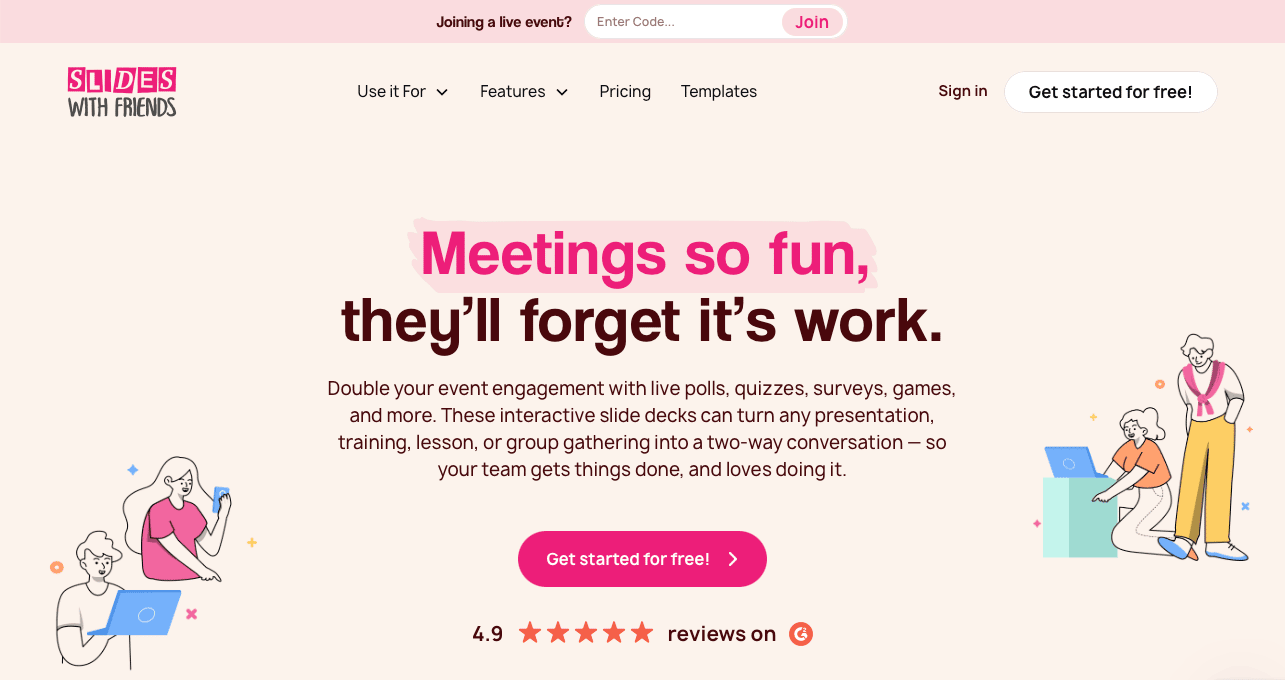
My cofounder and I work on Slides With Friends. It's an interactive presentation tool, launched in 2020. I don't share revenue publicly anymore, but we crossed $40k MRR in 2024.
I'm also recently postpartum and raising two young kids. Life is busy and full for me these days!
Building for her other business
Slides With Friends launched during the pandemic, a time of profound disconnection.
Like most useful tools, it arose from a need our own business had at the time: to facilitate connective teamwork like meetings, reviewing material, assessing, and playing.
We needed a tool that made gathering and engaging large groups easy, fun, and accessible for everyone — regardless of location. And we needed a way to onboard and train new team members.
So, Slides With Friends grew out of a different business's experience during quarantine.
Needs, experience, and time
Building an initial product that led to paying users was possible and quicker for us, with the help of three key elements:
A clearly defined need that we could fulfill not only for ourselves, but also for other users and businesses: running meetings with employee feedback and assessment.
SaaS business experience: We both previously ran companies and built software.
Time: With the pandemic, we could focus on this build because our other business slowed considerably.
My cofounder and I spent long hours talking about what would perfect the experience, what people wanted, why they wanted it, and how to make it all salable.
A product that lends itself to freemium
We're a subscription model, and we price by the seat. Most of our users are self-serve individuals, and we secure larger ACV contracts with orgs and enterprises through higher-touch sales. Our margins are typical-SaaS-excellent; the main costs are payroll and servers.
We started charging when we had an MVP and a sales website. The first paying user that we didn't know — always a very exciting moment — gave us $48 for unlimited annual access. This occurred after the tool had been live for a couple of months, with friends and users we had reached out to already using and paying us. At that point, we also had a few strong blog posts up.
We have a product that lends itself well to freemium: it's an interactive presentation tool. Users market it to their group when they use it, because their whole group experiences that "aha moment" during their live event. We therefore offer a robust freemium tier that lets people host unlimited live events. The more events, the more marketing they do for us.
Iterating on growth
We did a lot of wheel-spinning before we honed in on effective growth strategies. For example, we tried Product Hunt launches. But it didn't take off until we did two things.
First, we had to understand our Ideal Customer Profile (ICP) in extreme detail: What problems did we solve, and who was willing to pay for that solution?
Then, we had to target our ICP with:
Bottom-of-the-funnel, buying-intent blog content
Word of mouth, which worked well because our tool is a group event platform
In the beginning, organic search was our strongest channel and, also being one of our bailiwicks, yielded fast growth. Now, we still get enough traffic for good leads, but the recent shifts in the AI search landscape caused revenue to fall.
We are moving the needle back up again by focusing on higher LTV sales to inbound, qualified ICPs. AI sorts these leads to determine their potential value based on parameters like email address, onboarding details provided, product-qualifying activities, etc.
We iterate and adapt as we go.
Time and churn
One of the aspects of our particular industry is that it's novelty-biased, meaning we get some churn after annual subscriptions expire. As a result, we expanded into more business use cases, which offer longer staying power.
If I were to start over, I might position us this way from the start — less toy, more tool.
Time is my other challenge. It's the real golden value, and I have so little of it right now that I am hypervigilant about where I spend it. I think it would have been a good idea to pause more fully while having babies — trying to do both has been hard.
Unfair advantages
I would not be here today without all the help, luck, and perseverance I've been blessed with. First, my cofounder, who is also my husband, drives ideas and possesses true business and technical talent. His dedication to learning, adapting, and finding paths forward is our special sauce.
Past funding launched us to where we are now — I couldn't do this as I am without those angels.
I also have childcare and family help. I couldn't do this without help, especially with young kids at this stage of my life — if you can, I am impressed by you and hope you are doing okay!
In terms of books, I like the Buddhists, the Stoics, and systems thinkers. The last good book I read was A Swim in a Pond in a Lake.
My main quality is a drive to just keep going. You can just do things, you know.
Do your own thinking
Here's my advice.
Think about others before yourself. This helps you understand a need well enough to create a custom solution and sell it. If you start from "I want to be an entrepreneur," you lack direction. If you start from "Here's a problem I understand that others also have — what do they need, how can I help them?" — you gain business direction.
Oh, and don't use AI to give you ideas or strategy — it makes things muddy, and can only recycle from its training data, which is not a good recipe for "new" or sparks of genius. Use it for research and task completion; this is where it shines. It's like having a very dedicated, but not big-picture-understanding, first-time intern. Do your own thinking.
What's next?
From here, I want to grow to around $1M ARR, then sell, start something new, and spend more time with my kids. I'll do that by increasing ACV contract sales. And by hiring a salesperson once we solidify that process.
I don't have any socials anymore. They eat time and mindshare — and you have to tend and cultivate what gets your mindshare. But you can check out slideswith.com.

Leave a Comment
Great question — and I suspect the answer is "both, but the buyer change is what unlocks the habit." An org renewing is making a procurement decision; an individual is making an emotional one, and emotions fade after the novelty does. The "less toy, more tool" shift probably worked because it changed who was deciding to renew before it changed why. If I were Cecilia, I'd want to know whether the org accounts churned less than the individual ones after the first year — that would isolate which lever actually fixed it.
$40k+ MRR through word-of-mouth and bottom-of-funnel content is impressive, especially building it while running two businesses. The AI search impact you mention is something I'm starting to think about too — search behavior is clearly shifting away from traditional click-through. Without giving away too much, is the recalibration more about content format (e.g., writing for AI summarization) or about shifting spend toward other channels entirely?
"Time being the real golden value" is my favorite part of your story, couldn't agree more. I also loved your point about using AI for research and task completion, but keeping the actual thinking and strategy human. I think it's very easy to automate so much that you end up automating the part you're actually good at 😊. I really hope you get to that $1M ARR and the exit you're aiming for!
The “less toy, more tool” point really stood out to me.
I am seeing a similar challenge with AI/B2B products: it’s tempting to describe the product by the feature, but the buyer usually cares more about the operational risk or workflow behind it.
Also liked the point about shifting from chasing more organic traffic to understanding qualified ICPs more deeply. With AI search changing discovery, bottom-of-funnel content now needs to do more than rank — it has to clearly explain the pain, urgency, and next action.
Curious how you’d think about this: when traffic drops but the remaining leads are more qualified, what would you watch first — demo requests, activation, paid conversion, or ACV?
Really interesting read — especially the part about AI search impacting traffic. I'm working on an AI product myself, so hearing how you're recalibrating is super helpful.
Really inspiring! Great case study.
May I ask how SEO was initially built? Have you done any advertising and streaming? Or external link building?Thanks
The highest value thing we did in the beginning was probably: deep research into what constituted buying-intent, bottom-of-funnel, perfect-use-case-match search terms / keyword phrases. For this we used SEMrush / SurferSEO / GA4 / and heavy actual searching in incognito mode (what's ranking? what are people actually looking for and clicking on when they look for X term?")
We made a spreadsheet of over a hundred of these high-potential terms, rated by best match for our tool, and started working our way down the list creating blog posts. This was by hand, pre-llm. Each post was a prospect. Some yielded gold. We ended up with about a hundred posts, and 5-20 of them made us a huge portion of our total growth. Hope that helps.
The most interesting takeaway for me is that the answer to declining organic traffic isn't necessarily “publish more content.” Shifting toward higher-LTV customers and getting more value from qualified ICP traffic seems much more sustainable. I also liked the “less toy, more tool” positioning — novelty can drive adoption, but recurring business workflows are what ultimately drive retention.
The AI-search pivot away from pure bottom-of-funnel content matches what I've seen on a Roblox game guide site I run — the pages that still hold up are the ones answering a specific mechanic question in detail rather than generic overview content, since that's exactly the kind of granular query an AI answer engine tends to cite verbatim rather than summarize away. A step-by-step page like this one keeps ranking even as broader guide pages lose visibility: https://maplehospitalroblox.com/blog/how-to-do-surgery
"Your summary of 'needs, experience, and time' is spot on. Many great SaaS products aren't just dreamed up out of thin air; instead, they’re born from real-world work scenarios where founders identify pain points and solve them firsthand. This 'scratch your own itch' approach is often the fastest way to validate a product's core value
Love this! Interactive group tools really have the best built-in freemium flywheel. Thanks for sharing such an honest breakdown! 💡
Fantastic breakdown. Moving from a novelty tool to a core business solution is such a smart way to beat SEO shifts.
When you pushed toward enterprise use cases, did you separate your self serve funnel from your high touch sales pipeline?
Once signed up, we pull out the higher value (based on pql and metrics provided during onboarding) leads and contact them separately. Or we point people to our sales form, and work with them as larger leads from the start.
Cecilia mentions shifting toward higher-LTV sales to qualified inbound ICPs instead of just chasing organic volume. How significant and quick of a traffic drop occurred that led to the higher-LTV focus ? Trying to figure out how much to plan for that shift versus react to it when it happens.
You cannot predict -- only react to what is, from where you are. (try predicting the pandemic / ai /whatsnext, and you'll spin your wheels forever on defense.)
Honestly so impressive balancing two kids and scaling to $40k+ MRR! 🤯 AI search screwing with traffic is such a real pain right now though, super curious to see what tactics she's using to pivot. Thanks for sharing this!
hey, this is one of those stories that makes me rethink everything. $40k MRR, kids, life chaos and still pushing forward. the advice about thinking of others first is gold. AI for research, not ideas. thank you for sharing this.
The part about bottom-of-funnel content getting hit by AI search really stood out to me. It feels like SEO alone is becoming a much less dependable growth engine, while knowing your ICP deeply and building distribution into the product itself matters more than ever. I also liked the point about using AI for research and execution, but not outsourcing the actual strategic thinking to it.
Awesome case study! The built-in viral loop of interactive presentations—where every live event doubles as a product demo for attendees—is product-led growth at its finest. Wishing you the best as you scale toward $1M ARR!
Huge respect for sharing the reality of postpartum founder life alongside building a $40k+ MRR business. Moving away from low-ACV, high-churn self-serve use cases toward enterprise/org-level contracts is the absolute right play.
Also, love your take on AI: treated as a task-oriented intern rather than a source for strategy. Congrats on the consistent growth
Huge respect for sharing the reality of postpartum founder life alongside building a $40k+ MRR business. Moving away from low-ACV, high-churn self-serve use cases toward enterprise/org-level contracts is the absolute right play.
Also, love your take on AI: treated as a task-oriented intern rather than a source for strategy. Congrats on the consistent growth
The shift from "toy to tool" is such an underrated piece of advice here. When you build something highly interactive or event-based, it’s easy to get caught up in the engagement metrics and miss the actual enterprise utility. Transitioning that positioning to focus heavily on long-term business use cases is exactly how you beat the novelty-bias churn. Really appreciated the candid takeaway on ICP alignment.
This is incredibly valuable. Seeing the $40K+ MRR journey laid out like this is inspiring.
The "toy vs tool" shift really resonates. Building my API product (ModelBridge), I've been going through the same realization — starting as a side project that made multi-model access easier, but the real retention comes from being "production-grade infrastructure."
Also, the AI search traffic change hits close to home. AI makes information more accessible, but it also makes "just blogging" harder to reach users. Are you seeing a strategic shift from PLG toward SLG with the higher-ACV enterprise focus?
the line that stuck with me wasn't the mrr number, it was "i think it would have been a good idea to pause more fully while having babies." most founder interviews skip that kind of honesty in favor of the growth-hack details. appreciate you including it.
Really impressive founder journey especially interviewing hundreds of founders. I think the biggest lesson is how much you can learn by consistently talking to users and building around real problems. I’m also interested in the indie-hacker space and recently came across thepickuplinez always interesting to see how different products find their audience.
Really interesting how you found a distribution channel that actually fits the product. The part about users naturally exposing the product to their whole group is especially interesting. Curious—what was the hardest part about figuring out your ICP and finding that channel?
when i read this story ,how people are getting nice ideas why im not getting such a idea ?
I visited your slideswith and it was awesome idea. Connecting between people and keep their relation closely is the core idea of social I think. I am really sorry you are gonna sell the agency and retire from the socials since your sildeswith is quite good creation I've ever seen. and As a ML engineer, it would be ok if there ML-related function in slideswith like simple Q&A as a support or chatapp. thank you.
Bottom-of-funnel content is underrated — most founders chase viral top-of-funnel and wonder why nobody converts. The shift to visual/AI-optimized content is becoming the new SEO. We're seeing it firsthand with creators who now optimize for mobile search results, not just rankings.
The most interesting part for me was the shift from bottom-of-funnel SEO to increasing LTV from the qualified traffic that still comes in.
A lot of founders react to AI search by trying to publish even more content, but this is a good reminder that the better response may be downstream: understand the ICP more deeply, score intent better, and extract more value from fewer but higher-quality leads.
Also loved the “less toy, more tool” takeaway. Virality can get people in the door, but recurring business workflows are what make retention durable.
That incognito-mode research process you described (rating terms, watching what's actually ranking and getting clicked) is the same discipline that still works now, just aimed at a different question. I run something close to it weekly, real buyer questions, private browser, no login, logging whether ChatGPT/Perplexity name a business, paraphrase it, or skip it entirely. Same manual grind you're describing, just a different destination for the click.
One nuance worth adding to the 'AI search forced a change' framing: Google's own public position is that solid SEO fundamentals (clear entity signals, content that actually answers the question, off-site consistency) still carry most of the weight in whether an AI engine cites you. What changed isn't that SEO stopped working, it's that ranking #1 and getting cited are now two different outcomes that can move independently, so a page can hold its position and still stop being the thing an AI model reaches for. Worth tracking both, not swapping one for the other.
"Less toy, more tool"—that line hits the nail on the head for any interactive or event-driven SaaS. Event apps get insane initial virality and word-of-mouth through freemium exposure, but annual churn will eat you alive if users only log in once a quarter for a team social. Shifting positioning toward everyday business workflows is the only way to turn novelty into actual long-term retention.
The shift from BOFU organic search to AI‑driven search disruption is affecting many content‑first SaaS companies right now. The clever move by Cecilia is that of trying to out‑volume AI content engines they doubled down on lead scoring parameters such, as email domains, onboarding signals and in‑app usage to close larger ACV enterprise deals. When organic top‑of‑funnel volume falls, squeezing lifetime value out of qualified inbound traffic becomes the exact operational playbook to run.
The "GSC won't tell you when ChatGPT stopped naming you" point above is the one I'd chase first. GSC only reports what Google's crawler saw and what triggered a click from Google's SERP — it has zero visibility into whether an LLM cited you, paraphrased you, or skipped you entirely when answering the exact buyer question your bottom-of-funnel post was written for.
The cheap version of this diagnostic: take your best-performing BoFu post title, phrase it as the buyer would actually ask an AI assistant (not the keyword, the question), and run it against ChatGPT/Perplexity/Claude a few times over a couple weeks. Log whether you show up, get paraphrased without attribution, or vanish. That log is the leading indicator — rankings and even clicks can hold steady for a while after a page has already stopped being the source an AI model reaches for.
The pages that keep surviving in my experience are the ones that answer one specific question unambiguously in the first two sentences, structured so an LLM can lift the answer cleanly — vs. pages that bury the answer under throat-clearing intro paragraphs, which is exactly what most "buying-intent" blog content optimized for old-school SEO looks like.
The "churn after annual subscriptions expire" part is the one I keep circling back to. With a novelty-biased product, the annual renewal is basically a second purchase decision — the novelty is gone, so the customer has to re-justify the tool.
When you expanded into business use cases, did renewals improve because the buyer changed (an org renewing vs. an individual), or because the tool got woven into recurring workflows? Curious whether the fix was the buyer or the habit.
The bottom-of-funnel content worked because it was written in buyer language, what someone actually types when they are ready to pay, not how the product describes itself. That gap between how a founder describes their product and how a buyer searches for it is exactly where the AI disruption hits hardest. The content that survives is the content that already closed that gap before AI search arrived.
The same thing happens at the product level. Founders who built on vibe-coding tools often end up with a product that works but cannot explain itself to an AI model cleanly no clear architecture documentation, no consistent way the product is described across the site and external sources. The AI search problem for content and the AI recommendation problem for products are the same underlying issue: the thing exists but there is nothing citable for the buyer question.
Zero to $15k MRR in seven months, mostly programmatic SEO — reading this, I'm wondering how much runway that channel has left.
The line about AI search hitting revenue is the one I keep coming back to. I run a small portfolio of AI image tools, all built on programmatic SEO, and I'm watching the same thing from the other side of the world — impressions holding up reasonably well, clicks not following them anymore.
I'm struggling to develop an SEO strategy for thesupplementpost. I'd like to be successful someday. The site has high-quality content, but it's very difficult to run a business in the YMYL sector.
The phrase "Less toy, more tool" was particularly impressive. While novelty can drive adoption, building around practical business use cases can lead to much stronger user retention.
I also strongly agree with the advice to think for yourself and utilize AI primarily for execution. I fully agree.
That’s an impressive result. I especially like the focus on bottom-of-funnel content because it connects content directly to an existing buying intention instead of optimizing purely for reach.
I’d be curious which signals helped you identify the highest-intent topics before investing heavily in them. That seems like an important part of making the strategy repeatable.
BoFu still converts; the leak is that GSC won't tell you when ChatGPT stopped naming you. If inbound fell while rankings held, I'd run the actual buyer questions against ChatGPT/Perplexity once a week — not a screenshot, a log. You're either in the three-name shortlist or you're invisible to that customer. Higher-LTV inbound is the right response; just don't let "we still get traffic" hide a citation drop.
Great read — the AI-search shift is real but almost nobody can measure it. We see the same: ChatGPT sessions land as direct/unknown, so founders recalibrate on vibes instead of data. Curious how you're tracking AI-driven traffic now.
What is your source or traffic? Is this purely SEO or paid marketing?
The shift from traffic volume to higher-LTV, qualified ICPs is probably the most important part of this story. When organic traffic starts getting disrupted by AI search, optimizing for clicks becomes less useful than understanding which visitors actually have buying intent.
I also like the “less toy, more tool” positioning point. Expanding into use cases with stronger business value can improve both acquisition quality and retention, rather than trying to replace every lost visitor with more traffic.
Really inspiring — hitting $40k MRR through content shows how powerful bottom‑of‑funnel strategy can be. With Finsight AI, I’m exploring how SMBs discover financial tools, and I’m curious how you balanced content creation with product iteration in the early years. — Francisca @ Finsight AI
The best businesses don't start with "I want to be an entrepreneur." They start with a real problem worth solving. When you focus on understanding other people's needs, you create solutions that naturally deliver value. Use AI as a tool for research and execution—not as a substitute for original thinking. The strongest ideas still come from human curiosity, empathy, and experience.
Really interesting founder journey. I especially liked the shift from relying heavily on organic search to focusing more on qualified ICPs, higher-LTV customers, and business use cases.
The point about building around a real problem rather than simply wanting to become an entrepreneur is also valuable. Congrats to Cecilia and the team on the progress, and best of luck reaching $1M ARR!
The ICP point is huge. I’ve wasted time building for “users” when I should’ve been building for a very specific buyer.
Once that’s clear, product and distribution both get easier.
curious how much the AI search shift actually forced a real strategy change vs just needing to diversify content types.
The 100-posts, 5-to-20-winners detail is the part worth protecting now that AI answers are changing discovery. Those posts won because they used the buying-intent language of the ICP, and AI answer engines still cite pages that phrase things the way a buyer actually asks. In her position I would keep the catalog but start tracking which pages AI assistants cite for the same queries, as a separate signal from search clicks. The winning text usually survives both channels, even when the ranking page does not.
Interesting how well bottom-of-funnel content worked until AI search started changing discovery. Feels like the next advantage will come from brands that can adapt their content for both traditional search and AI answers instead of treating them as separate channels.
The shift from optimizing for traffic to optimizing for higher-LTV ICPs is probably the most interesting part here. More qualified traffic can be worth far more than simply replacing the volume lost from AI search.
I also like the “less toy, more tool” positioning change. It seems closely connected to the LTV issue — if the product becomes part of a recurring business workflow rather than just a novelty, the acquisition economics change quite a bit too.
Would be interesting to see which ICP signals have been most predictive of those higher-ACV customers.
Fascinating story about building to $40k+ MRR purely with bottom-of-funnel content. It’s such a clear reminder how fragile traffic strategies can be now that AI search is reshaping discovery. Curious to see what new tactics Cecilia adapts moving forward.
Balancing $40k+ MRR while raising two young kids is incredible execution! The realization to shift from 'toy to tool' to solve novelty-biased annual churn is a huge lesson for interactive platforms.
Also, using AI to score inbound leads (PQLs, domain data, onboarding behavior) to prioritize high-ACV outreach is such a smart pivot away from declining organic search traffic. How are you setting up that scoring pipeline to filter out one-off event hosts from true enterprise leads?
This looks interesting $ 40k+ MRR is huge !
Balancing $40k+ MRR while raising two young kids is incredible execution! The realization to shift from 'toy to tool' to solve novelty-biased annual churn is a huge lesson for interactive platforms.
Also, using AI to score inbound leads (PQLs, domain data, onboarding behavior) to prioritize high-ACV outreach is such a smart pivot away from declining organic search traffic. How are you setting up that scoring pipeline to filter out one-off event hosts from true enterprise leads?
What stood out to me most was how much time you spent on the bottom of the funnel before moving on. I feel that too often we give up on a certain channel too soon (because it's not feeling like it's growing) when in reality, we just didn't put in enough time or effort to really capitalize on it.
Reaching $40k+ MRR is a great sign that something is working, and that you should probably stick with it even if it's not exciting or trendy.
Sometimes the grind actually pays off.
The big lesson here is that bottom-of-funnel content can drive serious revenue, but relying on it alone becomes risky when search behavior changes.
AI search is pushing SEOs to build content that answers questions earlier in the buyer journey, demonstrates expertise, and gives people a reason to trust the brand—not just target high-intent keywords.
The best strategy now seems to be a mix of BOFU content + topical authority + original insights + brand visibility across multiple channels.
thrrh
hello
gd
did you have your own website?