Tether Gets First Full KPMG Audit With Unqualified Opinion: What It Means for USDTTether's Achievement and Motion
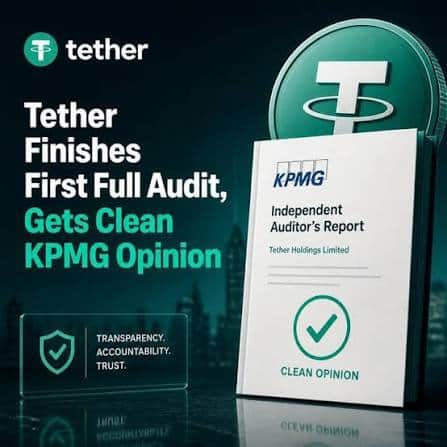
Tether, recognized as the issuer of the world’s largest stablecoin, USDT, made a significant announcement on August 13, 2026. The company revealed that KPMG U.S., a prominent global audit firm, has successfully completed a comprehensive independent audit of the financial statements for the year 2025 pertaining to Tether International, S.A. de C.V. This audit is particularly noteworthy as the auditor issued an unqualified opinion, which is regarded as the strongest form of assurance available. This opinion indicates that the financial statements present a true and fair view, in all material respects, of the company’s financial position, operational results, and cash flows, all in accordance with U.S. generally accepted accounting principles (GAAP). The audited financial figures reveal that Tether's reserves exceed its liabilities by an impressive amount of $6.814 billion as of December 31, 2025.
This achievement marks a significant milestone for Tether, fulfilling a long-standing commitment to transparency and accountability. It also signifies a shift for Tether, moving beyond the quarterly reserve attestations that the company has published consistently over the years. An unqualified opinion is particularly important, as it carries no reservations, exceptions, or caveats, providing a clean bill of health for the financial statements. For holders of USDT and the broader cryptocurrency market, this result offers a higher level of independent verification regarding the issuer’s balance sheet. However, it also leaves some lingering questions about the extent of full public disclosure and the consolidation of group-level financial information unresolved, which may require further clarification in the future.
KPMG Delivers the Strongest Possible Audit Opinion
An unqualified opinion, which is frequently referred to as a clean opinion, represents the most favorable conclusion that an independent auditor can possibly issue. In this context, KPMG U.S. has confirmed that it diligently applied the standards set forth by the AICPA and subsequently found that the financial statements for the year 2025 of Tether International were fairly presented, accurately reflecting the company’s financial position and performance in accordance with U.S. GAAP. It is important to note that the engagement encompassed the complete set of financial statements, rather than merely conducting a limited review focused solely on reserve balances.
This positive outcome stands in stark contrast to qualified opinions, adverse opinions, or disclaimers of opinion, all of which signal the presence of material issues or limitations in the scope of the audit. By successfully securing an unqualified result on its very first full financial-statement audit, Tether has obtained formal external validation, confirming that its reported financial numbers are in alignment with the applicable accounting standards. This distinction is particularly significant for institutional counterparties and regulators who are evaluating the reliability and integrity of the issuer’s financial reporting practices.
Audit Scope Extends Far Beyond Prior Attestations
Previous transparency efforts centered on quarterly attestations that verified reserve composition at specific points in time. The KPMG engagement examined the full balance sheet, including the assets backing Tether’s tokens and the corresponding liabilities, along with the income statement, statement of changes in equity, and cash-flow statement. Auditors also tested transactions, internal systems, ownership records, asset valuations, counterparties, and supporting documentation to assess whether the reported figures were properly substantiated. The process also included the physical inspection and counting of every individual gold bar held by Tether, rather than relying solely on reports provided by custodians or third-party institutions.
This level of substantive testing addresses long-standing questions about the existence, ownership, valuation, and verification of certain reserve assets. It also provides a more detailed view of how the company’s reported financial position corresponds with the underlying assets supporting its operations. The shift from point-in-time assurance to a comprehensive year-end financial-statement audit represents a material upgrade in the depth of external scrutiny. Rather than focusing primarily on whether reserves were present at selected reporting dates, the broader engagement provides auditors with a more extensive opportunity to examine Tether’s financial position, transactions, and supporting records across the reporting period. This distinction could make the latest audit a more significant milestone in Tether’s ongoing efforts to strengthen transparency around its reserves and overall financial condition.
Reserves Exceed Liabilities by $6.814 Billion
According to the audited statements, Tether’s reserves surpassed its related liabilities by $6.814 billion at the end of 2025. Chief Financial Officer Simon McWilliams stated that the figure further confirms the quality and reliability of the company’s earlier public attestation reports. The surplus provides an additional buffer above the one-to-one backing required to support the circulating supply of USDT, strengthening the company’s financial position. A positive equity position of this magnitude offers a measure of resilience against market fluctuations in the value of reserve assets. It also indicates that the issuer retained earnings and managed its reserve portfolio in a manner that generated cumulative excess capital over its liabilities.
This additional cushion could help Tether absorb potential volatility while maintaining confidence in its ability to meet redemption obligations. Market participants will continue to monitor whether subsequent reporting periods maintain or expand this buffer under varying interest-rate, liquidity, and asset-price conditions. The size and composition of Tether’s reserves are likely to remain important indicators as scrutiny of stablecoin issuers and their financial backing continues to increase.
Physical Verification of Gold Holdings Stands Out
One procedural detail shown by Tether is KPMG’s decision to physically count and inspect every gold bar in the company’s holdings. Auditors verified both the existence and identifying information for each individual bar rather than relying solely on third-party confirmations or documentation provided by custodians. Gold has become a visible component of Tether’s reserve mix in recent years, making the verification process an important part of the broader audit. Physical verification reduces reliance on paper trails, accounting records, and custodial attestations when assessing a tangible asset class.
By examining the bars directly and confirming their identifying details, auditors were able to establish a stronger link between the reported reserves and the physical assets held. The step also responds directly to historical skepticism surrounding whether certain reserve assets could be independently and fully verified. Although gold represents only a portion of Tether’s overall reserves, the level of scrutiny applied to it provides an indication of the depth of KPMG’s audit fieldwork. Rather than limiting the review to financial statements and supporting documentation, the process included direct examination of physical assets, adding another layer of verification to Tether’s reported reserve position.
CEO Frames the Result as Industry Vindication
Paolo Ardoino, Tether’s chief executive, described the completion of the audit as a defining moment for the stablecoin sector. He noted that critics had long argued that a full audit could not, or would not, be completed and that Tether had deliberately avoided rigorous independent scrutiny. Ardoino presented the unqualified opinion as clear evidence that those assertions were incorrect, emphasizing that the company had subjected its financial statements to a comprehensive review by a major global auditing firm.
The CEO further characterized the exercise as evidence that Tether’s financial infrastructure, internal controls, and governance have matured alongside the company’s rapid growth. With hundreds of millions of users relying on USDT for savings, payments, remittances, and everyday commerce, particularly across emerging markets, the audit provides external confirmation of the company’s financial reporting and operational resilience. It also represents an important step in addressing longstanding concerns around transparency as stablecoins become increasingly integrated into the global financial system.
CFO Emphasizes Ambition and Continuity with Prior Reporting
Simon McWilliams, who joined as CFO in early 2025, described the project as one of the most ambitious financial initiatives in the company’s history. He stated that the finance team had worked to meet the highest standards applied to leading global companies, while emphasizing that the audited surplus further confirms the reliability of the quarterly attestation reports that have already been made publicly available.
The comments position the new full audit as an important extension of Tether’s existing transparency framework rather than a complete replacement for its established reporting process. Maintaining this continuity allows market participants to compare the year-end audited financial figures with the company’s more frequent point-in-time attestations. This provides investors and other stakeholders with a broader basis for assessing the consistency of Tether’s reported reserves and financial position over time.
Private-Company Status Limits Public Release of Full Documents
Tether has not published the complete audited financial statements or KPMG’s detailed opinion letter. As a private company, it is not subject to the same mandatory disclosure requirements that apply to publicly listed entities, which gives it greater flexibility over how much financial information it makes publicly available. A source familiar with the matter indicated that many private firms follow a similar practice of limiting the public distribution of full audit reports and underlying financial documents. The absence of these underlying documents means external parties must largely rely on Tether’s summary of the audit results and KPMG’s confirmation that it issued an unqualified opinion. Critics have pointed to this limitation, arguing that greater transparency would require public access to the complete financial statements and supporting audit documentation.
They contend that independent verification is more meaningful when stakeholders can review the underlying figures themselves rather than relying primarily on the company’s interpretation of the findings. Supporters, however, argue that the completion of an independent audit by a major Big Four accounting firm represents a meaningful improvement in Tether’s transparency standards. From this perspective, a clean or unqualified opinion provides an important level of external assurance, even if the complete documents are not publicly released. The development therefore represents a step forward while leaving some questions about the depth of publicly accessible financial information unanswered.
Scope Centers on the Issuing Entity
The audit covers Tether International, S.A. de C.V., the entity responsible for issuing USDT. Tether CEO Paolo Ardoino has confirmed that this entity is the sole issuer of the stablecoin. However, some observers have questioned whether the review extends to a fully consolidated view of Tether’s broader corporate group, including all related entities and their respective assets and liabilities. Tether maintains that the audited company is the relevant issuing entity responsible for USDT liabilities and the reserves backing the circulating supply.
Clarity around these legal-entity boundaries is important for understanding exactly which balance sheet supports the tokens in circulation. The focus on the specific issuing vehicle allows the audit to remain closely aligned with the obligations owed directly to USDT holders and provides greater clarity over the financial position of the company responsible for issuing the stablecoin. At the same time, it leaves some questions regarding intercompany arrangements, asset ownership across affiliated entities, and other activities conducted elsewhere within the wider Tether group. These distinctions can be important when assessing the full financial structure supporting the stablecoin ecosystem.
Industry Benchmark and Competitive Implications
Tether has described the engagement as the largest inaugural financial audit in history and a new benchmark for the stablecoin market. As stablecoins continue to grow in importance for payments, remittances, trading, cross-border transactions, and access to dollar-denominated assets, the level of independent scrutiny applied to issuers is expected to rise. By completing a full financial-statement audit with a Big Four accounting firm, Tether has raised the bar against which competitors may eventually be measured. The development could also influence how investors, institutions, regulators, and users assess the credibility of stablecoin issuers. Other issuers operating under different regulatory frameworks or relying on alternative attestation standards may increasingly face comparisons over the transparency, depth, and frequency of their financial disclosures.
As stablecoins become more deeply integrated into both crypto markets and traditional financial infrastructure, stronger verification of reserves and financial statements could become an increasingly important factor in establishing market confidence. The move may therefore accelerate expectations for deeper external verification across the sector, particularly for stablecoins that serve as critical infrastructure for global payments, trading, and settlement. If this standard becomes more widely adopted, independent audits could gradually shift from being viewed as a differentiating feature to becoming an expected component of credibility and transparency within the broader stablecoin industry.
Limitations and Remaining Questions for Market Participants
An unqualified opinion provides a comprehensive assessment of the fair presentation of the 2025 financial statements in accordance with the applicable accounting standards. It is important to note that this opinion does not serve as a guarantee of future performance, nor does it represent an endorsement of the underlying business model. Additionally, it does not offer absolute assurance that every conceivable operational risk has been completely mitigated or eliminated. The audit was conducted following AICPA standards, which differ from the PCAOB standards that are specifically applicable to certain issuers regulated within the United States.
As market participants continue to engage in their evaluations, they will closely examine various factors, including the composition of reserves, the frequency and thoroughness of future full audits, the potential for enhanced public disclosure, and the ongoing evolution of regulatory requirements across major jurisdictions. While the issuance of a clean opinion addresses one long-standing objection that had been raised, it does not effectively close off every possible avenue of inquiry related to the management of risks associated with stablecoins and the transparency of their operations.
What the Milestone Means for USDT Holders and the Broader Market
For holders of USDT, the recent audit provides independent confirmation that the issuer’s year-end 2025 balance sheet was accurately and fairly stated, demonstrating that reserves significantly exceeded liabilities by a considerable margin. The physical verification of gold holdings, along with the extensive breadth of testing conducted, offers additional reassurance when compared to attestation-only regimes that lack such thorough verification processes. However, it is important to note that the private nature of the company, coupled with the decision not to disclose the full financial statements, means that certain details remain internal and are not available for public scrutiny.
This outcome notably strengthens Tether’s position in ongoing discussions with institutional partners, payment providers, and regulatory bodies. Furthermore, it establishes a practical precedent within the industry: a major stablecoin issuer has the capability to subject its complete financial statements to the rigorous scrutiny of one of the Big Four accounting firms and receive a clean opinion in return. Whether this precedent will evolve into the new standard baseline for the industry will ultimately depend on various factors, including competitive responses from other market participants, developments in regulatory frameworks, and the sustained demand for higher standards of accountability and transparency in the financial ecosystem.
FAQs
What exactly did KPMG audit?
KPMG U.S. audited the complete 2025 financial statements of Tether International, S.A. de C.V., covering the balance sheet, income statement, statement of changes in equity, and cash-flow statement under U.S. GAAP and AICPA standards.
What is an unqualified opinion?
An unqualified opinion, also called a clean opinion, means the auditor concluded that the financial statements present fairly, in all material respects, the company’s financial position and results, with no reservations, exceptions, or caveats.
How large was the reported surplus?
The audited statements showed that reserves exceeded liabilities by $6.814 billion as of December 31, 2025.
Did the auditors physically verify gold holdings?
Yes. KPMG physically counted and inspected every individual gold bar held by Tether, verifying existence and identifying information rather than relying solely on custodian reports.
Has Tether released the full audited financial statements?
No. As a private company, Tether has not published the complete statements or KPMG’s detailed report, a practice common among many private firms.
Is this the first full audit in Tether’s history?
Yes. The company has long published quarterly reserve attestations, but the KPMG engagement marks its first full independent financial-statement audit.
Disclaimer: This content is for informational purposes only and does not constitute investment advice. Cryptocurrency investments carry risk. Please do your own research (DYOR).

