The 23-Hour Build: AI CV Screening Post-Mortem 🚀
Hey everyone,
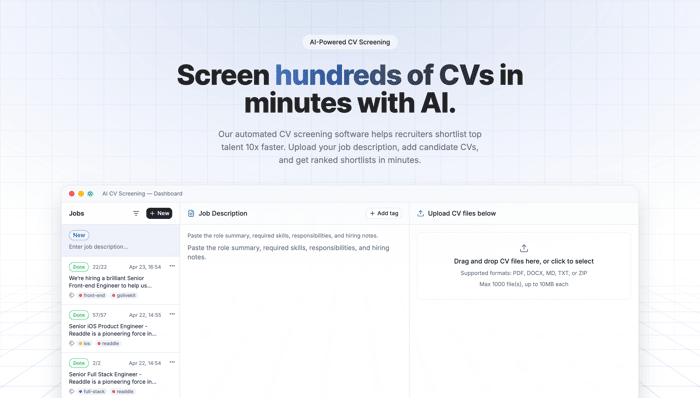
I just launched AICVScreening.com - a tool designed to screen hundreds of CVs against a job description in minutes.
The idea came from a place of frustration. I once waited 5 weeks for a generic automated rejection email. That’s a month of silence that kills employer branding and leaves candidates in limbo. I wanted to build something that helps recruiters find that top 1% instantly so they can actually talk to humans instead of sorting PDFs.
The "Battle Test" (23 Hours Total)
I used this project to see how fast I could ship a production-ready app using a Next.js starter kit (GoLiveKit). Here is exactly where my time went:
Day 1 (3h): Architected a massive project.md with full business requirements. Planning is the highest ROI hour you can spend.
Day 2 (4h): AI-assisted task splitting and core implementation.
Days 3-5 (6h): The "polish" phase. Fixing bugs and manual testing to make sure the AI logic wasn't hallucinating.
Day 6 (4h): The "Administrative Grind." This was the most annoying part. Domain, Cloudflare, R2, Stripe, Plunk, Auth, Analytics... I spent 4 hours just connecting 3rd-party keys.
Day 7 (6h): Marketing assets. Writing copy, making the video, and social images. Honestly? This is the most painful part for me as a dev.
Total build time: ~23 hours.
My biggest takeaway:
Starter kits massively optimize the core build, but the "administrative" setup and creative assets remain the "final frontier" for optimization. We need a tool that handles the 3rd-party "plumbing" in one prompt.
I’d love your feedback on two things:
The Landing Page: Does the value prop click immediately?
The Stack: How are you all speeding up the "Day 6" administrative setup? Is there a better way than manual key-hunting?
Check it out here: https://aicvscreening.com
Product Hunt link (Supporting us today!): https://www.producthunt.com/products/aicvscreening?launch=aicvscreening

Thanks for sharing this! It's always interesting to see what can be built in a short timeframe, especially when the focus is on solving a real hiring problem.
One thing I've learned while building AI recruitment tools is that production readiness often comes down to privacy, reliability, and explainability rather than just model accuracy.
I recently built a privacy-first AI resume screening agent using FastAPI, in-memory resume processing, OpenRouter model fallback, and GitHub profile enrichment for developer roles.
Looking back on the project, what architectural decision would you change if you were rebuilding it today?