The 3 SaaS Metrics That Actually Matter (Everything Else Is Founder Entertainment)
Most early SaaS founders (including past-me) make the same mistake:
We act like we’re running a Series B dashboard…
while we’re still trying to find 20 people who care.
Charts everywhere. Funnels. Colorful KPIs.
It feels like progress — it’s really procrastination disguised as analytics.
Here’s the truth nobody wants to say out loud on Indie Hackers
👉 Before $20K MRR, almost every metric is useless.
Not because the metric is bad, but because the sample size is a joke.
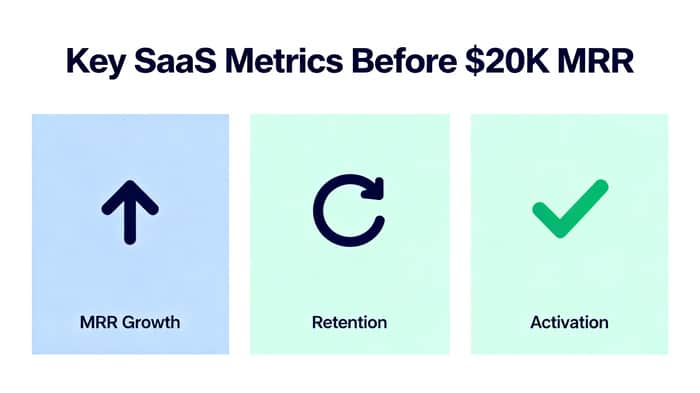
The only numbers worth obsessing over this early?
MRR that doesn’t flatline
Retention that isn’t embarrassing
Activation that doesn’t require a PhD
Everything else is a distraction.
Let’s break it down founder-to-founder.
1. MRR Growth — Your Only “Is This Working?” Signal
MRR is brutally honest.
If it goes up, you’re onto something.
If it doesn’t, no amount of dashboards will save you.
You don’t need a model.
You don’t need LTV:CAC.
You don’t need “north star metrics.”
You just need to answer one question:
👉 Did more people pay you this month than last month?
If yes — keep going.
If no — your messaging, ICP, or onboarding is wrong.
Simple. Not easy. But simple.
2. Retention — The Only Proof That Users Actually Care
Founders love signups.
Investors love signups.
Your ego really loves signups.
But signups lie.
Retention doesn’t.
If users don’t stick, the product isn’t delivering value.
That’s it. No story, no excuse, no “but our funnel…”.
Talk to every churned user.
You’ll learn more in 15 minutes than you will staring at Mixpanel for two weeks.
👉 Good retention = You have real value.
👉 Bad retention = You’re selling a promise, not a product.
3. Activation — The One Metric That Moves Every Other Metric
Activation is the moment a user feels,
“Oh okay — this is actually useful.”
Every SaaS has that moment:
First dashboard load
First project created
First teammate added
First file synced
First AI output that isn’t nonsense
Users who hit the “aha” moment stay.
Users who don’t… disappear into the SaaS graveyard.
Your job early on?
👉 Make the path to “aha” stupidly fast.
The shorter that path, the faster everything else improves.
Everything Else Is Founder Theater
Before $20K MRR, ignore:
CAC
LTV
Funnel micro-steps
Payback periods
Attribution
Magic Numbers
That one metric from that one VC blog post you saved in Notion
These aren’t wrong.
They’re just meaningless without enough customers.
Your data isn’t mature.
Your segments aren’t stable.
Your assumptions are doing most of the work.
Run lean. Run simple. Run close to users.
A Stupidly Simple Early-Stage Dashboard
If I had to rebuild my first SaaS today, I’d track only three questions:
Is MRR going up?
Are users coming back after week 1?
Are new users hitting value quickly?
If all three are “yes,” keep building.
If even one is “no,” stop everything and fix it.
This framework isn’t elegant.
It’s not VC-approved.
But it works — especially when you’re still eating noodles at your desk.
If you want a quick teardown…
If you’re stuck and can’t figure out why, drop your site below.
I’ll take a look and DM you:
1 positioning fix
1 messaging gap
1 activation blocker
1 SEO win you’re ignoring
No pitch. No upsell. Just founder-to-founder feedback.

Strong framing. I am researching AI workflows for SaaS analytics and this hits the thing I keep wondering about: for activation/retention, is the hard part choosing the 3 metrics, or defining them consistently enough that another person or AI assistant can answer questions without guessing?
Example: "are new users hitting value quickly?" depends on what counts as value, which events qualify, and which customers to exclude.
Do founders usually keep that definition in their head/SQL/dashboard, or do they write it down somewhere?
Agree on the focus — but revenue attribution doesn't have to be complex. Our first paying user at zenovay literally said 'I just want to know which blog post makes me money.' That one question is $0 CAC insight that changes your content strategy overnight. Took us 5 min to set up. Attribution is worth it when it's actually simple
Solid framework. One thing worth splitting out inside the retention metric: voluntary vs. involuntary churn.
Most founders look at their retention number as one thing. But some of that churn isn't customers deciding to leave — it's failed payments. Card expired, over limit, bank blocked the charge. The customer still wants the product, but they dropped off anyway.
Industry data puts this at 5-9% of monthly subscription charges at any given time. For a $10K MRR business, that's $500-900 quietly disappearing each month — and it doesn't show up differently in your retention number than intentional cancellations.
The fix is different from a retention problem too. You don't need better onboarding or more value. You need a D+1/D+3/D+7 email sequence that sends a card update link and stops the moment payment succeeds.
Built exactly this for Stripe: tryrecoverkit.com