The 7 Best AI Investing Apps for 2026
Artificial intelligence is no longer a buzzword reserved for hedge-fund quants. In 2025, more than 44% of retail investors say they already rely on AI-driven insights to guide portfolio decisions.
The results are tangible: DIY investors who adopted dedicated AI tools earned an average 14% higher annual return in 2024 than peers who stuck to manual research.
With dozens of new platforms launching every quarter, choosing the right AI investing app can feel overwhelming.
The seven stand-out options available below are based on performance data, pricing, user experience, education resources, and community strength.
Why AI-Powered Investing Tools Matter in 2026
-
Mountains of data: Global listed companies now release over 700,000 PDF pages of earnings material each quarter.
-
Faster markets: The average holding period for retail equities has fallen below five months, doubling the need for real-time decision support.
-
Human bias: Behavioral studies continue to show that overconfidence and loss-aversion wipe out as much as 3 percentage points of annual returns for self-directed investors.
AI platforms ingest headlines, options flows, social sentiment, and raw fundamentals in seconds, surfacing signal-weighted ideas a human could not spot alone.
How We Ranked the Apps
-
Performance – independently reported or third-party-audited win rates and back-test results.
-
Transparency – clear explanation of data inputs and model logic.
-
Pricing – free tiers, commissions, or subscription cost.
-
User Experience – mobile design, onboarding flow, and alert customisation.
-
Education & Community – tutorials, newsletters, Discords, or copy-trading features.
#1 Prospero — Overall Best & Free
Prospero delivers hedge-fund-grade analytics to your phone at no cost. The app crunches 100 + million data points and 10,000 + machine-learning models to generate curated stock “Picks” that have outperformed the S&P 500 by 12.9× since inception.
Even more impressive, its public newsletter shows a 4-year average beat of the S&P 500 of 67%. 2025 individual picks won vs S&P500 at a 60% rate and are beating S&P by 63% annualized as of 11/3/25.
Key highlights:
-
Real-time signals on institutional options sentiment.
-
Bi-weekly Investing Newsletter and daily Trading update.
-
Users' testimonials say “Our Picks” narrows focus to only the top 20% of stocks.
Prospero is ideal for data-driven traders who want institutional signals–for free. It uncovers repeatable patterns and translates them into clear, actionable strategies, so users can learn a proven trading framework they can rely on again and again.
#2 Trade Ideas — Best Real-Time Scanner
Trade Ideas has been around since 2003, and its proprietary AI engine “Holly” now analyzes more than a million trade setups every evening.
In 2025, the platform reports a win rate between 55% and 65% with risk-adjusted returns beating the SPDR S&P 500 ETF by roughly 2 percentage points.
Why it stands out
-
Real-time strategy windows flag momentum, gap-up, and reversal plays the moment volume spikes.
-
Integrated brokerage lets you execute directly from the alert panel, shaving crucial seconds.
-
The OddsMaker back-tester helps refine parameters before risking capital.
Trade Ideas is priced from USD 118/month, so it targets active traders who will milk value from the intraday feed.
#3 eToro — Best Social Copy-Trading Platform
eToro couples social sentiment with machine learning to surface high-performing “Popular Investors.”
The platform’s top 50 copied portfolios delivered a 17% average return in 2024, versus 11% for the MSCI World Index.
Stand-out features
-
Smart Portfolios: AI-clustered thematic baskets (e.g., Driverless Cars, Gig Economy) rebalanced automatically.
-
CopyTrader: allocate any sum to mirror a vetted investor’s trades proportional to your capital.
-
Large multilingual community posts trade rationale, creating a built-in learning loop.
Commissions are baked into the spread; equity trades remain zero-commission in most regions.
#4 Wealthfront — Best Hands-Off Robo
If you prefer a set-and-forget approach, Wealthfront’s robo-advisor leverages AI for tax-efficient ETF allocation. Its direct-indexing algorithm harvested an estimated 1.8 percentage-points of additional after-tax alpha for taxable accounts in 2024.
Perks
-
Automatic rebalancing and daily tax-loss harvesting.
-
Goal-based planning for college, real-estate, or retirement.
-
Flat 0.25% annual advisory fee with zero trading commissions.
Wealthfront suits long-term investors focused on compounding rather than stock-picking thrills.
#5 RockFlow — Most Beginner-Friendly Interface
RockFlow packages serious machine learning under a playful UI. Its in-app bot TradeGPT answers plain-language questions (“Should I buy NVDA after earnings?”), while fractional share support lets newcomers start with just USD 1.
Back-tests published in May 2025 show the model delivering daily trade signals that beat the S&P 500 by 27% with a 54% win rate on nearly 5,000 picks.
What you get
-
Clear colour-coded conviction scores.
-
Gamified badges to encourage educational milestones.
-
Optional CopyTrading to follow expert portfolios.
A generous free tier includes one daily idea; paid plans from USD 12/month unlock unlimited scans.
#6 Alpaca — Developer Favourite for Algorithm Builders
Alpaca offers a fully open REST and WebSocket API, making it the go-to brokerage infrastructure for quants who want to deploy their own AI models.
Thousands of notebooks on GitHub integrate Alpaca with TensorFlow and PyTorch libraries.
Highlights
-
Commission-free stock and crypto trading in the US.
-
Paper-trading sandbox replicates market data for safe back-testing.
-
Python SDK shortens the time from model to live trade to a few lines of code.
Alpaca also partners with community marketplaces where developers can sell subscription access to their algorithms, turning side projects into revenue streams.
#7 Robinhood — Zero-Commission Starter App
Robinhood remains the entry point for many retail investors. In 2025 the brokerage rolled out an AI-powered news sentiment flag inside its popular “Top Movers” list, nudging users toward deeper research when volatility spikes.
Combined with its trademark zero-commission trades and intuitive gestures, it still deserves a seat on this list.
Added value
-
Instant settlement on deposited funds (up to limits) for rapid execution.
-
An optional Gold subscription provides Level-II quotes and Morningstar reports.
-
Crypto, options, and stocks under one roof.
While Robinhood lacks the depth of analytics seen in Prospero or Trade Ideas, its frictionless UX makes it perfect for first-timers.
Choosing the Right AI App for Your Style
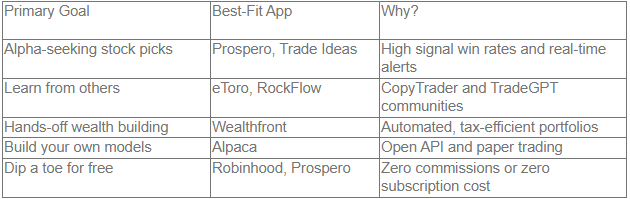
Remember, diversification isn’t just about assets; tooling diversification matters too. 60% of first-year AI-app adopters keep at least two platforms active.
Risks & Caveats
AI is powerful but not magic:
-
Over-fitting – Models trained on bull-market data can falter when volatility regimes flip.
-
Latency – Retail data feeds sometimes lag institutional pipes, muting the edge.
-
Behavioral complacency – Delegation to algorithms can dull critical thinking.
-
Regulatory risk – The SEC continues to evaluate disclosure rules for AI-driven advice.
Prudent investors cross-check signals, size positions conservatively, and keep a manual stop-loss discipline.
Conclusion: Level Up Your Edge
Artificial intelligence has levelled the playing field between Wall Street and Main Street. Whether you crave actionable trade ideas, social validation, or effortless robo-allocation, at least one of the seven apps above can sharpen your edge.
Start by exploring Prospero for free to experience institutional-grade signals; then layer in a secondary tool that matches your personal style.
The key is not to fear the machines, but to make them your co-pilots on the road to better returns.

Good roundup. One gap I keep running into with these AI investing app lists is that they focus on the stock-picking layer but skip the broker execution side, which matters just as much once you're actually placing trades. I put together a side-by-side on moomoo vs Interactive Brokers recently (fees, order routing, HK/US access) since that comparison kept coming up in my own research: https://www.lowrisktradesmart.org/en/blog/moomoo-vs-ibkr
Really solid roundup. The stat about DIY investors earning 14% higher returns with AI tools is eye-opening. One angle I think is underexplored here is the behavioral side — even with the best AI signals, investors still panic-sell or chase FOMO. I've been building KeepRule (keeprule.com) which curates investment principles from 26 legendary investors like Buffett, Munger, and Dalio, so when the market gets choppy you can quickly revisit relevant wisdom instead of reacting emotionally. Pairs really well with the analytical tools you listed here. Would love to see a future post on how AI + behavioral discipline tools work together.