The Anthropic Shockwave: Why we built a 1-click router to Chinese LLMs to protect our startup's runway (and independence)
Hey fellow hackers,
If you’ve been reading the news this weekend, the AI space just got hit by a massive reality check. The US government abruptly ordered Anthropic to disable global foreign access to its latest Fable 5 and Mythos 5 models due to export controls.
For indie founders outside the US, this is a terrifying reminder of Supplier Risk. Relying on a single Western API vendor means your entire business can be turned off overnight by a compliance officer.
At the same time, look at the economics. Alibaba just dropped Qwen 3.7 Max, and MiniMax released M3. These models are ranking at the absolute top of coding and agent leaderboards (SWE-Bench Pro), but they cost roughly $2.50 per million tokens. That is nearly 3x to 5x cheaper than traditional frontier models.
But as an international indie hacker, trying to leverage these hyper-efficient Eastern models is a bureaucratic nightmare: you need local phone numbers, complex overseas billing, and you end up managing 5 different API keys just to keep your app running.
My co-founder and I got tired of the fractured ecosystem and the growing risk of vendor lock-in. We wanted a clean fallback strategy that slashes our API bill.
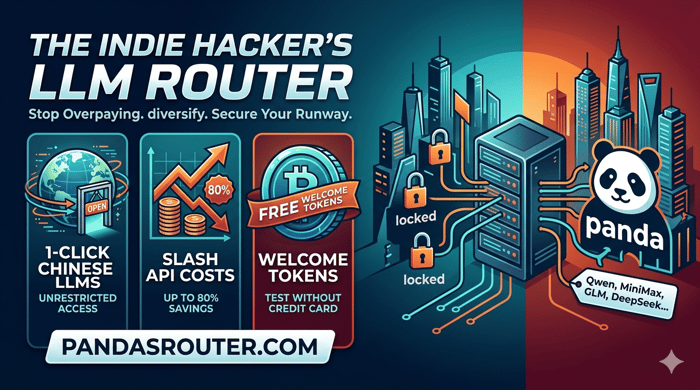
So we built PandasRouter — a developer-first, zero-bureaucracy proxy designed to give indie hackers instant access to the world’s most cost-effective LLMs.
Here are the 3 leverage points we focused on to help your startup survive:
-
Zero-Friction Chinese Model Deployment: Access DeepSeek V4 Pro, Qwen 3.7 Max, MiniMax M3, GLM-5, and Kimi K2.6 through a single unified API. No foreign phone verifications, no complex identity checks. One clean integration, and you're set.
-
Radical Runway Extension (Insane Pricing): If you are running high-volume background workers, scraping agents, or multi-step RAG pipelines, switching your heavy lifting tasks to these models will easily cut your monthly infrastructure bill by 60% to 80%.
-
Test Without Your Credit Card (Free Welcome Tokens): We know hackers hate signing up for "free trials" that demand a credit card. You can test our latency, concurrency, and routing logic entirely for free. Just log in, grab your welcome tokens, and run a benchmark against your current stack.
We are actively tuning our global routing nodes to minimize latency. We would love to get your most brutal feedback on the dashboard and speed.
👉 Check it out: pandasrouter.com
Are you guys building redundancy into your AI stacks yet, or are you still single-homed on one provider? How are you handling the latest export control news? Let's talk in the comments!

The cost argument is real for high-volume background tasks. Where I've found it breaks down is browser automation and multi-step agent tasks — those are heavily dependent on instruction-following quality, not just raw capability scores. Cheaper models tend to miss tool call formats or skip retry logic steps, and the debugging time eats the savings fast.
The pattern I use: route classification, extraction, and summarization tasks to cheap models; route anything that's making decisions or controlling a browser to a frontier model. That hybrid split ends up 40-50% cheaper than all-frontier without the quality drops on the critical path.