The Art of Crafting a Landing Page That Converts
Hey there, I’m André – tech entrepreneur and founder of LaunchFast. If you’re new here, LaunchFast is a stack designed to help web developers speed up their project development process, from launch to scale. I’m building in public, and I’ve been sharing daily updates on my journey.
Today, I’m taking you behind the scenes of one of the toughest parts of this journey: building a landing page that actually converts visitors into customers.
The Reality Check
In the past few weeks, LaunchFast has been attracting around 40 new users a day, which adds up to about 1,500 new users a month. At first glance, this sounds great, right? The product’s clearly generating interest. But then comes the kicker: out of those users, I’ve only made 6 sales. That’s right – just 6 sales in 3 weeks.
Every single sale is a huge morale boost, but the low conversion rate is a clear sign that the landing page isn’t pulling its weight. The product’s solid – I know that. But the marketing? Well, that’s another story.
The Marketing Challenge
Here’s the thing: marketing has two jobs. First, bring qualified users to the website – not just any users, but the ones who’ll find real value in what you’re offering. Second, convert those visitors into paying customers. Simple, right? Not exactly.
I’ve come to realize that the landing page doesn’t convert customers. Users convert themselves – if the message is right, if it speaks to their needs, and if it’s clear why they should care. That’s where my focus has been for the past two weeks: dialing in the message on the landing page.
Learning to Sell (When You’re a Developer)
As a tech entrepreneur, marketing is my Achilles heel. I can build. I can code. But selling? That’s been a learning curve, and not a quick one. I promised myself I wouldn’t touch the product until I had the marketing figured out – which is why the past two weeks have been dedicated to getting this landing page right.
You might be thinking: Two weeks? Isn’t that a long time for just a landing page? Honestly, it feels like it sometimes. But learning to market takes time, especially when you’re determined to do it authentically – no sleazy sales tactics here. I want the copy to resonate with people emotionally, while still being clear, concise, and effective.
At its core, entrepreneurship boils down to two things:
• Knowing how to build.
• Knowing how to sell.
I’ve got the first part down. The second? I’m learning as I go.
My Process for Crafting the Landing Page
Let’s talk about my process, because I know you’re curious. First off, I subscribe to ChatGPT for $20 a month, and it’s become an integral part of my workflow. I split my ultrawide screen into thirds: one-third for ChatGPT, one-third for VS Code, and the last third for the browser. This setup allows me to keep everything I need in view as I work.
Now, here’s where the magic happens: I use ChatGPT to create extremely short feedback loops. I’m asking hundreds of questions a day, so I created a custom GPT specifically for LaunchFast. It knows the product, the features, and the target audience. This allows me to get faster, more relevant feedback without having to re-explain the context every time.
When interacting with ChatGPT, I find it helps to ask it to act in a specific role. For example, I’ll start with: “Act as a seasoned Conversion Rate Optimization Designer and copywriter to assist me in…” And when I’m mid-conversation, I’ll say, “Still acting as a seasoned Conversion Rate Optimization Designer and copywriter…” This keeps the responses focused and on point.
Structuring the Landing Page
The first thing I did was ask ChatGPT about the ideal structure for a landing page. Here’s the framework it suggested:
- Hero section
- Problem/Solution section
- Features/Benefits section
- Testimonials
- Call-to-Action (CTA) & Pricing
- FAQ (to handle objections)
- Final CTA
With this structure in mind, I approached each section individually, breaking the task down into three core skills: layout, copy, and design.
Copywriting: The Iterative Process
The real work begins with the copy. For each section, I start by asking ChatGPT to draft the copy while also recommending layout and design ideas. Once I have a rough draft, I hand it off to V0 for a basic layout. Then, with some manual adjustments, I refine the design until I’m happy with the look.
But the copy? That’s where I spend most of my time.
I ask ChatGPT to rate the copy based on emotional impact, clarity, brevity, and whether it speaks the language of my audience. I also use my own judgment to make adjustments, working in an iterative process. Sometimes I zoom out to check the overall flow, other times I zoom in on a single paragraph to fine-tune the details.
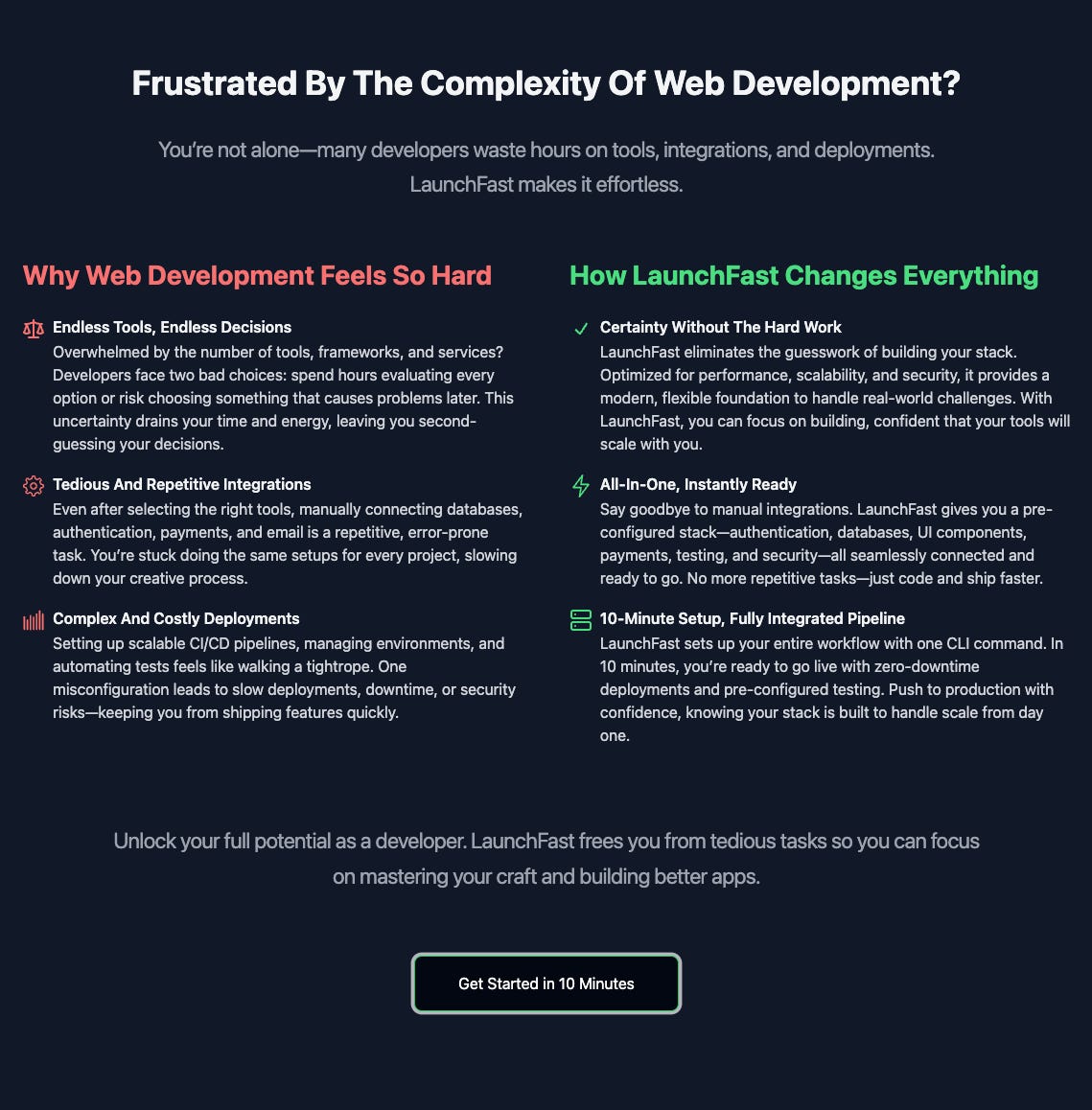
Take the Problem/Solution section, for example. This part went through over 100 iterations – yes, really! At first, I focused on structuring it with a title and two columns: the pain points on the left and the solutions on the right. Then, I zoomed in on every word – title, subtitle, and paragraph – until it was just right. Finally, I zoomed out and checked the flow, tightening the copy along the way.
It’s a long process, but for someone learning marketing, it’s invaluable.
Final Thoughts
If there’s one takeaway from this experience, it’s that learning to sell is just as important as learning to build. And while it may feel like a slow grind, the payoff will come when the landing page does what it’s supposed to: convert visitors into customers.
Until then, I’m staying focused on the journey, building in public, and sharing the highs and lows along the way.
Have a great week ahead 🙌😄

Grea resource Andre :) To me, simplicity is key when it comes to high-converting landing pages. From my experience, the best-performing pages are the ones that are clear, focused, and match the ad copy.
Absolutely, 100%! However, achieving simplicity can be quite challenging 😄
Hehe, verrry true :P