The Beginner’s Guide to Guest Posting and Link Building
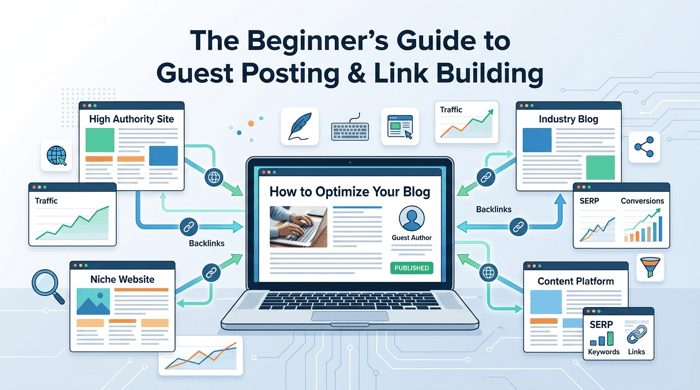
If you’ve recently launched a website, blog, startup, or SaaS product, you’ve probably heard the same advice again and again:
“You need backlinks.”
But getting your first quality backlinks can be confusing. Where do you find them? Should you pay for links? Is guest posting still effective? How do you know whether a website is worth contacting?
This beginner’s guide explains guest posting and link building, how they work, and how you can approach them without wasting time or your SEO budget.
What Is Link Building?
Link building is the process of acquiring links from other websites to your own website.
For example, imagine you have a SaaS website and a technology blog publishes an article about productivity software. If the article naturally references your SaaS product and links to your website, you've earned a backlink.
Backlinks can help with:
Increasing website authority
Improving online visibility
Supporting search engine rankings
Generating referral traffic
Building brand awareness
However, the quality and relevance of backlinks matter. Simply collecting a large number of links isn't a sustainable SEO strategy.
What Is Guest Posting?
Guest posting, also called guest blogging, involves creating an article for another website and contributing it as a guest author.
Depending on the publisher's guidelines, the article may include a contextual link to your website.
For example, a cybersecurity company might contribute an article to a technology publication about common security mistakes. Within the article, a relevant resource on the company's website could be referenced naturally.
The best guest posts are not written just for search engines. They should provide useful information to the publication's existing readers.
Why Do Businesses Use Guest Posting?
Guest posting can provide several benefits when done strategically.
- Relevant Backlinks
A guest post can provide an opportunity to earn a contextual backlink from a website related to your industry.
A link from a relevant technology publication may make more sense for a SaaS company than a link from an unrelated general website.
- Referral Traffic
A good guest post can introduce your business to a completely new audience.
If readers find the article useful and are interested in your product or service, some may click through to your website.
- Brand Visibility
Getting your company mentioned on industry websites can help people become familiar with your brand.
For startups, this can be particularly useful because you're not only building backlinks—you're also building awareness.
- Industry Relationships
Guest posting can help you connect with publishers, bloggers, marketers, and other businesses in your industry.
Over time, these relationships can lead to interviews, collaborations, partnerships, and other marketing opportunities.
How to Find Good Guest Posting Websites
Finding websites is easy.
Finding good websites is the difficult part.
Before approaching a website, check:
Relevance: Does the website publish content related to your industry?
Content quality: Are the articles original, useful, and well-maintained?
Website activity: Is the site regularly publishing new content?
Organic visibility: Does the website appear to have genuine search visibility?
Audience: Is the website reaching the type of people you want to target?
Link placement: Are backlinks placed naturally within editorial content?
Don't choose a website based only on DA or DR. Third-party metrics can be useful for comparison, but they shouldn't replace manual evaluation.
How to Find Guest Post Opportunities Faster
Manual research can take a lot of time.
You may need to search Google, review websites, check their content, identify contact information, analyze metrics, and determine whether they accept guest contributions.
This is one reason platforms such as Guest Post Discovery can be useful. Instead of spending hours searching for potential websites manually, you can use a dedicated resource to discover guest posting opportunities across different niches and then evaluate the sites according to your own requirements.
The tool or platform should support your research—not replace it. Always review each website before deciding whether it is appropriate for your link-building campaign.
What Makes a Quality Backlink?
A quality backlink generally comes from a website that is:
Relevant to your topic or industry
Genuine and actively maintained
Publishing useful content
Editorially managed
Providing a natural context for the link
For example, a link from an established marketing article discussing SEO tools is much more relevant to an SEO software company than a random link from an unrelated website.
Think relevance first, metrics second.
Guest Posting Mistakes to Avoid
Beginners often make a few common mistakes.
Buying Too Many Cheap Links
Large quantities of low-quality links may look attractive, but they don't necessarily provide meaningful SEO value.
Focusing Only on DA or DR
A high metric doesn't automatically mean a website is a good placement.
Using the Same Anchor Text Everywhere
Your backlink profile should look natural. Avoid forcing the exact same commercial keyword into every article.
Publishing Poor Content
A guest post should be useful enough that readers would want to read it even without the backlink.
Choosing Completely Irrelevant Websites
Relevance should be one of your first filters when evaluating opportunities.
A Simple Guest Posting Strategy for Beginners
If you're just getting started, keep the process simple:
Step 1: Identify your target niche.
Step 2: Create a list of relevant websites.
Step 3: Evaluate their content, audience, relevance, and overall quality.
Step 4: Find the appropriate contact or submission method.
Step 5: Pitch a useful and original topic.
Step 6: Create high-quality content for the publication.
Step 7: Add relevant links naturally where appropriate.
Step 8: Track your published links and results.
Don't try to build hundreds of backlinks overnight. Focus on creating a consistent process that produces relevant opportunities.
Final Thoughts
Guest posting isn't simply about placing a link on another website.
Done properly, it combines content marketing, relationship building, brand visibility, referral traffic, and SEO.
For beginners, the most important lesson is simple:
Don't chase the highest number of backlinks. Chase the highest-quality opportunities that are relevant to your audience.
Start with a small number of trustworthy, relevant websites, create genuinely useful content, and build your backlink profile gradually.
That's a much better foundation for long-term SEO than relying on bulk or low-quality link building.
What has worked best for you when building backlinks—guest posting, digital PR, content marketing, partnerships, or something else?
