The Best Side Projects Start With Real Problems
One of my favorite things about building tools is that the best ideas rarely come from brainstorming sessions.
They come from frustration.
A repetitive task.
A workflow bottleneck.
A problem you encounter so often that eventually you stop asking, "Why does this exist?" and start asking, "Why hasn't anyone fixed this?"
That's exactly how many successful software products begin.
Recently, I came across a project that reminded me of this principle. Instead of tackling a flashy trend, it focused on solving a practical SEO problem that affects agencies, consultants, and website owners every day: understanding how search results actually look in different locations.
The Local Search Problem
For years, local SEO professionals have faced a common challenge.
A client asks:
"How do we rank in London?"
Or:
"What does our search result look like in Manchester?"
Or:
"Why is our competitor outranking us in Birmingham but not in Leeds?"
The problem is that Google personalizes and localizes search results heavily.
What you see from your own device often isn't what users in another city, region, or country see.
This creates a major obstacle when diagnosing ranking issues.
Why Traditional Checks Fall Short
Many SEO professionals still rely on:
VPNs
Incognito mode
Manual searches
Third-party screenshots
Rank tracking estimates
While these methods can be useful, they don't always provide a clear picture of localized search visibility.
Small differences in location can produce dramatically different search results.
For local businesses, those differences matter.
A lot.
Turning a Pain Point Into a Tool
That's why I appreciate projects that emerge from genuine workflow frustrations.
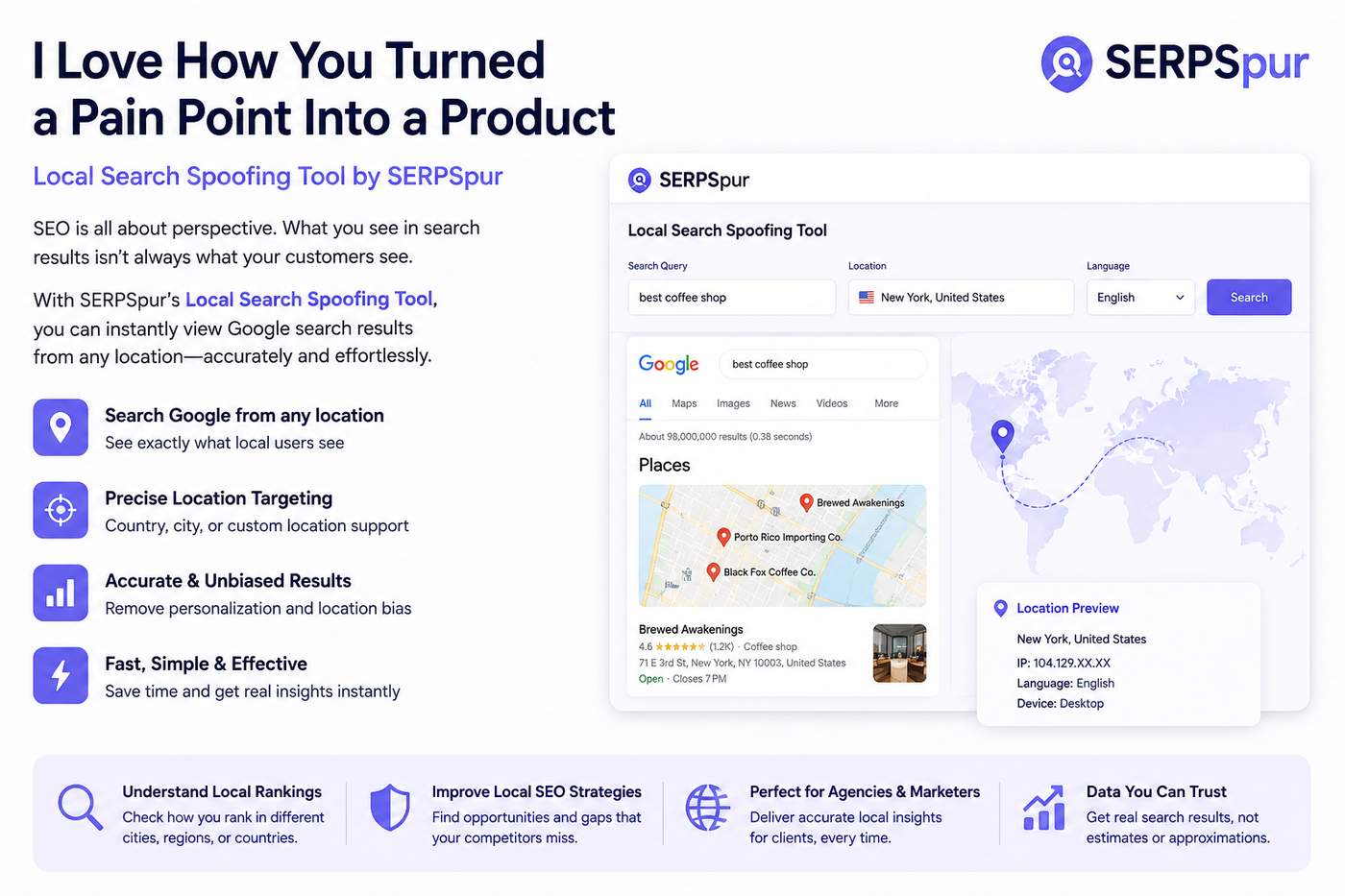
The Local Search Spoofing Tool from SERPSpur is a great example.
Instead of forcing users to rely on manual workarounds, it allows them to view search results as if they were searching from different locations.
Simple idea.
Huge practical value.
These are often the most successful tools because they're built to solve a real problem rather than chase a trend.
The Hidden Value of Local Search Data
Many website owners focus solely on national rankings.
But local search behavior often tells a very different story.
A business might:
Rank #2 in one city
Rank #12 in another
Appear in local packs for some regions
Disappear entirely in others
Without location-specific visibility, it's easy to draw incorrect conclusions.
You might think an SEO campaign is failing when it's actually performing exceptionally well in target regions.
Or worse, assume rankings are healthy while missing major opportunities in key markets.
Why Small Tools Often Win
One thing I've learned from building and testing SEO software is that users don't necessarily want more features.
They want fewer headaches.
The most useful products are often those that remove friction from existing workflows.
They save time.
They eliminate guesswork.
They make decisions easier.
That's exactly why niche SEO utilities continue to gain traction despite competition from larger platforms.
Solving Real Problems Creates Real Value
There's an important lesson here for anyone building products.
Don't start with technology.
Start with a problem.
Look for:
Tasks you repeat constantly
Questions clients ask repeatedly
Data that's difficult to obtain
Processes that require unnecessary workarounds
Those frustrations often contain the seeds of valuable software.
The Local Search Spoofing Tool exists because local search visibility is difficult to analyze accurately.
By simplifying that process, it provides immediate value to SEO professionals and marketers.

