The Brain Song Review 2026 Does It Really Work? My Honest 30-Day Experience
I was sitting at my desk with my coffee going cold, staring at an email from my project manager. It was not a long email. Maybe four sentences. I read it once, scrolled down, and realized I had no idea what he was asking me to do. So I scrolled back up and read it again. Same thing. By the third time, I set the mug down and rubbed my eyes. This was not the first time. It was just the first time I admitted to myself that something was off.
That same week, I walked into the garage to grab a screwdriver. I stood there looking at my workbench for a solid ten seconds before I remembered why I had walked in. At a cookout, a guy I had known for fifteen years came over to say hello, and his name sat on the tip of my tongue like a word in a foreign language I used to know. I laughed it off, but inside I was annoyed. I was not even fifty yet. I worked out. I ate okay. I slept fine, or at least I thought I did. But my brain felt like a browser with too many tabs open, and half of them were frozen.
When My Brain Started Feeling Slower
It did not happen overnight. It crept in. I started keeping a notepad next to my keyboard because I could not trust myself to remember the three things my wife asked me to pick up from the store. I would sit down to answer a few emails after lunch, and by two in the afternoon I felt like I had run a mental marathon even though all I had done was type. I would start cleaning out a closet, find an old box of baseball cards, and an hour later the closet was still a mess and I was sitting on the floor reading about the 1986 Mets.
I told myself it was stress. I told myself it was just part of getting older. But the truth was, I was working harder to think clearly than I used to. Reading a technical document felt like wading through mud. In meetings, I would realize I had been nodding along without actually processing the last two minutes of conversation. I was not losing my mind. I was not confused about where I was or who my family was. I was just... slower. Everything took a little more effort.
My Friend Brought Up The Brain Song
I was complaining about this to my buddy Mike over burgers. Mike and I have known each other since college. He has seen me at my best and my worst, and he does not sugarcoat anything. I was telling him about the email incident, half laughing, half frustrated, when he wiped his hands on a napkin and said, "You know, my dad has been using this thing called The Brain Song."
I looked at him. "The what?"
"The Brain Song. Some audio program he listens to with headphones. He does it every morning. Says it helps him feel a little sharper."
I waited for the sales pitch. It never came. Mike was not trying to sell me anything. He was just telling me what his father did. His dad was in his seventies, still sharp, still doing the crossword every morning. Mike said he had noticed his father seemed a little more on the ball lately, less of the "where did I put my glasses" routine. He shrugged. "I don't know if it would help you, but he seems to like it. It's just an audio track. He listens for seventeen minutes."
I was skeptical immediately. How can listening to an audio product help with concentration? It sounded like one of those internet products that promises to rewire your brain while you sleep. I had questions. Does The Brain Song really work? Are The Brain Song reviews real? Is The Brain Song legit, or is it another scam with a fancy website? Mike did not have answers. He just knew his dad used it and seemed to think it was worth the time.
See what the Brain Song program includes
What Is The Brain Song?
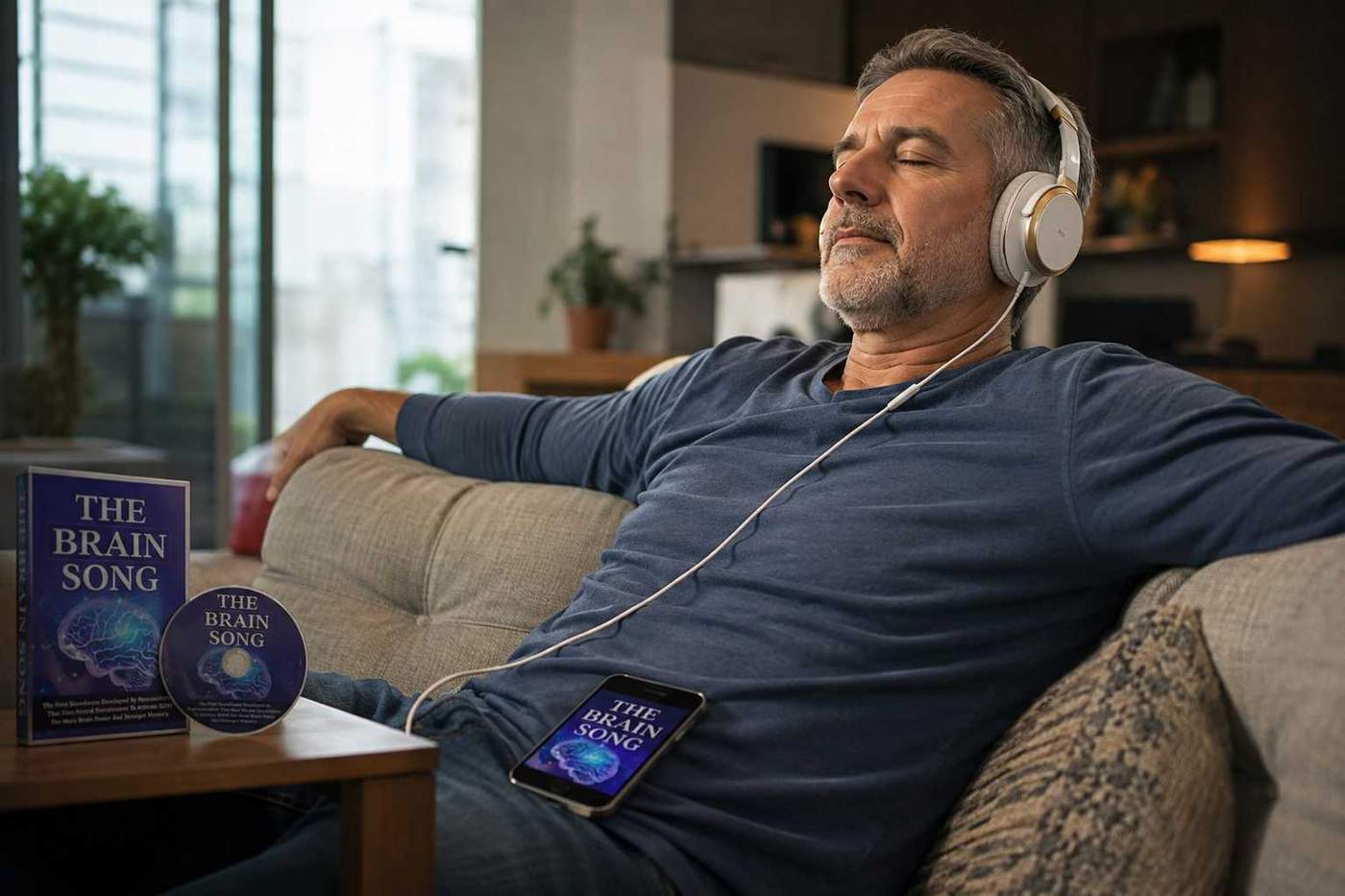
I looked into it that night. According to the product's sales page, The Brain Song is a digital audio program created by a man named Dr. James Rivers, who is described as a NASA-trained neuroscientist. It is a single audio track, about seventeen minutes long, that you listen to once a day using stereo headphones. The idea is that the audio uses specific sound frequencies to stimulate gamma brainwave activity, which some neuroscience research links to attention, memory, and mental clarity.
The program sells for 39 as a one-time purchase through ClickBank. You get instant digital access to the audio file and a companion guide. There are no pills, no equipment, no monthly subscription. The brand offers a 90-day money-back guarantee, which is handled through ClickBank's checkout system. I will be honest: the sales page uses some language that made me roll my eyes. Words like "genius-level potential" and "NASA-inspired" always make me suspicious. But the core idea was simple enough. Listen to a track for seventeen minutes a day and see if you notice anything.
I was still on the fence. But I was also tired of feeling foggy every afternoon. I figured 39 was less than I spent on golf balls in a month, and the refund policy meant I was not risking much except my time.
Does The Brain Song Really Work?
Here is where I have to separate what happened to me from what the marketing claims. The Brain Song's promotional materials talk about gamma waves, BDNF, and neuroplasticity. Those are real scientific concepts. There is legitimate research showing that auditory stimulation at certain frequencies can influence brainwave patterns, and that gamma activity around 40 Hz is associated with focus and memory consolidation in neuroscience studies. Some studies on binaural beats and brainwave entrainment have shown modest effects on attention and relaxation.
But here is the important part. That general research does not prove that this specific audio track, sold by this specific company, will give you the results they hint at on the sales page. No independent clinical trial has validated The Brain Song itself for specific cognitive outcomes. The brand's own terms characterize the product as entertainment rather than medicine. So when I ask "does The Brain Song really work," the honest answer is: the mechanism is plausible, the science behind entrainment is real, but the product's specific claims are marketing, not proven medical fact.
I decided to try it anyway. My thinking was simple. It was low risk, non-invasive, and if it did nothing, I could get my money back.
What Changed For Me
I started listening every morning after breakfast. I would put on a decent pair of headphones, hit play, and sit in my armchair with my eyes closed. The audio itself is strange at first. It is not music in the traditional sense. It is more like layered tones and pulses, almost like sitting inside a gentle, rhythmic hum. The first few days, I did not notice anything dramatic. I did not suddenly feel like a genius. I did not memorize a deck of cards or ace a crossword puzzle.
But after about two weeks, I started noticing small things. I was reading emails and getting through them without scrolling back up as often. Not every time, but enough that I noticed. One afternoon, I sat down to work on a budget spreadsheet, and when I looked up, an hour had passed without me checking my phone or wandering into the kitchen. That used to be normal for me, but lately it had not been.
I still walked into rooms and forgot why I was there. I still had moments where a name would not come to me right away. Some days I felt sharper, some days I did not. It was not a straight line upward. But the background static, that feeling of my brain working overtime just to do normal things, seemed to dial down a notch. I was not as mentally tired by four in the afternoon. I was making fewer notes to myself because I was actually remembering the three things I needed to do.
Was it The Brain Song? Was it placebo? Was I just paying more attention to my own habits because I was trying something new? I honestly do not know. Probably some combination of all three. But I kept listening because the routine was easy, and I felt like I was doing something proactive instead of just accepting that my brain was slowing down.
Check the current Brain Song offer and details
The Brain Song Reviews
When I was researching before I bought, I spent some time reading The Brain Song reviews online. Here is what I found. There are a lot of affiliate review sites out there. Pages with titles like "The Brain Song Reviews 2026" or "Brain Song Review: Is It Worth It?" Most of them follow a similar template. They summarize the sales page, list the benefits, and drop a buy link. That does not make them wrong, but it does mean they have a financial incentive to be positive.
Then there are the reviews on the product's own site and in promotional materials. Those are curated by the seller, so they are naturally going to skew positive. I could not find many independent, verified user reviews on neutral platforms like Trustpilot or Reddit. That made it hard to get a clear picture of what real buyers thought. The lack of independent, third-party feedback is something I noticed right away. If you are searching for brainsong reviews or brain song reviews, you will mostly find affiliate content and seller testimonials. That does not mean the product is bad, but it does mean you should read carefully and understand who is writing what you are reading.
The Brain Song Original Reviews and Complaints
I did find some recurring themes when I dug into brain song original reviews and complaints. The most common complaint was about expectations. Some buyers expected immediate, dramatic results and were disappointed when they did not feel different after a few sessions. Others mentioned that the audio format was not for them. Some people do not like sitting still with headphones for seventeen minutes. A few buyers had trouble with the purchase process or did not realize it was a digital product and expected a physical CD.
Price comes up sometimes. Thirty-nine dollars is not a lot for some people, but for others it feels like a lot to pay for a single audio file, especially when free binaural beat tracks are all over YouTube. The refund policy is supposed to be 90 days, but a few buyers mentioned confusion about whether ClickBank's standard policy applied or the brand's extended guarantee. I did not have any issues with my purchase, but it is worth verifying the current refund terms at checkout before you buy.
The biggest legitimate concern, in my opinion, is the gap between the marketing language and the actual evidence. The sales page implies a level of scientific backing that does not quite match what is independently verifiable. That is not unique to this product, but it is something any potential buyer should know.
Look up the official Brain Song guarantee and pricing
Is The Brain Song Legit?
Let me answer this directly. Is The Brain Song legit? Yes, in the sense that it is a real product sold by a real company through ClickBank, which is a legitimate digital retailer. You pay 39, you get a digital audio file and a guide, and there is a stated refund policy. I received exactly what I paid for. The download link worked. The audio played. The company responded to a basic inquiry I sent through their contact form.
But "legit" does not mean "guaranteed to work for you." It means you are buying what is advertised: a digital audio program based on brainwave entrainment concepts. It is not a medical device. It is not FDA approved. It does not have independent clinical trials backing its specific formula. So if your definition of legit is "scientifically proven to improve my memory," then the answer gets murkier. If your definition is "a real company selling a real audio product with a refund option," then yes, it is legit.
Is The Brain Song A Scam?
I do not think The Brain Song is a scam. A scam, to me, is something where you pay money and receive nothing, or where the product is deliberately fraudulent. That is not what is happening here. You get the audio. It is a real file. You can listen to it.
What The Brain Song is, in my view, is a product with marketing claims that are stronger than the available evidence. There is a difference between fraud and aggressive marketing. The sales page uses neuroscience terminology to create an impression of clinical validation that does not fully exist. It references gamma waves and BDNF and NASA training, which sounds impressive, but none of that proves this specific audio will improve your concentration. It is a wellness product, not a medical treatment. If you go in knowing that, you will not feel scammed. If you expect a miracle, you will feel disappointed.
The Science Behind The Brain Song
I want to touch on the science because it matters, and because I did some reading before I bought. The Brain Song is based on the concept of brainwave entrainment, which is the idea that rhythmic auditory stimuli can influence the electrical activity in your brain. Gamma waves are brain oscillations in the 30 to 100 Hz range, with 40 Hz being particularly interesting to researchers because it appears during active concentration, memory processing, and problem solving.
There is research, including some studies at MIT and other institutions, showing that exposing the brain to 40 Hz light or sound can increase gamma activity. Some animal studies have linked this to increased BDNF, which is a protein that supports neuron health and neuroplasticity. Other studies on binaural beats, where slightly different frequencies are played in each ear, have shown small but measurable effects on focus and anxiety in some people.
Here is the catch. Most of that research is general. It looks at the concept of gamma entrainment or binaural beats broadly. It does not test The Brain Song specifically. The product takes real science and applies it to a commercial audio track, but we do not know if this particular track is calibrated correctly, if the frequencies are precisely aligned, or if it produces the same effects as the lab studies. So the science is real, but the connection between that science and this product is an open question.
What I Liked
The routine is dead simple. I do not have to swallow pills, follow a complicated protocol, or buy any equipment beyond headphones I already own. Seventeen minutes is short enough that I can fit it into my morning without rearranging my life. I like that it is a one-time purchase. I am tired of subscriptions for everything, and this does not have one. The audio itself is actually kind of relaxing once you get used to it. It is not unpleasant to listen to.
I also liked that there was no pressure. I could try it, and if it did nothing, I could get my money back. That low-stakes approach made it easier to commit.
What I Didn't Like
I did not notice anything for the first ten days or so. That is a long time to sit and wonder if you are wasting your time. If you are someone who needs immediate feedback, this will frustrate you. I also do not love the sales page. It feels like it is trying too hard to sound like a scientific breakthrough when it is really just an audio program. That tone makes me trust it less, not more.
Another thing: I still have bad days. I still lose my train of thought. I still forget why I walked into a room sometimes. The Brain Song did not fix my brain. It may have helped a little, but it is not a cure for normal aging or a busy life. And honestly, I am still not entirely sure how much of what I noticed was the audio itself and how much was the fact that I started paying closer attention to my own habits.
Who The Brain Song May Be For
This is primarily for men around my age, roughly forty to sixty, who have started noticing everyday concentration problems. If you find yourself rereading emails, struggling to stay focused during meetings, feeling mentally tired by mid-afternoon, or just feeling like your brain is not as quick as it used to be, you might find this worth exploring. It is for guys who want a simple, audio-based routine and are curious about non-pill options for mental clarity. It is not expensive, it is not dangerous, and it does not require a prescription.
Who Should Skip It
If you are expecting guaranteed memory improvement, skip it. This is not a medical treatment. If you have a diagnosed neurological condition, or if you are experiencing serious memory loss, you need a doctor, not an audio track. If you hate sitting still with headphones, you will not stick with it, and consistency seems to matter. If you need hard, objective proof that something works before you will try it, you will not find that here. The evidence is suggestive, not conclusive.
Is The Brain Song Worth It?
Here is my honest verdict. The Brain Song is a legitimate digital product based on a plausible scientific concept. It is easy to use, affordable, and low risk thanks to the refund policy. I noticed some small improvements in my day-to-day focus and mental fatigue after a few weeks of consistent use. I did not experience a dramatic transformation. I did not become a memory champion. But the background fog lifted a little, and I feel a bit more present during my workday.
If you are a man in your forties, fifties, or early sixties who is starting to feel like your brain is running on half power, and you want to try something simple and non-invasive, I think The Brain Song is worth trying. Go in with realistic expectations. Do not expect a miracle. Use it consistently for at least three weeks. Keep track of whether you notice any difference in your everyday tasks. If you do not, get your refund.
The Brain Song reviews you find online are mostly affiliate content, so read them with that in mind. The complaints about slow results and strong marketing are fair. But the product itself is real, the mechanism is scientifically interesting, and my personal experience was positive enough that I am still listening. Check the current Brain Song offer

