The Clarity Trap: Why “Pretty” Pages Kill Profits (And What To Do Instead)
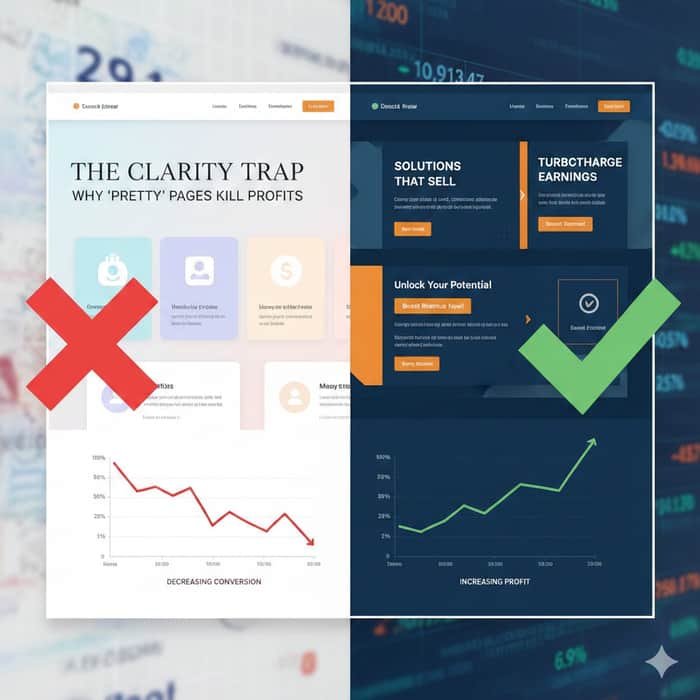
Confused visitors don’t buy.
That’s not dramatic. That’s not marketing fluff.
That’s human behavior.
If someone lands on your page and has to think too hard to understand:
What you do
Who it’s for
Why it matters
What they get
What happens next
They leave.
Not because your offer is bad.
Not because your pricing is wrong.
Not because your product isn’t powerful.
They leave because their brain said: “This feels like work.”
And work loses to scrolling. Every single time.
Welcome to The Clarity Trap — the silent revenue killer most SaaS founders and digital product creators don’t even realize they’re stuck in.
This is what we fix at Quratulain Creatives.
The Illusion of Clarity
Here’s the trap.
You built the product.
You lived the pain.
You know every feature.
You know every nuance.
So your copy feels obvious.
It makes sense — to you.
But you are the worst possible judge of clarity on your own page.
You don’t read it like a stranger.
You read it like someone who already understands everything.
Your brain fills in the gaps automatically.
Your visitor’s brain does not.
And that gap? That’s where your revenue leaks.
Why Confusion Kills Conversions
Human brains are wired for cognitive ease.
If something is:
Hard to process
Vague
Ambiguous
Abstract
Overloaded with jargon
Feature-heavy but outcome-light
It creates friction.
And friction creates doubt.
Doubt sounds like:
“I’m not sure if this is for me.”
“I don’t fully get what I’m buying.”
“Let me think about it.”
“I’ll come back later.”
They won’t.
Because clarity builds confidence.
And confidence drives action.
When someone clearly understands:
The problem
The transformation
The path
The result
Buying feels safe.
Confusion feels risky.
And people don’t pay for risk they don’t understand.
The Most Dangerous Sentence on Your Page
It’s not always the big things.
Sometimes it’s one sentence.
One vague line like:
“An innovative solution for modern teams.”
What does that mean?
Innovative how?
What solution?
Which teams?
For what problem?
With what result?
Your brain thinks: “It’s clear.”
Your visitor thinks: “This sounds generic.”
And that tiny moment of friction chips away at trust.
Now multiply that across:
Headline
Subhead
Features section
Testimonials
CTA buttons
Pricing explanation
A single misplaced sentence can cost you conversions.
Not because it’s grammatically wrong.
Because it’s strategically unclear.
Clarity Is Not Simplicity
This is important.
Clarity does not mean:
Shorter copy
Fewer words
Dumbing things down
Clarity means:
Specific
Outcome-focused
Concrete
Direct
Intentional
“Simple” can still be vague.
“Short” can still be confusing.
A two-line headline can be crystal clear.
Or it can be meaningless fluff.
Length isn’t the issue.
Precision is.
The Founder Blind Spot
Let’s be honest.
You’ve read your page 47 times.
You’ve tweaked words.
You’ve rearranged sections.
You’ve changed button colors.
But conversion is still “meh.”
Here’s why.
You are too close.
You know:
The backend logic
The onboarding flow
The roadmap
The industry context
The terminology
So when you write:
“Streamline your workflow with smart automation layers.”
You see the whole system in your head.
Your visitor sees… nothing.
They need:
What gets streamlined?
What changes after?
What pain disappears?
What result shows up?
You can’t see clarity gaps because your brain auto-completes them.
That’s the trap.
The 7 Hidden Clarity Gaps That Kill Sales
Let’s break this down practically.
These are the most common clarity leaks we dissect at Quratulain Creatives.
- The “What Is This?” Gap
Within 5 seconds, your visitor should know:
What it is
Who it’s for
What outcome it delivers
If they can’t answer those three instantly, you’re bleeding conversions.
- The “Why Should I Care?” Gap
Features are not motivation.
People don’t buy:
Dashboards
Integrations
AI engines
Analytics tools
They buy:
Less stress
More revenue
Saved time
Predictable growth
If your copy stays in feature-land, you’re invisible.
- The “Is This For Me?” Gap
If your message tries to speak to everyone, it convinces no one.
Clarity requires exclusion.
Specificity builds belonging.
When someone thinks, “This is exactly my situation,” you win.
- The “What Happens Next?” Gap
Your CTA should never feel like a leap into the unknown.
“Get Started” is weak if the next step isn’t clear.
Free trial?
Book a demo?
Immediate payment?
Account creation?
Uncertainty slows action.
- The Outcome Gap
If someone buys, what changes in 7 days?
In 30 days?
In 90 days?
If you can’t articulate that clearly, they won’t imagine it clearly.
And if they can’t imagine it, they won’t pay for it.
- The Objection Gap
Silence does not remove objections.
It amplifies them.
If you don’t address:
Price concerns
Complexity fears
Setup doubts
Competitor comparisons
They assume the worst.
Clarity neutralizes hesitation.
- The Hierarchy Gap
Even great sentences fail if structure is chaotic.
When everything looks equally important, nothing feels important.
Clarity requires:
Visual flow
Logical sequencing
Intentional emphasis
Your page should guide thought — not dump information.
Pretty Pages Don’t Convert
This part stings.
You invested in:
Clean UI
Modern layout
Sleek typography
On-brand colors
But design does not rescue unclear messaging.
A beautiful page with confusing copy is still confusing.
In fact, it’s worse.
Because it creates the illusion of professionalism without persuasive depth.
Clarity beats aesthetics in conversion hierarchy.
Every time.
The Emotional Cost of Ignoring Clarity
Let’s talk about what founders don’t say out loud.
You refresh analytics.
Traffic looks decent.
Conversion rate is low.
You think:
“Maybe I need more traffic.”
“Maybe my audience isn’t ready.”
“Maybe the price is wrong.”
“Maybe I need ads.”
So you spend more.
You push harder.
You hustle more.
But the real issue is a sentence in your hero section.
Or a vague promise in your subhead.
Or an unclear transformation in your offer breakdown.
Ignoring clarity is choosing failure slowly.
It’s choosing to guess.
It’s choosing to bleed quietly.
The Sentence-by-Sentence Dissection
This is where most “copy audits” fail.
They give you:
High-level advice
Generic suggestions
Surface comments
Random rewrites
That’s not what moves revenue.
At Quratulain Creatives, we dissect your page like a conversion autopsy.
Sentence by sentence.
We ask:
What is this sentence trying to do?
Is it clear?
Is it necessary?
Is it persuasive?
Is it outcome-driven?
Is it specific?
Is it aligned with the buyer’s awareness level?
If a sentence doesn’t serve a conversion function, it goes.
If a claim is vague, it gets sharpened.
If a promise is abstract, it gets grounded.
If a section lacks strategic flow, it gets rebuilt.
Because guessing is expensive.
Clarity is profitable.
Why $150 Is Not an Expense — It’s Risk Control
Let’s reframe this.
What’s the cost of unclear messaging?
If you get:
1,000 visitors per month
And you convert at 1% instead of 3%
That’s:
10 customers instead of 30.
What’s that revenue gap worth to you?
One unclear headline can cost more than $150 in a week.
But most founders hesitate.
Not because they don’t need clarity.
Because they underestimate its impact.
They think:
“It’s probably fine.”
Fine doesn’t scale.
Fine doesn’t optimize.
Fine doesn’t convert at its potential.
$150 prevents guessing.
It replaces assumptions with strategic insight.
It shows you:
Exactly what’s broken
Exactly why it’s broken
Exactly how to fix it
No fluff.
No ego.
No vague advice.
Just clarity.
The Psychology Behind Buying Decisions
Let’s zoom out.
People buy when three things align:
-
They clearly understand the problem.
-
They clearly see the solution.
-
They clearly trust the path.
If any of those are blurry, sales stall.
Your job isn’t to sound impressive.
It’s to reduce mental effort.
Because the easier it feels to understand,
the safer it feels to commit.
Clarity creates:
Safety
Certainty
Direction
Momentum
And momentum converts.
The Brutal Truth About “Good Enough”
Most SaaS pages are not terrible.
They’re just slightly unclear.
And slight unclarity compounds.
A 5% confusion at the headline. A 7% confusion in the features. A 10% doubt in pricing. A 3% friction in CTA.
Layer that together and you don’t have a disaster.
You have underperformance.
And underperformance is harder to notice — and easier to tolerate.
Until you realize how much revenue you left on the table.
You Don’t Need More Traffic. You Need More Precision.
Traffic amplifies what already exists.
If your page converts poorly, more traffic just scales inefficiency.
Clarity optimization is leverage.
Before ads.
Before scaling.
Before expansion.
You fix the message.
Because message is multiplier.
What Working With Quratulain Creatives Looks Like
We don’t guess.
We don’t sugarcoat.
We don’t rewrite randomly.
We:
Audit your page structure.
Break down each section.
Identify clarity gaps.
Highlight friction points.
Map buyer psychology.
Rewrite strategically where needed.
Explain why changes matter.
You walk away knowing:
What to delete.
What to refine.
What to emphasize.
What to reposition.
What to test.
Not opinions.
Decisions backed by behavioral logic.
The Real Question
If confused visitors = lost sales…
And you know you’re too close to your product to see clarity gaps…
And one misplaced sentence can cost conversions…
Why keep guessing?
Every day you delay clarity, you’re making a choice.
Not a dramatic one.
A quiet one.
To operate below your potential.
Clarity is not optional in competitive markets.
It’s survival.
The Final Thought
You don’t need louder copy.
You don’t need cleverer words.
You don’t need more buzzwords.
You need:
Precision.
Alignment.
Intentional messaging.
Strategic structure.
Outcome clarity.
That’s what converts.
That’s what scales.
That’s what separates average pages from revenue machines.
The Clarity Trap is subtle.
But once you see it, you can’t unsee it.
And once you fix it, everything changes.
For $150, you stop guessing.
You start knowing.
And in business, that shift is everything.
—
Quratulain Creatives
SaaS Copy & Conversion Specialists
We don’t make pages sound better.
We make them convert better.
My portfolio
https://quratulaincreatives.carrd.co/

The 'clarity trap' hits Notion workspaces especially hard - founders spend hours building aesthetically gorgeous dashboards that still can't answer 'what should I focus on today?'
Building a Solopreneur OS taught us this the hard way. The version with color-coded headers, icon packs, and nested page hierarchies got way less traction than the stripped-down version that surfaced revenue, active pipeline, and next actions on one screen.
Pretty ≠ clear. Clear means the system answers a specific question faster than your brain can. Every extra design element that doesn't reduce a decision is friction disguised as polish.
100% this. As a Data Architect, I constantly see founders obsess over CSS and animations while completely ignoring their data layer. You can have the highest-converting, clearest UI in the world, but if your top-of-funnel traffic is driven by stale, scraped lead lists, your profit drops to zero anyway. Clarity in design is crucial, but clarity in intent signals—knowing exactly who is landing on the page and what procurement triggers brought them there—is what actually closes enterprise deals. Great breakdown.
This really hit home. I spent weeks making my landing page "perfect" for my Mac app before realizing the landing page wasn't the bottleneck — nobody was even seeing it because I wasn't marketing.
The biggest clarity trap for indie devs isn't the landing page design. It's spending all your time on the product/site instead of getting it in front of people. I was polishing pixels when I should have been writing posts, commenting in communities, and telling people about what I built.
What actually moved the needle for my apps (TokenBar and Monk Mode) was writing authentic posts about the problems they solve — not optimizing button colors.
The ugly truth: a mediocre landing page with traffic converts better than a beautiful landing page nobody visits.
How anyone can stomach this type of writing is beyond me. Just cut to the chase already and put each word on its own line - you're not far off.
Hahahaha
lmao i spent 3 weeks on my landing page gradients before i had a single user. this post is a personal attack
the ugly landing page that converts > the beautful one that doesnt. learned this the hard way
my best converting page rn is literally just "listen to any artcile like a podcast" + a big button. no fancy animations no parallax scrolling no custom illustrations. just the value prop and a way to try it
same w my horoscope app. the page that works is "your daily horoscope as a personalized podcast based on your actual birth chart". thats it. ppl get it instantly
clarity beats aestethics every single time. wish someone told me this before i burned a month on figma lol
😂 Not a personal attack, just collective founder trauma. We’ve all been there.
What you described is exactly it — when the value prop is instantly graspable, design becomes support instead of disguise.
The fastest-converting pages are usually the ones brave enough to say one clear thing and let it breathe
"Confused visitors don't buy" applies perfectly to pricing positioning.
Most DTC brands show store-wide average: "$95 average price." Customer thinks: "Why should I pay $110 for this product?"
Missing context: Competitor A premiums this category +40%. You're actually 15% below market. Clarity gap = revenue leak. Same principle you described for copy applies to pricing strategy. Great breakdown on founder blindspot. How often do you find pricing positioning is the hidden clarity issue vs pure copy?
Pricing is often the silent killer of conversions because founders focus on the words while the numbers tell a different story. If a customer sees a price without the market context, they naturally default to thinking it is expensive.
Great example — pricing positioning is often the silent clarity leak. I’d say in a lot of audits it’s not pure copy or pure pricing, but the gap between them.
When the value narrative isn’t strong enough to carry the price, even a fair price feels expensive. Once positioning and pricing context align, the friction drops fast.
"Gap between copy and pricing" - exactly.
I've seen this: Brand charges $110 (15% below market for category), but copy says "premium quality." Customer sees: "$110 = expensive."
Missing: "Competitors charge $130 for same category. We're $20 less for same quality."
Copy + pricing context = aligned narrative.
Do you usually include competitor pricing context in your copy audits? Or is that something clients bring separately?
Exactly — without context, price floats in a vacuum and defaults to “expensive.”
In audits, we usually map competitor pricing and positioning alongside the copy — not to obsess over them, but to understand what narrative the buyer already has in their head.
The real lift comes from aligning price, promise, and market context so the number feels logical instead of arbitrary.
"Map competitor pricing and positioning alongside copy" - that's the full picture.
Quick Q: When you map competitor pricing, are you scraping full catalogs or spot-checking key products?
(Asking because I'm offering free audits of exactly that - scrape 200-500 SKUs, show category-level gaps, 24-48h delivery. Building portfolio before switching to paid.)
Wondering if there's overlap: You handle copy clarity, I handle pricing positioning data.
Together = complete narrative alignment package.
Free audits close Feb 28 (2 days, 2 spots left). Want to see output on one of your client's competitors?
Love the initiative — mapping category-level gaps can definitely surface useful signals.
In our case, competitor pricing is usually sampled strategically around anchor products rather than full catalog scrapes — the goal is less about volume and more about identifying narrative leverage points.
Narrative alignment works best when pricing data is interpreted through buyer psychology, not just surfaced.
"Narrative leverage points" - exactly the goal.
Full scrapes give the raw material, but the value is in the interpretation layer.
Example: Vuori premiums shirts +52%, budgets accessories -15%.
Raw data = numbers. Interpretation = "They're positioning as premium performance brand while keeping accessories accessible for entry customers." That positioning context = your narrative leverage point.
Sounds like we're after the same outcome, just different collection methods.
Curious: When you sample "anchor products," how do you decide which ones without seeing full category spread first?
The founder blind spot thing is painfully real. I spent weeks on a landing page for a dev tool last year and thought it was crystal clear. Then I watched three people try to use it via screen share and none of them could tell me what the product did after reading the hero section. I was devastated.
The fix that actually worked for me wasn't hiring a copywriter (though that helps). It was recording 5-second Loom clips of random people landing on my page and just watching their eyes. Where did they look first? Where did they pause? Where did they leave? Turns out my beautiful feature grid was being completely ignored because the headline above it was so vague that people bounced before scrolling.
One thing I'd push back on slightly — I think "pretty pages" don't kill profits on their own. Pretty pages with ONLY pretty and no substance kill profits. I've seen ugly pages convert well because the copy was sharp, but I've also seen sharp copy on ugly pages lose trust because it looked sketchy. There's a minimum design threshold where people take you seriously enough to read your words. Below that, clarity doesn't matter because they've already decided you're not legit.
The real killer combo is sharp copy on a clean (not fancy, just clean) page. That's where conversions live.
I am glad you fixed it yourself,but if founders can afford professional help to fix fast they hire agency like us,🙂
This is a wake-up call for every founder. That point about 'auto-completing' the gaps in our own copy because we’re too close to the product is so true. It’s the 'Curse of Knowledge' in action. I especially liked the distinction that clarity isn't just about making things shorter, but making them more precise. Precision definitely feels like the higher hurdle to clear. Great post!
I’ve shipped gorgeous landing pages that still flopped because the headline was mush. Clean layout + zero clarity = just a pretty exit page. Now I wireframe copy first, pixels later.
Totally
Yeah that's why we work with founders to fix their copy issues
The "Founder Blind Spot" section is the most important thing here, and also the hardest to internalize.
I've been going through 100+ startup postmortems lately, and one of the clearest patterns: most failed startup pages had brilliant founders who were terrible narrators of their own work. They'd write things like "the industry's first truly unified data layer" when customers needed to know "you'll stop losing customer data between your CRM and billing tool."
The product was technically accurate. The copy was strategically invisible.
Your point about the 5-second "What Is This?" test is the one I keep coming back to. It's the first gap, and it's the one that cascades — if someone can't identify the product in 5 seconds, the rest of the page is just scrolling.
One thing I'd add to your 7 gaps: The Comparison Gap. Many pages describe what the product IS, but not what it competes against. "Replace your spreadsheet" or "like Notion but for X" does more clarity work than a 200-word feature list. People anchor on familiar things.
The $150 reframe at the end is exactly right. It's not a cost, it's a cost-per-conversion-point reduced. Founders who think in those units understand why good copy is the highest-leverage spend before ads.
Absolutely — the “Founder Blind Spot” is the sneakiest one because it’s invisible to the people living it.
Love your addition of the Comparison Gap — anchoring on something familiar often does more work than pages stuffed with technical features.
The $150 cost-per-conversion framing is such a subtle multiplier; when teams start thinking in those terms, copy stops being “nice-to-have” and becomes the revenue engine.
I turned to my wife to take a look at my landing page, and each time she gives her honest opinion, I was able to make it better. 100% agree that we can't be the judge of our own products.
You are right and I appreciate your wife for her honestly that helped you grow,as a SaaS copywriter agency we help SaaS founders fixing the messaging.
What stands out to me is how often clarity issues aren’t just copy problems — they’re structural problems. I’ve seen landing pages that look beautiful but don’t guide decision-making. The hierarchy doesn’t match the buyer’s thought process. When messaging isn’t aligned with actual workflow or onboarding experience, even strong traffic underperforms. Curious in your audits, do you find clarity gaps more in messaging itself, or in how the page structures the buying journey?
We find them in messaging the SaaS founders are not sharp in copywriting they give their best in creating real life problem but fail to communicate with the art of copywriting with real life users and fail in marketing,my agency serves in fixing it
We find them in messaging the SaaS founders are not sharp in copywriting they give their best in creating real life problem but fail to communicate with the art of copywriting with real life users and fail in marketing,my agency serves in fixing it
This hits way too close to home. So many founders obsess over design and features, but completely miss that confusion is the real conversion killer. Clarity isn’t nice-to-have—it’s the entire game.
SaaS founders are good in building and designing the product that solves real life problem but fails in clarifying the messaging that's why Quratulain Creatives serves as SaaS copywriter agency to fix this ,we help in finding the weak points and rewrite for real life users
the biggest clarity killer ive seen on my own landing pages is trying to explain the how before the what. spent weeks describing our AI video pipeline architecture when users just wanted to know: can i get a video for my product for under $5, and is it going to look good?
swapped the entire above-fold to a before/after comparison with price and turnaround time. conversion went up immediately. no copy changes below the fold, just getting the outcome visible in 3 seconds.
one practical test that works better than reading backwards: send your landing page to someone over text and ask them to tell you what it does in one sentence. if they cant do it in under 10 seconds of looking, your clarity is broken. real people, not other founders - ask someone who has zero context about your space.
This is such a sharp example. The “how before what” trap is brutal — founders fall in love with the mechanism and forget buyers only care about the outcome.
The fact that your lift came just from surfacing price + turnaround above the fold proves how often clarity beats complexity.
That 10-second test is gold — we run a similar friction test in audits, and it’s wild how many “beautiful” pages fail it instantly.
the "founder blind spot" section is the most underrated part of this.
you don't just read your own page — you interpret it through everything you already know. the brain fills gaps automatically. which means your internal clarity test is broken by definition.
the practical fix I've seen work: read your page backwards, section by section. forces your brain out of narrative mode and into evaluation mode. you start seeing paragraphs as isolated claims instead of a flowing argument you already believe.
the other thing — "clarity vs simplicity" distinction is important but I'd extend it. you can have precise, outcome-focused copy and still fail if the hierarchy is wrong. even perfect sentences underperform when placed in the wrong sequence. structure is the multiplier on clarity. your point on the hierarchy gap touches this but I think it deserves its own section.
You’re absolutely right — internal clarity tests are broken by default because founders read with context, not curiosity.
The backwards read is a great way to break narrative bias. In audits, the biggest lift often comes not from rewriting sentences, but from fixing sequence and hierarchy — the same words perform wildly differently depending on placement.
Structure really is the multiplier most teams underestimate.
This is one of the sharpest breakdowns of the clarity problem I've seen.
The part about "founder blind spot" is especially accurate. Most founders don't realize they're auto-completing gaps their visitors can't see. That asymmetry is where revenue leaks quietly.
One thing I'd add to the "7 Hidden Clarity Gaps" — there's often an eighth gap that compounds the others: the timing gap.
Even when messaging is clear, if it doesn't match where the visitor is in their decision process, it still fails. Someone in discovery mode sees "Book a demo" and bounces. Someone ready to buy sees "Learn more" and loses momentum.
The tricky part is that most pages try to serve all awareness levels with one message. That's where clarity becomes context-blindness.
Your point on "confusion creates doubt" is spot on. I'd frame it slightly differently: confusion doesn't just stall action — it forces mental shortcuts. And mental shortcuts almost always favor the status quo or the competitor who made things clearer faster.
Appreciate the depth here. The sentence-by-sentence dissection approach is exactly what separates tactical clarity from surface-level polish.
Really appreciate this — the “timing gap” is such an important layer. Clarity without stage-awareness absolutely turns into context-blindness.
We see this a lot: strong copy, wrong moment. And you’re right — when timing misses, visitors default to the status quo or whoever reduced friction faster.
That alignment between message, sequence, and decision stage is usually where the biggest hidden lift lives.
Always helpful, keep up.
Thank you
This comment was deleted 7 months ago