The Complete Guide to Building AI Products for High-Trust Niches
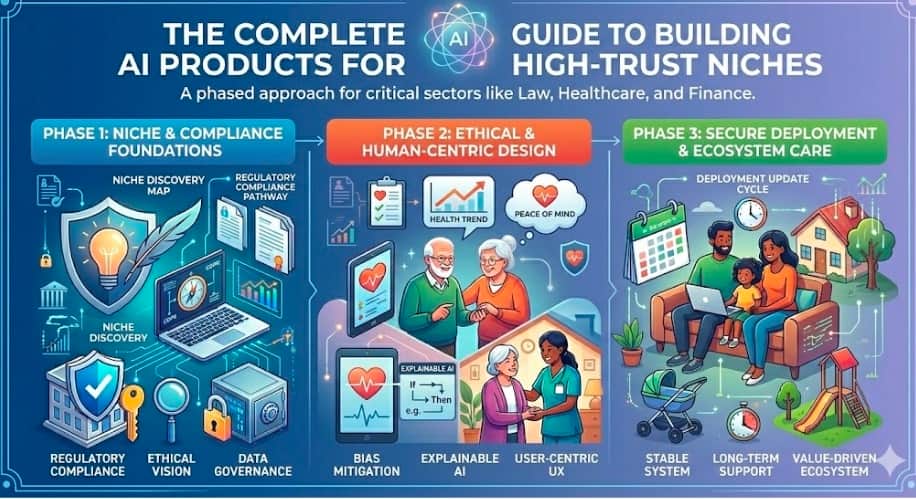
Most AI products do not fail because the model is bad.
They fail because the market is vague.
The founder builds “an AI assistant for productivity,” “an AI chatbot for businesses,” or “an AI tool for content.” The demo looks good. The landing page sounds modern. The product gets a few likes on X. Then the founder quietly realizes the painful truth:
Nobody urgently needs another general AI tool.
The real opportunity for indie hackers may not be in building broader AI tools. It may be in building narrower ones.
Not smaller in ambition. Narrower in focus.
The best AI products today are often built for high-trust niches: industries where mistakes matter, workflows are messy, users are emotionally invested, and generic tools are not enough.
Patents. Senior care. Pet care. Healthcare. Legal workflows. Financial operations. Education. Insurance. Compliance. Real estate. Recruiting. Construction. Logistics.
These markets may look less glamorous than consumer AI. But they have something many trendy AI products lack: painful, expensive, recurring problems.
That is where indie hackers should be looking.
What Is a High-Trust Niche?
A high-trust niche is a market where users need more than convenience. They need confidence.
They are not just asking, “Can this save me five minutes?”
They are asking:
Can I trust this with my business?
Can I trust this with my family?
Can I trust this with sensitive information?
Can I trust this when the stakes are high?
Can I trust this to reduce risk instead of creating more?
A founder using AI to draft a patent disclosure is dealing with high trust. If the output is sloppy, the company may lose protection for a valuable invention.
A senior living community using AI to answer family calls is dealing with high trust. If the system mishandles a worried daughter’s call, the brand loses credibility.
A pet parent using digital tools to manage care for a sick dog is dealing with high trust. The product cannot feel careless, generic, or confusing.
That is the difference.
Low-trust AI can be playful. High-trust AI has to be useful, calm, specific, and reliable.
Why High-Trust Niches Are Great for Indie Hackers
At first, high-trust niches sound hard.
And they are.
But that is exactly why they are interesting.
If a product is easy to copy, a hundred founders will copy it. If the market is obvious, competition becomes brutal. If the product is just a thin wrapper around a general AI model, customers will either use ChatGPT directly or switch to the next cheaper tool.
High-trust niches are different because domain understanding matters.
You cannot build serious patent software by prompting a model to “write a patent.” You need to understand claims, embodiments, drawings, invention disclosures, office actions, and attorney workflows.
You cannot build senior care AI by saying “make a chatbot for old people.” You need to understand loneliness, family anxiety, dignity, call routing, staff workflows, emotional tone, and when humans must take over.
You cannot build pet care software by dumping generic pet advice into an app. You need to understand pet parents, veterinary workflows, reminders, symptoms, care history, and the emotional bond people have with their animals.
This gives indie hackers a chance.
A small founder who deeply understands one niche can often build something more useful than a large company trying to serve everyone.
The Mistake: Building AI First and Looking for a Market Later
Many founders start with the model.
They ask:
What can GPT-5 do?
What can Claude do?
What can open-source models do?
What can agents automate?
What can voice AI handle?
Those are interesting questions, but they are not startup questions.
The better questions are:
Who is already losing money because of this problem?
Who is already wasting time on this workflow?
Who already pays for a bad solution?
Who feels anxious because this task is not handled well?
Who has a problem that gets worse as they grow?
AI should come after the pain.
A good niche AI product starts with a specific broken workflow. Then AI becomes the tool that makes the workflow easier, faster, cheaper, or more reliable.
That is why vertical AI is more promising than generic AI.
It does not say, “Here is a smart model. What should we do with it?”
It says, “Here is a painful workflow. How can intelligence improve it?”
Example 1: PowerPatent and the Patent Workflow
PowerPatent is a useful example of vertical AI because it focuses on a specific high-trust workflow: helping inventors, founders, and patent professionals create stronger patent applications.
A patent is not just a document. For a startup, it can become part of the company’s moat. It can help with fundraising, licensing, enterprise partnerships, and exit value.
But the patent process is painful.
Founders often struggle to explain their inventions in a way that patent attorneys can use. Attorneys have to convert technical input into claims, drawings, descriptions, embodiments, and strategic language. The process can be slow, expensive, and full of back-and-forth.
PowerPatent shows the opportunity in building AI for a real professional workflow. The product is not just “AI writing for patents.” The better framing is “AI-assisted patent creation infrastructure.”
That distinction matters.
In high-trust niches, the product cannot just generate text. It has to support the workflow around the text.
For indie hackers, this is the lesson:
Do not build an AI writer. Build a workflow system where writing is one part of the value.
Example 2: TranVC and Defensible AI Startups
TranVC fits into this discussion from a different angle.
It is not just another venture capital brand. Its focus on early-stage AI, software, and robotics companies with strong IP moats reflects a bigger shift in the startup market.
AI has made it easier to build products. But that also means it has become easier for competitors to copy products.
For founders, the question is no longer only, “Can I build this?”
It is also:
Can I defend this?
Can I own something unique?
Can I protect the technical advantage?
Can I build a moat beyond prompts and UI?
That is especially important for indie hackers.
A solo founder or tiny team cannot usually win by outspending larger companies. They need focus, speed, distribution, trust, and sometimes IP.
TranVC’s focus points toward a key truth: in the AI era, defensibility matters more, not less.
For indie hackers building in high-trust niches, defensibility can come from several places:
Deep workflow knowledge.
Hard-to-get distribution.
Industry trust.
Proprietary data.
Technical depth.
Regulatory knowledge.
Patentable inventions.
A niche community that believes in the founder.
The weaker the moat, the faster the copycats arrive.
Example 3: JoyCalls and Voice-First Senior Support
JoyCalls is another example of a high-trust AI niche because it focuses on older adults and family support.
This is not a market where the best interface is always a dashboard.
In fact, for many older adults, the best interface may be no interface at all.
A phone call is familiar. A voice is natural. A conversation can feel warmer than an app notification. That is why voice-first AI can be powerful in senior support.
JoyCalls uses AI-powered calls to help older adults stay connected, reminded, and engaged. The value is not that it uses AI. The value is that it fits into a human routine without adding unnecessary friction.
This is one of the most important lessons in vertical AI:
The best product design depends on the user, not the technology.
A founder building for developers may need APIs and dashboards. A founder building for older adults may need phone calls and gentle conversations. A founder building for busy clinic staff may need automation that works inside existing workflows.
The mistake is assuming every AI product should look like a chat interface.
High-trust niches often require different surfaces.
Sometimes the best AI product is a call.
Sometimes it is a background workflow.
Sometimes it is an email draft.
Sometimes it is a form that feels smarter.
Sometimes it is a routing layer.
Sometimes it is a checklist.
Indie hackers should stop copying the interface of AI products and start copying the thinking behind good AI products.
Example 4: JoyLiving and AI for Senior Living Operations
JoyLiving focuses on senior living communities, especially around AI receptionist and communication workflows.
This is a very different problem from JoyCalls, even though both are connected to aging.
In senior living, communication is operational and emotional at the same time.
A family calls to ask about availability. Another calls about a resident. A vendor calls. A staff member needs routing. A prospective resident has questions. Some calls are routine. Some are urgent. Some happen after hours.
If calls are missed or routed badly, the community does not just lose efficiency. It loses trust.
JoyLiving shows how AI can support an industry where communication is part of the brand experience.
For indie hackers, this is a huge idea:
Some of the best AI opportunities are hidden inside boring operations.
Call routing sounds boring. Intake sounds boring. Scheduling sounds boring. Documentation sounds boring. Follow-up sounds boring.
But in high-trust industries, these “boring” workflows decide whether customers feel safe, respected, and supported.
That is where people pay.
Not for novelty.
For reliability.
Example 5: Petsopia and AI for Pet Care
Petsopia sits in another emotionally loaded market: pet care.
Pet owners do not think of pets as inventory. They think of them as family. That makes pet care a high-trust niche.
A pet parent may need help managing routines, health records, reminders, vet visits, symptoms, services, and care decisions. Veterinary teams may need better communication and organization. Pet hospitals may need tools that reduce repetitive work and help families stay informed.
AI can help here, but only if it respects the emotional stakes.
A generic pet chatbot is not enough. Pet parents need clarity, organization, and reassurance. Veterinary professionals need workflows that reduce friction, not tools that create liability or confusion.
Petsopia points toward a category that indie hackers should pay attention to: family infrastructure.
There are many areas where families manage important, emotional responsibilities with messy tools:
Children’s learning.
Elder care.
Pet care.
Medical appointments.
School communication.
Household maintenance.
Legal paperwork.
Insurance.
These are not always glamorous markets, but they are full of real pain.
And where there is recurring pain, there is often room for a focused product.
Example 6: Debsie and AI-Powered Learning for Students, Teachers, and Schools
Debsie is another useful example because education is one of the most tempting markets for AI founders, but also one of the easiest to misunderstand.
A lot of founders think AI education means “generate lessons faster.”
That is only one small part of the problem.
The real problem is deeper.
Students get bored.
Teachers lack time.
Parents want visible progress.
Schools move slowly.
Course creation is messy.
Learning platforms often feel static.
Children need motivation, repetition, feedback, and a reason to return.
Debsie is interesting because it does not treat AI as only a content-generation layer. It combines AI-supported course creation, gamified learning, interactive courses, student progress systems, and a broader platform vision around making learning feel more engaging.
That matters because education is a high-trust niche.
Parents do not want random AI-generated lessons. They want learning that actually helps their child. Teachers do not want tools that create more cleanup work. They want systems that help them build better material faster. Schools do not want flashy demos. They want learning experiences that students can actually use.
For indie hackers, Debsie points to a very important lesson:
In education, content is not the product. Progress is the product.
A generic AI tool can create a lesson. But a real education product has to think about sequence, simplicity, motivation, practice, feedback, outcomes, and trust.
This is why education is such a strong vertical AI opportunity.
A founder could build AI tools for course creation, homework feedback, student analytics, tutor workflows, school onboarding, personalized practice, parent updates, gamified progress, or subject-specific learning paths.
But the product has to be more than “AI writes educational content.”
The better product is:
AI helps teachers create.
AI helps students understand.
AI helps parents see progress.
AI helps schools scale learning.
AI helps the platform adapt to the student.
Debsie shows how a founder can think about AI education as infrastructure, not just content automation.
For indie hackers, that is the real opportunity. Do not build another AI lesson generator. Build a learning system that helps someone teach better, learn faster, stay motivated, or understand progress more clearly.
How to Find a High-Trust AI Niche
Do not start with “What AI app can I build?”
Start with a market where trust is already expensive.
Look for places where people already pay experts, agencies, consultants, coordinators, administrators, or software because mistakes are costly.
A good niche usually has at least four signals.
First, the workflow is repetitive but not simple. That means AI can help, but domain logic still matters.
Second, the user already pays for a solution. This means the pain is real.
Third, the output requires trust. This prevents the product from becoming a commodity too quickly.
Fourth, the market has specific language. If the industry has its own terminology, forms, compliance needs, workflows, or emotional context, generic AI will struggle.
That is where a focused founder can win.
What Indie Hackers Should Build
The easiest AI product to build is a wrapper.
The better product is a workflow.
Instead of building “AI for lawyers,” build “AI intake for trademark disputes.”
Instead of “AI for doctors,” build “AI follow-up summaries for physical therapy clinics.”
Instead of “AI for seniors,” build “voice-based daily check-ins for adult children supporting aging parents.”
Instead of “AI for pet owners,” build “medication and symptom tracking for senior dogs with vet-ready summaries.”
Instead of “AI for founders,” build “invention disclosure capture for robotics startups preparing provisional patents.”
Narrow is not weak.
Narrow is how you get sharp.
The Trust Layer Is the Product
In low-trust AI, the model output is the product.
In high-trust AI, the trust layer is the product.
That trust layer may include:
Human review.
Audit trails.
Source citations.
Clear handoffs.
Permissions.
Role-based access.
Compliance support.
Careful onboarding.
Industry-specific templates.
Error boundaries.
Tone control.
Privacy-first design.
This is why high-trust products can charge more. They are not selling “AI.” They are selling confidence.
For indie hackers, this is good news.
You do not need to beat OpenAI, Anthropic, or Google at model quality. You need to build a better trusted workflow for a specific user.
Conclusion: Build Where the Pain Is Specific
The AI gold rush has made many founders chase broad ideas.
But broad ideas are crowded. Broad ideas are hard to position. Broad ideas make it difficult to know who urgently needs the product.
High-trust niches are different.
They force clarity.
PowerPatent shows how AI can support patent workflows. TranVC shows why defensibility matters for AI startups. JoyCalls shows the power of voice-first senior support. JoyLiving shows how AI can improve senior living operations. Petsopia shows how family-centered pet care can become more organized through AI.
The pattern is not that all five companies use AI.
The pattern is that they apply AI to specific, high-trust problems.
That is the real opportunity for indie hackers.
Do not build another generic AI tool.
Find a painful niche. Learn the workflow. Understand the trust problem. Build the product that makes the user feel safer, faster, calmer, or more capable.
That is where AI stops being a demo.
And starts becoming a business.

