The Definitive Handbook to Collaborating with a Fabric Production Company
Introduction: Your Companion to Get Designs Implemented
The choice of the suitable production partner matters significantly for any fashion brand. A quality manufacturer who delivers your products on time is the key hidden secret to your success.
Choosing a fabric production company is tough; it is similar to being in a maze. You come across a multitude of options but the technical terms make understanding difficult.
This manual will be a guideline for you in the process. We will discuss varied forms of production along with the method of selecting a good partner for your brand.
Why your preference is a game changer
Your manufacturer is not only a supplier but also plays a role in the partnership with your brand. A good partner will meet deadlines and maintain quality. They will also be a part of your business growth process. A substandard partner can cause delays and impact your reputation.
What You Will Learn in This Guide
You will gain information on the complete layout of the topic covered here. In the beginning, you will get familiar with the various manufacturing models. The steps of production will be explained to you. Then we will teach you how to investigate a prospective cloth manufacturing company.
Understanding the Clothing Manufacturing Environment
The apparel production sector is filled with options and alternatives. They need to be comprehended for you to make a wise decision for your brand. This decision is directly related to the cost of your goods, the amount of control you have, and the quality of your final products.
The most common options are CMT (cut, make, trim) and FPP (full production package). They fulfill different requirements.
CMT vs. FPP
CMT denotes you give the fabric and outlines. The workshop merely hammers, stitches, and trims clothes. FPP is a full package; everything is done in one place. The workshop manages everything from fabric sourcing to finishing and delivery.
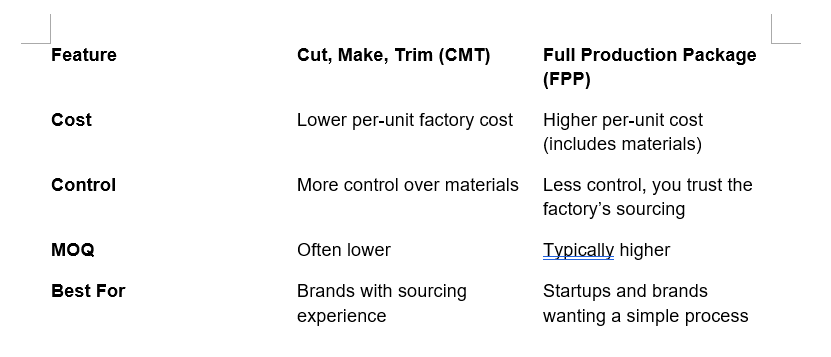
Domestic vs. Overseas Production
The decision between local production and international production is an important one.
Domestic production in your own country brings faster shipping and easy communication, which means higher quality control. The U.S. textile industry is a legend. Low-cost labor often drives overseas production. This helps make your product cheaper to produce. Factories across the globe may also possess different machines. Furthermore, they might be familiar with difficult designs. Each of these options serves as a proper fit for the developing apparel brand.
The Process of Making Apparel
Translating a concept into a finished garment involves some necessary steps. A reliable clothing-making business will assist you through each phase.
Step 1: Design and Tech Pack
It all begins with your design. A tech pack is formed out of this. It serves as the form of a garment blueprint. It contains sketches, measurements, types of fabric, colors, and trim details. A simple and clear tech pack is a must.
Step 2: Pattern Making and Prototyping
The factory makes a pattern-making guide using your tech pack. This pattern will be used to cut the fabric for your first prototype. This prototype is merely a replica of your design. The first prototype is a three-dimensional version of your design.
Step 3: Sample Approval
You are provided with the sample to check for fit, quality, and construction. Changes will likely be requested by you. This process can repeat several times; it may last until the sample is perfect.
Step 4: Grading and Marker Making
After the sample is approved, the pattern will be altered to fit different sizes. This is grading. Following this, a marker will be created. This denotes how to lay out the patterns on the fabric so that there is minimal waste.
Step 5: Bulk Production and QC
After that, the production process continues. The fabric gets cut, sewn, and assembled by the factory staff. Quality Control (QC) is put into practice in this stage. These checks will discover any errors and guarantee that each article fulfills your requirements.
Step 6: Finishing and Shipping
The items are finally trimmed, pressed, and tagged. Then they are folded, packaged, and shipped to your warehouse. After this, it is your turn to bring the product to the market.
The Vetting Checklist: How to Qualify a Partner
Selecting the right cloth manufacturing company is a major step that requires utmost attention. A trusted partner is essential. A significant number of brands have managed to either make or break their business based on this decision. Evaluate the different factories that you have shortlisted using this checklist.
Communication and Transparency
An outstanding partner clearly communicates and quickly responds. Consider these questions: * Do they respond to emails within a reasonable time? * Is there a dedicated person for your account? * Are they clear about their process and potential delays?
Our experience tells us that unfulfilled communication is the reason why most projects fail. A small misunderstanding can lead to tremendous mistakes during bulk production.
Technical Capability
Ensure that the factory can produce your product accurately and well. * Request samples of similar products they have made in the past. * Can they use the needed equipment for your fabrics and designs? * Ask for a factory tour: either physically or through a video call. Organizational cleanliness and updated equipment are the important aspects to consider here.
Quality Control Standards
You must be clear on how they maintain quality. * What is their Quality Control (QC) procedure? Do they check the products at each stage? * What is their average defect rate? * How do they deal with defective items? Do they remake them or give credits?
Ethical and Compliance Standards
Your brand’s name is on the line. Make sure that your partner operates in a responsible manner. * Ask if they have any certifications. Fair Trade, WRAP, or ISO 9001 are examples. * Are they candid about their payment and working conditions? * Eco-friendly manufacturing is not just an add-on anymore. It is more of a customer’s right to have such an option.
Logistics and Scalability
Besides the initial order, also think of your future quest. * What are their Minimum Order Quantities (MOQs)? * Are they able to scale to larger order quantities as your brand expands? * If you collaborate with a full-service cloth manufacturing company the process will become easier to manage. They usually have the processes for quality control and logistics in place already.
5 Common Pitfalls to Avoid
Collaborating with a manufacturer can be a bit tricky. But you can play the avoidance game by recognizing the most common pitfalls. Here you will find five commonly established pitfalls and tips on how to bypass them.
Pitfall 1: Missing Details In Tech Packs
The absence of details in the tech pack is a time bomb. * Problem: The factory must guess your intention. This leads to wrong samples and wasted time. * Solution: Develop a comprehensive tech pack. Include all necessary information, for instance, fabric type, stitching style, or button placement.
Pitfall 2: Overlooking Intellectual Property
Protecting your creations is your responsibility. * Problem: The factory can copy and sell your designs to others. * Solution: Always sign a Non-Disclosure Agreement (NDA) before sharing your tech pack. Use trustworthy factories with positive reviews.
Pitfall 3: Ambiguous Payment Terms
Money talks might be awkward but they definitely are necessary. * Problem: Confusion about payment terms can halt production or ruin the relationship. * Solution: Set the payment terms in writing before commencement of work. A common format could be 50% in advance and 50% post-completion, prior to shipping.
Pitfall 4: Quality Fade in Bulk Production
This is a tricky issue nonetheless. * Problem: The approved prototype has great quality whereas the bulk order is not up to standard. Manufacturers may reduce costs through shortcuts. * Solution: Have a transparent QC checklist that the manufacturer must comply with. If possible, check a portion of the order before the complete shipment is sent.
Pitfall 5: One-Size-Fits-All Assumption
Not every manufacturer is suitable for every product. * Problem: A factory that produces a perfect t-shirt might not be able to tailor a jacket. * Solution: Seek a partner whose core business is aligned with your product. A focused manufacturer like Chenglin Clothing may specifically seek niches in their projects. Therefore they can guarantee the necessary techniques to yield superior products.
FAQ: Your Questions Answered
We have compiled a list of questions which most brands inquire about when they are in search of a cloth manufacturing company. Go through our concise answers.
What is the average MOQ?
The minimum order quantities (MOQs) vary by quite a considerable degree. In some cases, overseas factories will need about 500-1000 pieces per style. A few domestic and startup-friendly factories could allow as few as 50-150 pieces per order. Always remember to check their MOQs during initial discussions.
What is the price of making clothing?
You can expect the prices to vary. The fabric type, design complexity, order quantity, and worker pay are all factors in the price. For instance, making a simple t-shirt might cost you a few dollars, whereas a complex one could suck your budget. You must provide a detailed tech pack so that the manufacturer can give you an appropriate quote.
What is a tech pack and why is it important?
A tech pack is your garment’s instruction manual. It gives the factory all the necessary technical details like sketches, measurements, and materials to make your product. It contains notes on how to assemble it too. To make accurate estimates or to get a perfectly made product, one must have a tech pack that is done well.
How do I protect my designs?
Frequently, it is good to use a Non-Disclosure Agreement (NDA) before sharing sensitive information. It is also important to work with a reputable cloth manufacturing company with a history of protecting their clients’ designs. It is a good practice to protect your brand name and logo through trademark registration.
Can I provide my own fabric?
Absolutely. This is the norm for the Cut, Make, Trim (CMT) model. In other words, you have to source and send the fabric to the factory yourself. However, under the Full Production Package model, the apparel manufacturing firm typically sources all materials needed for you.

I’ve had good results working with nylon spandex fabric wholesale for small apparel runs, mostly because the stretch and recovery stay consistent even after a bunch of wear tests. Being able to tweak weight or finish through their custom options saved me from juggling multiple suppliers, and the quicker lead times helped me hit a tight launch window without stressing.