The dumbest fight my co-founder and I ever had was about a spreadsheet
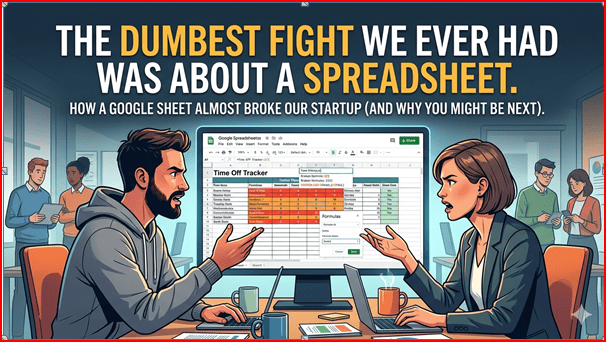
I'm going to tell you about the weekend our company almost broke up over a Google Sheet, because I think a lot of you are quietly running the same time bomb in your own startups and don't realise it yet.
We were six people. Two co-founders, three engineers, one designer. Bootstrapped, profitable-ish, the usual indie hacker shape. And like every small team that grew up too fast to install "real" HR software, we tracked everyone's holidays in a spreadsheet that one of us had built in a panic eighteen months earlier.
You know the spreadsheet. You probably have one open in another tab right now. Conditional formatting that breaks every time someone sneezes near it. A tab called "DO NOT EDIT" that everybody edits. A formula in cell J47 that nobody remembers writing and nobody dares to touch.
Here's what happened.
The week everything went sideways
My co-founder booked two weeks off in July. I knew this because we'd talked about it. What I did not know was that our designer had already booked the exact same fortnight, because she'd updated the spreadsheet on a Friday afternoon and I'd never opened it. Our lead engineer had also booked the back half of those two weeks. Three out of six people, gone, in the middle of a launch we'd been building toward for four months.
I found out on a Sunday. I was looking at the spreadsheet for the first time in maybe three weeks, trying to figure out who could cover a customer call, and the conditional formatting finally rendered properly on my laptop, and there it was. A wall of overlapping coloured bars where our launch week was supposed to be.
I called my co-founder. The conversation was not great. I said things like "how did you not check" and he said things like "I did check, you're the one who doesn't update it," and we were both right, which was the worst part. The spreadsheet was the single source of truth and the single source of truth was a lie because nobody trusted it enough to actually look at it.
The thing nobody tells you about being a small team
When you're two or three people, you don't need a system. You need a Slack message. "Taking Friday off, cool?" "Cool." Done.
Somewhere between five and ten people, that breaks. Not gradually — suddenly. One day the messages are working fine and the next day someone's mum is in hospital and they forgot to tell anyone they were taking compassionate leave and a client is calling about a deliverable that was supposed to ship at 9am.
The trap is that you don't notice the breaking point until you're already past it. Your team is small enough that buying "HR software" feels like cosplaying as a real company. So you keep duct-taping the spreadsheet. You add a Slack channel called #out-of-office that everyone forgets to post in. You write a Notion doc called "How We Do Time Off" that nobody reads. None of it works, because none of it is the system — they're all just shrines built around the spreadsheet, which is still the thing that breaks.
I kept resisting fixing it for the same reason every founder resists fixing it: it felt like overhead. Time-off tracking is the most boring possible problem. It does not ship features. It does not acquire users. Spending half a day evaluating tools for it feels like a personal failure.
But here's the maths I eventually did. We had six people. The spreadsheet was costing me, conservatively, two hours a week of my own time — chasing updates, fixing formulas, untangling double-bookings, having awkward "uh, you're not actually approved for that" conversations. Two hours a week of founder time. Over a year, that's a working fortnight. I was spending two weeks of my year on a spreadsheet. The thing I was avoiding because it felt like a waste of time was the actual waste of time.
What I'd do differently if I were starting today
I think there's a clean rule here, and it's the kind of rule I wish someone had told me at three people instead of me figuring it out at six.
Three people or fewer: Slack message in a public channel. Pin it. Move on. Don't build a system you don't need.
Four to about fifteen: Get a dedicated tool. Yes, even if it's just you, a co-founder, and a handful of contractors. The cost of any half-decent leave tracker is less than one hour of founder time per month, and the failure mode of not having one is the conversation I had on that Sunday in July.
Fifteen and up: You probably need a proper HR stack and you probably already know it.
The middle bucket is where indie hackers live, and it's the bucket where everyone underspends. You will never regret the $30 a month. You will absolutely regret the launch you torched because three people were on a beach.
When we finally did the switch, I picked Leave Dates because it didn't try to be HR software. What I actually needed was a proper leave management system — one that shows you who is off and when, in a calendar everyone can see, and stops two people from booking the same week without somebody noticing. That's the whole job. It's a UK-built tool and honestly the best small-business-owner-friendly option I came across over there — priced for a real bootstrapped team rather than an enterprise procurement department, and the setup took me about twenty minutes. We've used it for two years now and I have never had another Sunday phone call about a spreadsheet.
If you genuinely aren't ready to pay for a tool yet — and I get it, I was that guy too — at least upgrade your spreadsheet to one that actually works. I'd point people at this free Google Sheets leave tracker before I'd point them at building their own from scratch, because it has the formulas already worked out and a proper wall-chart view. Use it as a stepping stone. Just please, please don't keep using the one with the cell J47 formula that nobody remembers writing.
The actual lesson
The lesson isn't really about leave tracking. It's that founders are weirdly good at justifying the small operational debts that compound into the big ones. We'll spend a month optimising a marketing funnel for a 0.4% conversion lift, and we'll let an internal process bleed two hours a week for years, because fixing the funnel feels like startup work and fixing the spreadsheet feels like admin.
It's all the same work. The internal stuff just doesn't have a dashboard cheering you on when you fix it.
My co-founder and I are still co-founders. The launch survived. The spreadsheet is in a folder called archive_2023_do_not_open, which is where it belongs.
If your team is bigger than four people and you're still using a spreadsheet for time off, this is your sign. Go fix it this afternoon. It will take you less time than reading this article did to write.

